


The thickest, most cushioned sock isn’t always the best choice for cross-training. A session can move from lifting to jumping, sprinting or floor work, and each puts different demands on fit and feel. If you’re comparing cross training socks UK options, start with the activities you actually do and the shoes you wear.
It’s easy to get stuck between grip, cushioning and compression when product descriptions don’t explain how their features differ in practice. The right choice depends on your movements, how much room you have in your shoes and whether the sock stays comfortable and secure throughout your session. More features don’t automatically make a sock a better match.
This guide explains the trade-offs so you can choose by function rather than appearance. You’ll learn when grip may be useful, how cushioning affects feel in your footwear and what to consider with compression. We’ll also look at SZOKZ grip and high-intensity sport socks, as well as compression options in the 20-30 mmHg range, to help you compare products with your training in mind.
Key Takeaways
- Match sock coverage and fit to your footwear and the movements in your usual sessions.
- Compare construction, cushioning and grip against your needs instead of judging by appearance alone.
- Grip, cushioning and compression can overlap, so weigh their trade-offs against your training priorities.
- When comparing cross training socks uk options, check sizing and delivery details as well as the features.
- Use a feature checklist to assess SZOKZ grip socks and high-intensity sport socks against your sessions.
What should UK cross-training socks do during workouts?
Cross-training socks are chosen for comfort and fit across varied training movements. They should sit securely inside your footwear, feel comfortable through the session and provide the coverage you prefer. Socks are one part of your kit, not a substitute for suitable training shoes or sound technique.
A gym session might move from lifting to intervals, floor work and changes of direction. Each activity can feel different on your feet, even when you wear the same shoes. A sock that feels comfortable during a controlled lift may feel different during a fast interval or when you move laterally. There’s no single construction every athlete needs. Start with your own routine, then compare features that relate to it.
How cross-training differs from a single-sport session
Cross-training often brings together different movements, equipment and levels of foot contact in one workout. You might lift in trainers, change pace for intervals, then move to mat-based exercises. Look for a fit that doesn’t bunch or shift inside your shoes, and choose coverage that works with your footwear. The right balance depends on your training, not a universal formula.
Think about the parts of your workout that feel most demanding on your feet. If your session includes rapid direction changes, a sock that moves around may distract you. If you spend time on the floor or prefer a lower-profile feel, thickness and coverage may matter more. Socks are only one part of your setup: choose footwear suited to the activity and keep technique at the centre of each movement.
Which sock details matter before the design?
Look beyond colour, slogans and styling. Compare fit, fabric feel, coverage and construction. A close fit should feel secure without uncomfortable pressure; coverage is a personal choice shaped by your footwear and preference. Read how the sock is described and consider whether its construction suits the way you train. These details are more useful than appearance alone when comparing cross training socks uk options.
Grip is another feature to consider if contact between your sock and a surface matters to your training. Grip-focused socks aren’t automatically right for every session, especially if you’ll wear them inside training shoes. For more context on where grip may fit into your routine, explore a sports grip socks guide.
Compression is a separate consideration, not another way of describing a secure fit. It refers to garments designed to apply pressure, and the level and intended use can vary. The overview of compression stockings explains the topic in more depth. Don’t assume compression is necessary for every workout; consider the stated use and how the sock feels to you.
- Fit: Does it stay in place without feeling restrictive?
- Fabric feel: Is the texture comfortable against your skin?
- Coverage: Does the length suit your shoes and preference?
- Construction: Are the details relevant to your movements and equipment?
Use these points to separate functional choices from decorative ones. A useful sock is the one that fits your training demands and feels right in your footwear, not simply the one with the boldest design.
Which cross training sock features are worth comparing?
Product photos can show colour and coverage, but they can’t tell you everything about fit or feel. Compare the written details and sizing information instead. For cross training socks UK shoppers, a practical starting point is to match each feature to your footwear and movements, rather than assume one design will suit every workout.
Assess fit and construction together: the overall shape matters, as does how the sock is made to sit on your foot. Use this checklist to compare options:
- Fit: Read the sizing guidance and consider whether you prefer a close, secure feel.
- Coverage: Decide whether ankle or higher coverage suits your shoes and personal preference.
- Grip: Consider whether grip is relevant to the surfaces or footwear involved in your training.
- Cushioning: Compare the feel you want inside your shoes, from a lower-profile feel to more padding.
- Construction: Read the product details rather than assuming a feature from a photograph.
Fit, coverage and comfort inside training shoes
A sock that shifts or bunches inside a shoe can become a distraction, so consider how it sits on your foot as well as the size label. An ankle sock may suit someone who prefers less coverage, while a higher cut provides more fabric above the shoe. Neither is automatically better. Think about the shoe opening, the coverage you like and the demands of your session. Use the sizing information for the pair you’re considering.
Read the product description alongside the sizing details. Images can make a sock’s length or shape look different depending on how it’s styled, and they can’t reliably show how it will fit your foot. If your footwear already feels close-fitting, consider how extra thickness or a different coverage level may affect comfort inside it.
Grip, cushioning and compression: distinct considerations
Grip is worth comparing if contact between the sock and shoe or training surface matters to your movements. Its usefulness depends on how you train and what footwear you wear; it isn’t a substitute for suitable shoes. For cushioning, focus on the feel you want. More padding may appeal if you prefer a softer sensation, while a less cushioned sock may feel less bulky in your training footwear.
SZOKZ’s range includes 20-30 mmHg compression options. Treat this as a specific feature to compare with your preferences and intended use, not a default choice for cross-training. Grip, cushioning and compression can also appear in different combinations, so read each product description closely.
Once you know which details matter to your session, compare SZOKZ sock options by their stated features and sizing information, not appearance alone.
Grip socks, cushioned socks or compression socks: how do you compare them?
Each category points to a different consideration, not a guaranteed result. Grip relates to contact and feel, cushioning changes the sensation inside footwear, and compression describes a level of pressure. For cross training socks UK shoppers, the useful question is which feature suits your session, shoes and preferences. Use this comparison as a starting point, then read the product details rather than relying on a category label alone.
| Sock type | May suit someone who wants | Trade-off to consider |
|---|---|---|
| Grip-focused | A more secure-feeling contact with the shoe or training surface where grip is relevant. | Grip isn’t needed for every activity, so check that the product description states this feature. |
| Cushioned | A softer feel underfoot or more padding inside the shoe. | Added thickness can change how the sock feels in footwear, so consider your preferred fit. |
| Compression | A sock with a stated compression level as part of its design. | Suitability is personal. A stated level doesn’t guarantee recovery or circulation outcomes. |
These categories aren’t mutually exclusive. A sock may combine features, so compare the stated details instead of assuming that choosing one label rules out another. Consider your whole setup too: a feature that sounds useful on its own may feel different in your shoes or during your usual movements.
When a grip-focused sock may suit your session
Grip may be worth considering for movements where a secure-feeling contact between sock and shoe or training surface matters to you. It isn’t a requirement for all cross-training. Product descriptions should state whether a sock has grip, so don’t infer it from a sporty appearance or general training label. A sports grip socks guide can offer more context on grip-focused designs and the details to compare.
When cushioning or compression may matter more
Cushioning is a comfort preference. Think about how much padding you want and whether it feels comfortable inside your training shoes. A thicker feel may not suit every shoe or wearer, so weigh the stated cushioning against your preferred fit. There’s no universal level to choose; the right balance is the one that feels appropriate for your session and footwear.
SZOKZ’s range includes compression options in the 20-30 mmHg range. This is a product feature, not a recommendation that every athlete needs compression. The presence of a compression level doesn’t promise a recovery or circulation benefit. If you have a health concern or are unsure whether compression is suitable for you, seek appropriate clinical advice before choosing.
Compare the features that matter most to you, then check how they work together in the product description. That gives you a more useful basis for choosing than treating grip, cushioning or compression as a one-size-fits-all answer.
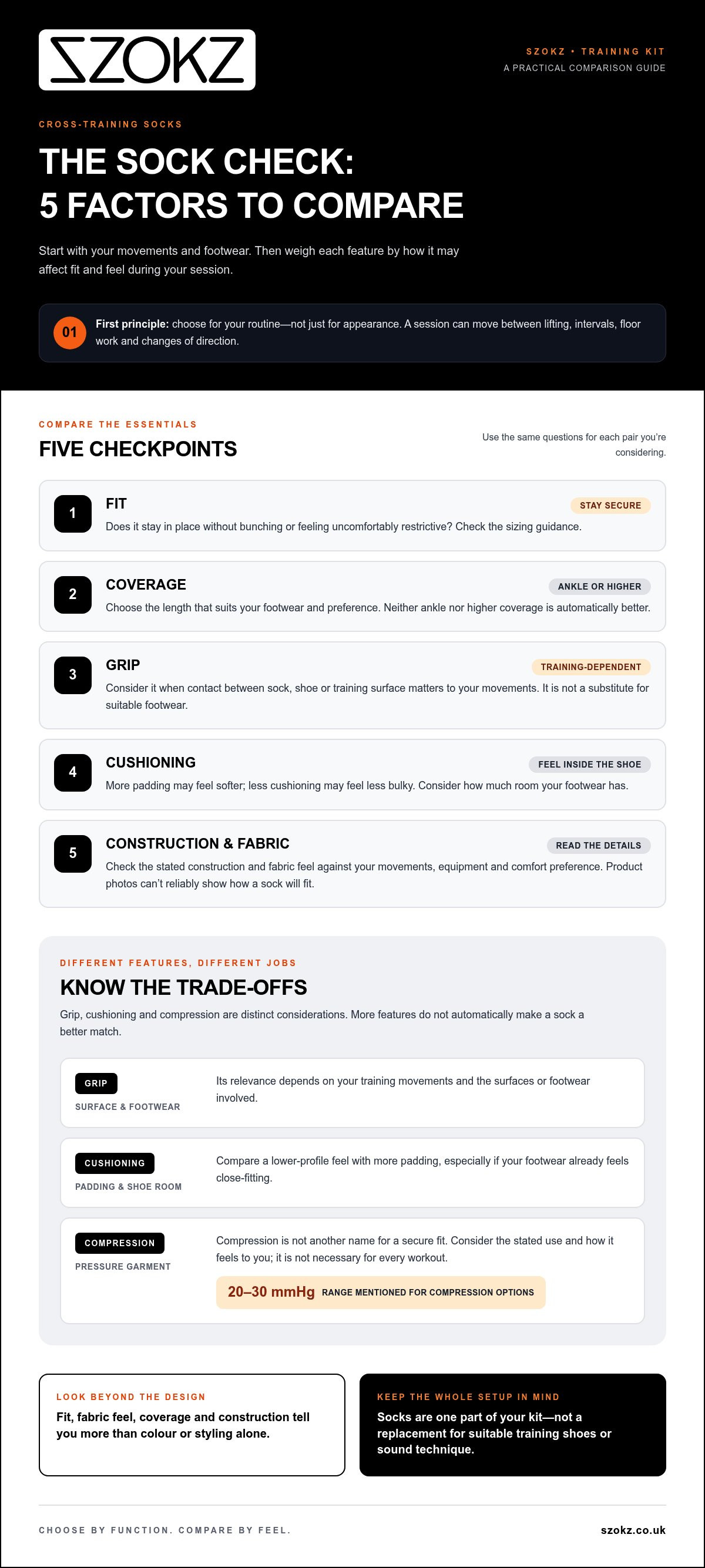
How to choose cross training socks in the UK: a practical buying checklist
A useful choice starts with your routine, not a broad claim that one sock suits every athlete. Think about your movements, footwear and preferred coverage, then compare product details against those needs. This makes cross training socks UK options easier to assess without relying on appearance or a general “training” label.
Match the sock to your training routine
A session centred on lifting may call for a different feel from one that includes intervals, quick changes of direction or varied floor movements. Note what you spend most time doing, then identify your main priority: fit, grip, cushioning or coverage. If your routine mixes activities, choose the feature that matters most in your footwear. Let your actual training guide the decision instead of assuming one pair is ideal for everyone.
Use this checklist in order:
- Identify session demands. Write down the movements you do most often, such as lifting, intervals or floor work. Consider whether your session stays consistent or changes pace and direction.
- Decide your fit preferences. Think about how close you want the sock to feel and whether you prefer ankle or higher coverage. Consider how that coverage sits with your training shoes.
- Compare the features. Check the product description for stated grip, cushioning and construction details. Prioritise features that relate to your movements and footwear, rather than choosing the longest feature list.
- Check sizing. Compare your measurements with the sizing information on the product page for the pair you’re considering. Use its UK sizing guidance as written; don’t assume a conversion from another sizing system.
- Review purchase details. Read the product information and care guidance before ordering. Factor delivery into your decision, especially if you’re buying more than one item.
Check sizing and purchase details before choosing
Take sizing seriously. A sock that feels too loose or too tight may not suit your preferred fit inside a training shoe. Use the sizing details for that specific pair, and compare them with your measurements where the product page provides a basis for doing so. Avoid guessing from a photograph or assuming size labels mean the same thing across every product.
Read the care guidance as well as the feature description so you know how to look after your chosen pair. Before completing your purchase, check the delivery information. SZOKZ offers free UK delivery on orders over £30. This is useful when planning an order, but it shouldn’t determine which sock features you choose.
With your priorities clear, compare SZOKZ socks by their stated details and choose the option that aligns with your routine and fit preferences.
Explore SZOKZ cross-training sock options for your next session
Let your priorities guide what you look at next. If grip is central to your preference, explore SZOKZ grip socks. If you’re comparing options for varied or demanding sessions, consider the high-intensity sport socks too. Neither category is automatically right for every athlete. Your routine, footwear and preferred fit still matter.
Match the range to the features you prioritise
Start with your main requirement. A grip-focused option may suit you if you’re specifically looking for grip features; read the product description to see what’s stated for the pair. High-intensity sport socks are another category to compare for sessions with varied demands. Think about how each option fits your routine, then weigh its stated details against the coverage and feel you prefer.
SZOKZ says its socks are worn by Team GB and Olympic athletes. That gives context about the brand’s users, but it doesn’t establish that one sock type is right for every person or session. Make your choice based on the product information and your needs, not on appearance or association alone. A feature-led comparison is more useful than assuming a category name tells you everything.
- Prioritise grip? Explore grip socks and review the stated features for the pair.
- Looking across training categories? Compare high-intensity sport socks with your session demands in mind.
- Focused on fit? Check the coverage and sizing information for the option you’re considering.
Take the next step with a feature-led choice
Use the same practical test when choosing cross training socks UK shoppers can buy: does the product information align with how you train? Review the sizing and feature details on the product page. Consider how the sock will feel with your footwear and whether its coverage suits your preference. If a detail matters to your decision, rely on the product information rather than inferring it from a photograph.
You don’t need to choose the most feature-heavy option. A clear understanding of your sessions and fit preferences can help you compare the range with purpose. Keep your usual movements in mind, check the details and choose accordingly.
Make your next sock choice work for your routine
Your training kit should support the way you move, not dictate it. Before choosing, picture a typical session and the shoes you’ll wear. That simple check can help you decide which details matter most instead of being drawn to features you may not use. The right cross training socks uk option is the one that suits your fit preferences and training demands.
Use your next session as a practical reference point. Notice whether your socks stay comfortable inside your shoes and whether their coverage and feel suit the movements you do. If you change your routine or footwear, revisit those preferences. A considered choice can make getting ready simpler, without treating socks as a substitute for suitable shoes or sound technique.
Compare the stated features and sizing information across the SZOKZ range. Choose with your sessions in mind and let your own comfort guide the final decision.
Keep training with purpose. Choose a pair that fits your routine and lets you focus on the work ahead. Explore the SZOKZ range to compare grip, high-intensity sport and other sock options for your next session.
Frequently Asked Questions
Are cross-training socks different from regular gym socks?
Not necessarily. The label alone doesn’t guarantee a particular construction or set of features. Compare the product’s stated fit, coverage, grip and cushioning with what you need for your session and shoes. For example, grip may not be a priority if you mainly lift in trainers. Read the product details and sizing information rather than assuming the name “training sock” tells you how it will feel.
Do I need grip socks for cross-training?
No. Grip socks are an option, not a universal requirement for cross-training. Consider whether grip matters for your movements and footwear, and whether you prefer that feel. A session performed in trainers may call for different considerations from one involving direct contact with a training surface. Check the product description for stated grip features. Grip socks don’t replace suitable shoes, and choosing them doesn’t guarantee improved performance or prevent injury.
Can I wear compression socks for cross-training?
You can consider them, but compression isn’t essential for every workout, and comfort and needs vary between people. SZOKZ offers options in the 20-30 mmHg range; that specification doesn’t guarantee a training or medical outcome. Think about your intended use and how the sock feels, rather than treating compression as a default. If you have a health concern or are unsure whether compression is appropriate for you, seek clinical advice.
How tight should cross-training socks feel?
They should feel comfortably secure, without bunching inside your shoes or creating pressure that distracts you. Try them with the footwear you usually train in, as a fit that feels fine on its own may feel different in a close-fitting shoe. Use the sizing guidance for the specific pair. Don’t choose a smaller size based only on a compression claim; check the product’s sizing information instead.
How often should I replace sports socks?
There’s no fixed replacement interval that suits everyone. Check your socks regularly for signs that they no longer serve you well, such as persistent loss of fit, visible wear, thinning or damage. Consider replacing a pair if these changes affect how it feels during training. Follow the care guidance provided with the product to look after the socks you already own.
Can I use the same socks for cross-training and running?
Possibly. Some people may find one pair suits both activities, but comfort priorities can change with footwear, distance and personal preference. A sock that feels comfortable during a short gym session may feel different over a longer run. Compare the pair’s stated features with the demands of each activity, then consider how it feels with both sets of shoes. Don’t assume one design will suit every session.
Comments
No comments yet. Be the first to add one.