


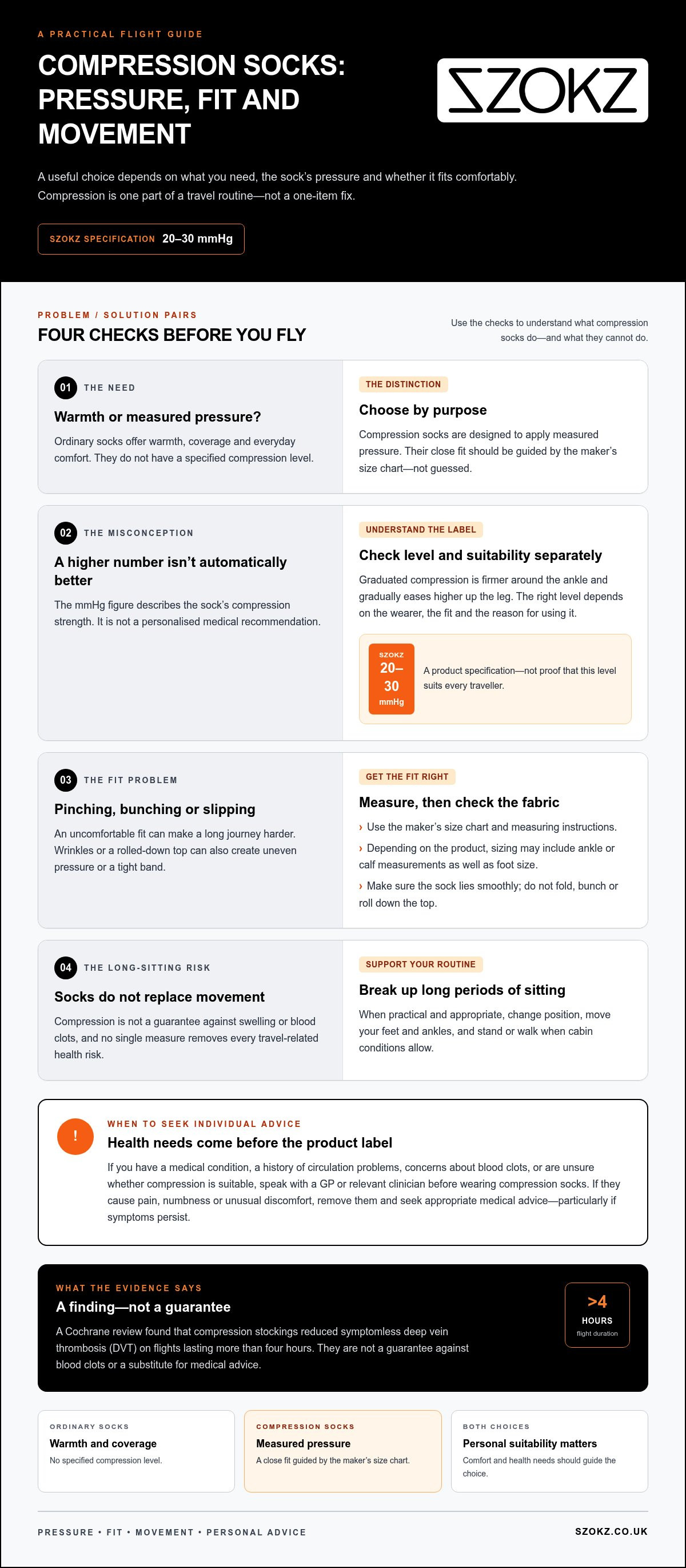
Should you wear compression socks to fly, or are they just another item to squeeze into your hand luggage? If you’re unsure whether they may help with swelling or circulation, you’re not alone. A Cochrane review found that compression stockings reduced symptomless deep vein thrombosis (DVT) on flights lasting more than four hours. They’re not a guarantee against blood clots or a substitute for medical advice.
The right choice depends on more than flight length. Compression level, accurate sizing and a smooth, comfortable fit all matter. Socks that pinch, wrinkle or slip can make a long journey less comfortable, so it pays to know what to look for before you travel.
This guide explains when flight compression socks may be useful, how to choose a suitable level and size, and when to seek individual medical advice. It also covers practical steps for wearing them and supporting comfort in the air, including moving your legs during the journey. Think of socks as one part of a considered travel routine, not a one-item fix. SZOKZ compression socks offer 20-30 mmHg compression, a firm level that may not suit everyone, so consider fit and personal health needs when choosing.
Key Takeaways
- Use compression socks to fly as one part of a considered travel routine, not as a substitute for moving during the journey.
- Understand how graduated compression differs from ordinary tight socks, and what the mmHg measurement tells you.
- Use the maker’s sizing guidance to find a secure, comfortable fit that doesn’t pinch, wrinkle or slip.
- Follow the sock maker’s instructions for when to put them on and how long to wear them.
- If you have circulation or other health concerns, seek individual advice from a GP or relevant clinician before wearing compression socks.
Why Wear Flight Compression Socks and What Do They Do?
Hours in an aircraft seat can leave your legs feeling stiff, heavy or uncomfortable. Some travellers also notice swelling around their ankles after sitting for a long time. Compression socks fit closely around the lower leg and apply pressure. People consider them for flights because they provide steady support when movement is limited.
The pressure is often graduated: it is firmer around the ankle and gradually lessens higher up the leg. That differs from ordinary tight socks, which may feel snug without applying a deliberately graduated pressure pattern. For a clear overview of what compression stockings are and how graduated pressure is used, see this general reference.
How might compression socks support comfort in flight?
Some travellers choose compression socks to fly because the close fit may help their legs feel more supported during prolonged sitting. The pressure pattern is designed to encourage circulation towards the heart, but individual experience and suitability vary. Socks may support comfort, but they don’t guarantee that swelling won’t occur or establish that a particular person’s circulation is safe.
Compression level and fit both matter. A sock that feels uncomfortably tight is not a better choice. If you have a medical condition or a history of circulation problems, seek individual advice before using compression wear. Any claim about treating or preventing a medical condition needs assessment by a qualified healthcare professional.
Are compression socks a substitute for moving during a flight?
No. Socks don’t replace movement, and no single measure removes every travel-related health risk. When practical and appropriate, change position, move your feet and ankles, and stand or walk when cabin conditions allow. Even small movements can break up long periods of sitting.
Think of compression as one possible part of a wider travel routine, alongside movement and any health guidance tailored to you. If you can’t move easily, have health concerns or are unsure whether compression is suitable, speak with a GP or relevant clinician before you travel.
In brief: Compression socks may support leg comfort during a long flight, but they aren’t a guarantee against swelling or a substitute for movement or personalised medical advice.
How compression socks work on a flight: pressure, fit and circulation
Compression socks apply measured pressure to the lower leg. The figure on the label is usually given in mmHg, short for millimetres of mercury, a unit of pressure. It describes the sock’s compression strength, not a personalised medical recommendation. A higher number isn’t automatically better for a flight. The right level depends on the wearer, the fit and the reason for using them.
What does mmHg mean on compression socks?
Graduated compression is designed to feel firmer around the ankle and gradually ease higher up the leg. Ordinary snug socks may feel tight, but they aren’t necessarily made to apply this specific pressure pattern. The number alone can’t tell you whether a pair is suitable for your health needs. For more detail on levels and selection, read this guide to 20-30 mmHg compression socks.
SZOKZ compression socks offer 20-30 mmHg compression. That’s a product specification, not a clinical instruction or proof that this level is appropriate for every traveller. If you’re considering compression because of a health condition or concern about the risk of blood clots during travel, get individual advice from a GP or relevant clinician. Product pressure and medical suitability are separate questions.
Why do size and fit matter when flying?
Compression socks fit as intended only when you choose the right size and put them on correctly. Use the maker’s size chart and measuring instructions rather than guessing from your shoe size. Depending on the product, the chart may use ankle or calf measurements as well as foot size.
Once on, the fabric should sit smoothly against your leg. Check that it isn’t folded, bunched or pinching, and don’t roll the top down, as this can create a tight band. A poor fit can make a long journey uncomfortable and may prevent the sock from applying pressure evenly.
If wearing compression socks to fly causes pain, numbness or unusual discomfort, remove them and seek appropriate medical advice, particularly if symptoms persist. Don’t force a pair that feels wrong. To compare SZOKZ compression options, explore the available compression socks and use the product’s sizing guidance to assess the fit.
Compression socks for flying versus ordinary socks: how to choose
Start by deciding what you want from your socks. Ordinary socks provide warmth and coverage; compression socks are designed to apply a stated level of pressure. Neither choice suits every traveller, and choosing the strongest pressure isn’t a shortcut to better comfort or a more appropriate fit.
| Feature | Ordinary socks | Compression socks |
|---|---|---|
| Purpose | Warmth, coverage and everyday comfort | Measured pressure for compression support |
| Fit | Varies by style; should feel comfortable in your shoes | Close fit guided by the maker’s size chart |
| Pressure | No specified compression level | Usually labelled with a pressure level, such as mmHg |
When might ordinary socks be enough for a flight?
If you’re mainly looking for warmth or basic coverage, a comfortable pair of ordinary socks may meet that need. Check that they sit smoothly inside your shoes and don’t feel restrictive around your toes, ankles or calves. Clothing that lets you shift position comfortably can also make the journey easier. Ordinary socks aren’t designed to address personal circulation concerns, so they shouldn’t be treated as a substitute for advice about them.
What should you compare before choosing flight compression socks?
Look beyond the label. Check the stated compression level, the maker’s sizing method, the fabric and care information, and whether the product is intended for your use. A pair that’s too tight, slips or bunches may be uncomfortable, so follow its measuring and fitting instructions before travelling. If you have a health condition or aren’t sure compression is suitable, seek individual clinical advice rather than selecting a level by guesswork.
Evidence is specific to the outcomes studied. The Cochrane review reports high-certainty evidence that compression stockings reduce symptomless DVT on flights over four hours. That finding isn’t a guarantee for an individual, nor does it mean every traveller should wear the same type or pressure. For more context on movement and other in-flight considerations, read this in-flight circulation guide.
When choosing compression socks to fly, match the product’s stated pressure and sizing guidance to your needs. Don’t assume that firmer is always better. To compare options, browse compression socks and review the product information before choosing.
How to Wear Flight Compression Socks: Timing and Routine
A simple routine helps you check comfort and fit without treating compression socks as a complete travel-health plan. The right timing and wear duration depend on the sock and your circumstances, so follow the maker’s instructions or advice from a clinician who knows your health needs.
- Prepare before travel. Read the product guidance for when to put the socks on, how to wear them and when to take them off. If you’ve been given individual clinical advice, follow that too.
- Check the fit before boarding. Put them on as directed and smooth the fabric so it sits evenly. Check for folds, bunching or pinching. Trying them before you reach the aircraft gives you time to address discomfort without the pressure of boarding.
- During the flight, reassess comfort. Follow the product instructions for wear duration. Move your feet and ankles, change position and get up to walk when it’s safe and practical. Don’t keep wearing socks that cause pain, numbness or unusual discomfort.
- After landing, check how your legs feel. Remove the socks according to the instructions and look for persistent discomfort or unusual changes. Seek medical advice if you’re concerned about symptoms.
When should you put compression socks on before flying?
There isn’t one timing rule for every pair or every traveller. Some products give specific directions, and individual health needs can change what’s appropriate. Follow the maker’s instructions or personalised clinical guidance, and check the fit before boarding. Don’t assume it’s suitable to sleep in compression socks; wear them overnight only if the product guidance or a clinician advises it.
What else can you do to stay comfortable in the air?
Break up sitting where possible. Flex and rotate your ankles, shift your position and walk when cabin conditions allow. Drink fluids in moderation to support general comfort, but don’t treat hydration as a way to prevent blood clots. If you have health concerns or a higher personal risk, general travel tips can’t replace advice tailored to you. For more practical ideas, see this in-flight swelling checklist.
Compression socks are easiest to use when you know how they should fit, when to wear them and when to remove them. Keep the instructions accessible during your journey, and don’t push through discomfort.
Who should seek advice before wearing compression socks to fly?
Compression socks aren’t automatically suitable for every traveller. If you have a circulation problem, a heart condition, reduced sensation in your legs, a skin concern or another health issue, speak with your GP or relevant clinician before wearing them. They can help you decide whether compression is appropriate and what level, if any, fits your individual needs. Don’t use a product label as a substitute for personalised advice.
When is individual medical advice important?
Get guidance before your journey if you’re unsure whether compression is suitable, especially if you have an existing condition affecting your legs or circulation. Personal circumstances matter. A clinician can consider your health history and travel plans rather than relying on a general recommendation.
Pay attention to new symptoms. If the socks cause pain, numbness, colour changes or unusual discomfort, remove them and seek appropriate advice. New leg pain or swelling can also need prompt medical assessment, whether or not you’re wearing compression. The NHS guidance on deep vein thrombosis describes symptoms that need urgent attention. Sudden breathlessness or chest pain should be treated as an emergency.
Choosing a comfortable pair for your next flight
Make your decision in this order: consider whether compression suits your circumstances, understand the stated pressure level, then use the maker’s size guidance to find a smooth, comfortable fit. The strongest pressure isn’t automatically the best choice. If you’ve been advised to use compression, follow your clinician’s guidance alongside the product instructions.
SZOKZ compression socks offer 20-30 mmHg compression. That describes the product’s pressure level; it isn’t a medical recommendation or a promise of a particular result during a flight. Review the product information and sizing guidance, and seek individual advice if you have health concerns before choosing.
Compression socks to fly can be one part of a practical travel routine when you understand the product and how it fits your needs. They don’t replace medical advice or other sensible steps during a journey. Choose based on fit and personal suitability, not just the number on the label.
Choose your flight socks with confidence
Compression socks to fly may support comfort during a long journey, but they’re not a one-size-fits-all solution. Check the stated pressure level and follow the maker’s sizing and wear instructions. A smooth, comfortable fit matters more than simply choosing the strongest compression.
Build socks into a broader travel routine. Move your feet, change position and walk when it’s safe and practical. If you have circulation or other health concerns, seek individual advice from a GP or relevant clinician before wearing compression socks. Remove them and get appropriate help if you experience pain, numbness, colour changes or unusual discomfort.
SZOKZ compression socks offer 20-30 mmHg compression, and the brand states its socks are worn by Team GB and Olympic athletes. These details describe the product and its use, not a medical endorsement or a guarantee of flight-related outcomes. Review the product information and sizing guidance before choosing.
Choose a pair that fits your needs and travel routine, then follow its wear instructions.
Frequently Asked Questions
Should I wear compression socks to fly?
You may find compression socks helpful for leg comfort during a flight, particularly if you’ll be sitting for a long time, but the experience varies. They apply pressure to the lower leg and aren’t essential or suitable for every traveller. If you have a circulation condition, another health concern or a history of blood clots, ask a GP or relevant clinician whether compression is appropriate for you.
Can compression socks prevent deep vein thrombosis on a flight?
No sock can guarantee that you won’t develop deep vein thrombosis (DVT). A Cochrane review found that compression stockings reduced symptomless DVT in studies of flights lasting more than four hours, but this doesn’t mean they prevent every clot or establish your personal risk. If you have risk factors or a history of blood clots, seek individual clinical advice about suitable travel measures.
How long should I wear compression socks when flying?
Wear them for the period specified by the maker or recommended by your clinician. Instructions can differ between products, and your health circumstances may affect how long they’re suitable to wear. Don’t assume you should keep them on after landing or wear them overnight. Check the guidance before your journey, and remove them and seek advice if you experience pain, numbness or unusual discomfort.
What compression level is best for flying?
There isn’t one pressure level that suits everyone. Compression is usually labelled in mmHg, a unit used to describe pressure. General travel guidance commonly refers to moderate compression of 15-20 mmHg, while 20-30 mmHg is a firmer level that may need individual advice. Your health, fit and reason for wearing socks all matter. Ask a clinician before choosing a higher level for a medical concern.
Are compression socks safe for everyone to wear on a flight?
No. Individual health circumstances can affect whether compression socks are suitable and what pressure is appropriate. If you have circulation problems, a heart condition, reduced sensation in your legs, a skin concern or another relevant health issue, speak with a GP or clinician before wearing them. A general travel recommendation or product label can’t take the place of advice based on your health history.
Can I wear compression socks overnight on a long-haul flight?
Only wear them overnight if the product instructions or a clinician’s advice support it. Guidance can vary between socks, and suitability depends on your personal circumstances. Check how long the maker recommends wearing the pair, including whether the instructions cover sleeping. If you have a medical condition or you’re unsure, ask a relevant clinician before the flight rather than assuming overnight wear is appropriate.
How should compression socks fit for a flight?
They should sit smoothly against your leg, without folds, bunching, slipping or painful pinching. Use the maker’s sizing instructions and measurements rather than guessing from shoe size alone. Don’t roll the top down, as this can create a tight band. If the socks cause pain, numbness, colour changes or unusual discomfort, remove them and seek appropriate medical advice, especially if symptoms continue.
Comments
No comments yet. Be the first to add one.