


In CrossFit, grip socks can be useful for more than barefoot work. Their grippers may help limit movement between your foot and the inside of a trainer, depending on the sock and shoe. They are not a replacement for suitable training footwear, and they will not suit every workout or athlete.
When choosing grip socks for crossfit, consider whether they will stay in place through lifts, jumps and rope climbs, or bunch up and feel uncomfortable. The answer depends on more than the grip pattern. Fit, fabric, cushioning and construction all affect how a pair feels during a varied session.
This guide explains when grip socks may help, which features to compare and how to choose a pair around the way you train. You will learn what to look for in the sole, fit and fabric, and how grip may matter inside trainers. The aim is a practical choice, without expecting socks to do the job of your footwear.
Key Takeaways
- Match grip sock design to where you train: in trainers, on mats or across a mixed WOD.
- Compare gripper coverage and pattern as practical design details, not guarantees of better performance.
- Use a quick fit check to assess heel placement, toe room and comfort through repeated movement.
- Choose grip socks for crossfit by reviewing your workout needs first, then weighing essential fit against preferences such as cushioning and height.
- See how SZOKZ grip socks fit into the decision, without expecting socks to replace appropriate training footwear.
Grip socks for CrossFit: when do they make sense?
Grip socks have textured grippers on the sole. Unlike ordinary training socks, they are designed to add contact between the sock and a surface, or between the sock and the inside of a shoe, depending on their construction and intended use. That distinction matters in a sport with varied movements. The CrossFit approach includes different types of training, so a sock that feels useful during one part of a session may not suit the next.
Grip socks for crossfit are not a substitute for suitable trainers. For lifts, jumps and other movements that call for footwear, wear trainers that suit the exercise and follow your gym’s footwear rules. Any benefit from a grippy sole depends on the sock’s fit, the surface, your footwear and how you move.
Which CrossFit movements might make grip relevant?
Grip may be worth considering during warm-ups, mobility drills or floor-based exercises, especially when you are barefoot and the grippers contact the mat or floor. In trainers, the question is different: does the sock sit securely inside the shoe, or does it move around? Sole grippers do not automatically increase the shoe’s traction against the floor.
Olympic weightlifting and box jumps generally call for suitable trainers. Your workout programme and facility rules determine when socks are appropriate, so consider the session as a whole rather than choosing a pair for one movement alone.
Grip socks versus ordinary training socks
The clearest difference is on the sole: grip socks have gripper elements, while ordinary training socks generally have a fabric sole without them. Their intended use can differ too. A grip sock may be designed for barefoot contact or to help limit movement between the foot and shoe. An ordinary sport sock is worn inside footwear without sole grippers.
Fit matters for both. A sock that shifts, folds or bunches can feel distracting, regardless of its grip pattern. Neither type is best for every WOD or athlete. Think about the footwear you will wear and whether the grippers will contact anything during the planned workout.
What grip can and cannot do
Grip socks are socks with grippers on the sole, intended to add traction at the sock’s contact point with a surface or help limit movement inside footwear. This describes a design feature, not a promise of better results.
Keep two kinds of traction separate. Grippers inside a shoe may help reduce movement between sock and footwear. They do not change the shoe’s outsole or guarantee more grip between trainer and floor. Barefoot on a mat, the grippers may contact the surface directly, but their usefulness still depends on the sock’s fit and the surface itself.
Use the planned movements as your guide. If trainers are required, wear them. If a floor-based drill allows socks, consider whether sole grippers suit that surface. Comfort and a secure fit matter alongside the grippers.
How grip sock construction affects comfort and control
Grip socks can look similar at a glance, but gripper placement, heel shape and fabric feel all affect how a pair sits during training. Treat these as details to assess, not proof of superior performance. A sock that feels secure during a floor drill may feel different inside a close-fitting trainer, where extra thickness or misplaced grippers can affect the fit.
Grippers may affect contact between sock and shoe, but they do not create traction between the shoe and the floor. Keeping those functions separate helps you judge construction against the way you plan to wear the socks.
Gripper coverage and placement
Look at the sole pattern and note where the grippers sit: across the forefoot, heel or both. Their distribution may change how the sock feels underfoot, particularly as your foot presses into different areas during movement. For barefoot floor work, check whether coverage reaches the parts of the foot that contact the surface. Inside a shoe, consider whether the pattern sits comfortably against its lining.
A larger gripper area is not automatically more effective. Placement, fit and intended use all matter. Treat the design as an observable feature, then consider whether it suits the movement and footwear you have in mind.
Fit, cushioning, and fabric feel
A secure fit can help limit bunching as you change direction, squat or move between exercises. Check that the heel sits in the heel pocket, the fabric lies smoothly over the top of your foot and your toes have room to spread without excess material folding at the end. Consult the brand’s sizing guidance before choosing a size rather than assuming your usual fit will transfer across brands.
Cushioning is a preference shaped by the space inside your trainers and the feel you want underfoot. Too much bulk may affect how a shoe fits; a thinner sock may feel less cushioned. Consider whether the fabric feels comfortable and breathable against your skin, including after a hard session when your feet are warm or damp.
Durability for repeated training
Repeated friction and laundering can affect both fabric and grippers. Follow the care instructions supplied with the socks, and check the sole after washing for loose, peeling or worn grippers. Inspect the seams and heel and toe areas too, as these parts experience regular contact inside footwear. Construction may show where reinforcement is placed, but it cannot establish how long a pair will last in your routine.
When comparing grip socks for crossfit, weigh the details together: sole coverage, a stable fit, comfortable fabric and enough room in your chosen trainers. SZOKZ offers grip socks to consider alongside your footwear and training needs. Browse the SZOKZ sock range to compare the available categories.
Compare grip socks for CrossFit by workout and footwear
The most useful choice depends on what you will wear and do during the session. A sock that feels comfortable for floor work may take up too much room inside a trainer. Use this comparison to narrow down what to look for, not as a performance ranking.
| Training situation | Gripper coverage | Fit and cushioning | Practical choice |
|---|---|---|---|
| Mostly in trainers | Grippers may sit between sock and shoe, not against the gym floor. | Prioritise a smooth, secure fit; avoid bulk that crowds the shoe. | Grip socks if they feel comfortable inside the trainers; ordinary training socks if not. |
| Floor-based or shoe-free work | Grippers only contact the floor where the activity and surface allow. | Check that the sock stays in place and feels comfortable underfoot. | Grip socks may suit permitted floor exercises; follow facility rules. |
| Mixed WOD | Contact changes as footwear and movements change. | Balance a secure fit with cushioning that works in your trainers. | Consider changing footwear or socks between activities when practical. |
For sessions performed mainly in trainers
Choose around the shoe first. A comfortable sock should sit smoothly inside your chosen trainers, without bunching at the toes or pressure from extra fabric. Sole grippers may be covered by the shoe, so they will not necessarily touch the gym floor or change the trainer’s traction. If a thicker sock makes your footwear feel crowded, an ordinary training sock may be more practical.
For floor work and shoe-free exercises
Check the surface and the facility’s footwear rules before weighing up the grippers. On a mat, the pattern may contact the floor during mobility or other permitted shoe-free drills. In trainers, it will not. That difference is central to choosing grip socks for crossfit. Do not assume socks are suitable for every lift or conditioning exercise. Follow the workout plan and wear appropriate footwear where required.
For a broader look at how sole grip relates to different activities, see The Ultimate Guide to Sports Grip Socks.
For mixed WODs and changing movement demands
A session might move from warm-up drills to barbell work, jumps or conditioning. One pair may be convenient, but it will not necessarily suit every phase. Consider whether changing between socks and trainers is manageable, and choose footwear according to the movement rather than relying on sole grippers to do the job of a shoe.
Sport-specific demands vary too. Football socks, for example, are worn with boots for a different set of movements; that context does not automatically translate to CrossFit. Compare socks by their fit and intended use, then consider how they feel with the footwear and exercises in your programme.
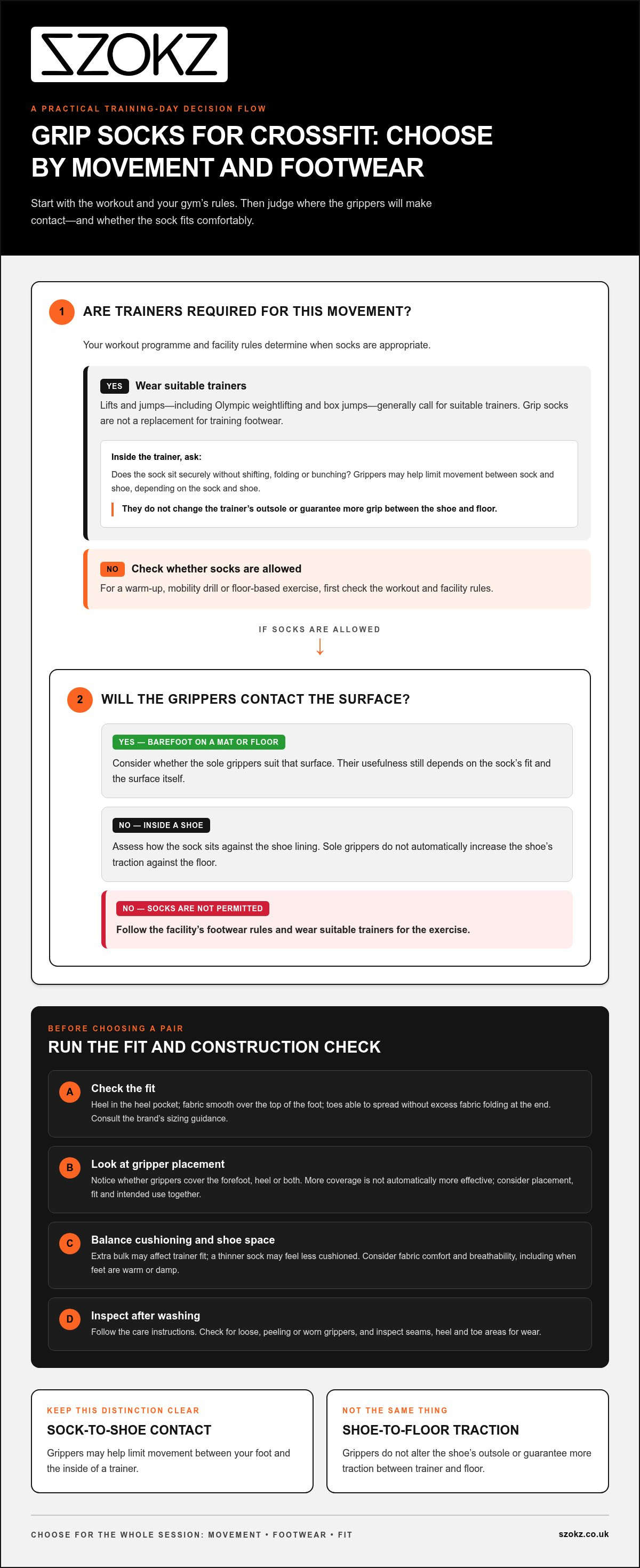
Use this checklist to choose grip socks for CrossFit
A useful choice starts with your training, not a product claim. Review where the socks will be worn, how they will fit inside your footwear and whether their construction suits the session. For grip socks for crossfit, the essentials are a comfortable fit and a relevant use for the grippers. Cushioning and sock height are preferences to weigh against your shoes and training style.
Start with your training week
List the movements and surfaces where you expect to wear grip socks. Separate exercises done in trainers from shoe-free drills where the grippers might touch a mat or floor. A week with mostly barbell work and jumps may call for trainers and conventional sport socks; sessions with permitted floor-based mobility may give the sole grippers a clearer role.
Check any gym-specific footwear requirements before comparing pairs. A sock that suits one part of a workout will not override the rules or make unsuitable footwear appropriate for another movement.
Check fit and construction before buying
Use the brand’s size guide, then consider your foot shape and the space available in your chosen shoes. A good fit should feel secure without pulling tightly across the toes or leaving excess fabric that could fold. Do not size down just to make a sock feel more secure; an undersized pair may compromise comfort.
Look at where the grippers sit, whether the seams feel comfortable against your foot and how much cushioning you prefer. These are practical details to compare against your intended use, not guarantees of performance. Thicker cushioning may suit your preferred feel, but it can take up more room in a close-fitting trainer. Sock height is another preference, shaped by comfort and coverage rather than a universal CrossFit requirement.
Read the care guidance as well as the size information before buying. Washing instructions help you care for the fabric and grippers as intended. Consider whether the recommended care routine fits your regular training and laundry habits.
Decide whether one pair suits the intended use
Compare the sock’s stated intended use with the actual mix of your sessions. If you move between floor drills and shoe-based lifts, decide whether changing socks or footwear is practical. A single pair may be convenient, but do not assume one design will suit every WOD. For workouts performed entirely in trainers, standard sports socks and suitable footwear may be all you need.
Use this quick sequence before choosing:
- Identify the workout movements, surfaces and footwear rules.
- Check the sock’s intended use and gripper placement against those activities.
- Compare the size guide, fit, seams and cushioning with your foot and trainers.
- Review care guidance, then weigh optional preferences such as height.
Choose the pair that fits the training you actually do, rather than prioritising a feature that will not contact a surface or suit your footwear.
Choose SZOKZ grip socks for your CrossFit training
The right sock depends on your session, not a broad promise about performance. SZOKZ grip socks and high-intensity sport socks offer options to consider for demanding training. Start with the movements you do, the footwear you wear and where the sock’s grip will make contact. Then compare fit and comfort against those needs.
Match the range to the needs you identified
Think back to your workout mix. If you will wear trainers throughout, check how a sock fits inside them and whether its intended use matches your session. For permitted floor-based exercises, consider whether the grippers will contact the surface. These are different use cases, so do not choose on the word “grip” alone.
SZOKZ sells grip socks and high-intensity sport socks. Use the buying checklist to weigh fit, intended use and your balance of shoe-based and floor-based work. Choose based on what you need from a sock, rather than assuming one category suits every WOD or athlete.
What to expect from the SZOKZ approach
SZOKZ designs and sells high-performance grip and compression socks for athletes and everyday wear. Its socks are worn by Team GB and Olympic athletes. That offers context about the brand’s sporting audience, but it is not evidence of a particular CrossFit result or an endorsement for this use.
Your own fit and training demands remain the best guide. Consider whether the sock feels comfortable in your chosen footwear, whether its intended use matches your workout and whether you like its construction through a full session. A sock is one part of your kit, not a substitute for appropriate trainers or facility rules.
Browse grip socks and choose your next pair
Before deciding, make a final check: identify the workout type, note when you will wear footwear, assess the fit and consider where the grippers will sit. A pair that suits floor work may not feel right inside a trainer, while a conventional sport sock may be more practical for sessions spent entirely in shoes. Keep comfort and intended use at the centre of your choice.
Choose the option that aligns with your training rather than expecting one pair to cover every movement. SZOKZ grip socks are worth considering if their intended use fits the way you train. Compare the categories and make your decision with your footwear and workout mix in mind.
Make your next kit choice with confidence
Before choosing grip socks for crossfit, decide what you want them to add to your training. A useful purchase has a clear purpose in your kit, rather than relying on a broad promise of better performance. Give comfort equal weight: if a pair distracts you or feels wrong in your footwear, the grippers alone are not a reason to keep wearing it.
Use your next session as a reference point. Notice what you wear for each part of the workout and where you would genuinely value a different sock. That simple observation can help you choose with more confidence and avoid buying features that do not match your routine. SZOKZ’s specialist athletic sock range offers options to compare with your training needs, without asking socks to do the work of suitable footwear.
Choose deliberately, then get back to the work that matters: your training.
Frequently Asked Questions
Are grip socks good for CrossFit?
They can be useful for parts of CrossFit training, but their value depends on how you use them. Grip socks for crossfit may suit a permitted shoe-free drill or feel secure inside a particular trainer. For a session built around footwear, check that the socks fit comfortably in your shoes and do not distract you during movement. They are a kit option, not a requirement or a substitute for suitable footwear.
Can you wear grip socks inside CrossFit shoes?
Yes, if the socks fit comfortably inside your shoes. Try them on with the trainers you plan to use, then walk, squat and flex your feet to check for pressure, slipping or bunching. Grippers may sit against the shoe’s lining, but they do not change the grip of its outsole on the floor. If the fit feels crowded, use a thinner sock that works better with that footwear.
Do grip socks help with weightlifting?
They do not replace weightlifting shoes or trainers chosen for the lift. If you wear footwear, the sock’s grippers are inside the shoe rather than in contact with the floor. Prioritise footwear that feels stable and appropriate for your programme, then assess whether the socks are comfortable inside it. If your coach or facility requires shoes for a lift, follow that requirement rather than switching to socks alone.
Should grip socks feel tight?
They should feel secure, not restrictive. Check that the heel stays in place and the fabric lies smoothly without pulling at the toes or leaving folds underfoot. A sock that feels uncomfortably tight while standing is unlikely to become more comfortable during a session. Use the manufacturer’s size guide, and try the socks with your training shoes if you will wear them together. Do not size down simply to increase compression.
How do you wash grip socks without damaging them?
Follow the care label first, as washing and drying instructions can vary by sock. Turn the pair inside out only if the label allows, and avoid harsh treatment that could wear the fabric or grippers. Do not assume high heat is suitable; check before using a tumble dryer or ironing. After washing, let the socks dry fully before storing them, and inspect the soles for peeling or worn areas.
Can you wear grip socks without shoes at the gym?
Only where the gym’s rules and the activity allow it. Check before taking your shoes off, as requirements may differ between spaces and exercises. The floor or mat also affects how the grippers feel, so a pair that seems suitable for mobility work may not be right for another movement. For lifting or conditioning that calls for trainers, wear appropriate footwear rather than assuming grip socks are enough.
Comments
No comments yet. Be the first to add one.