


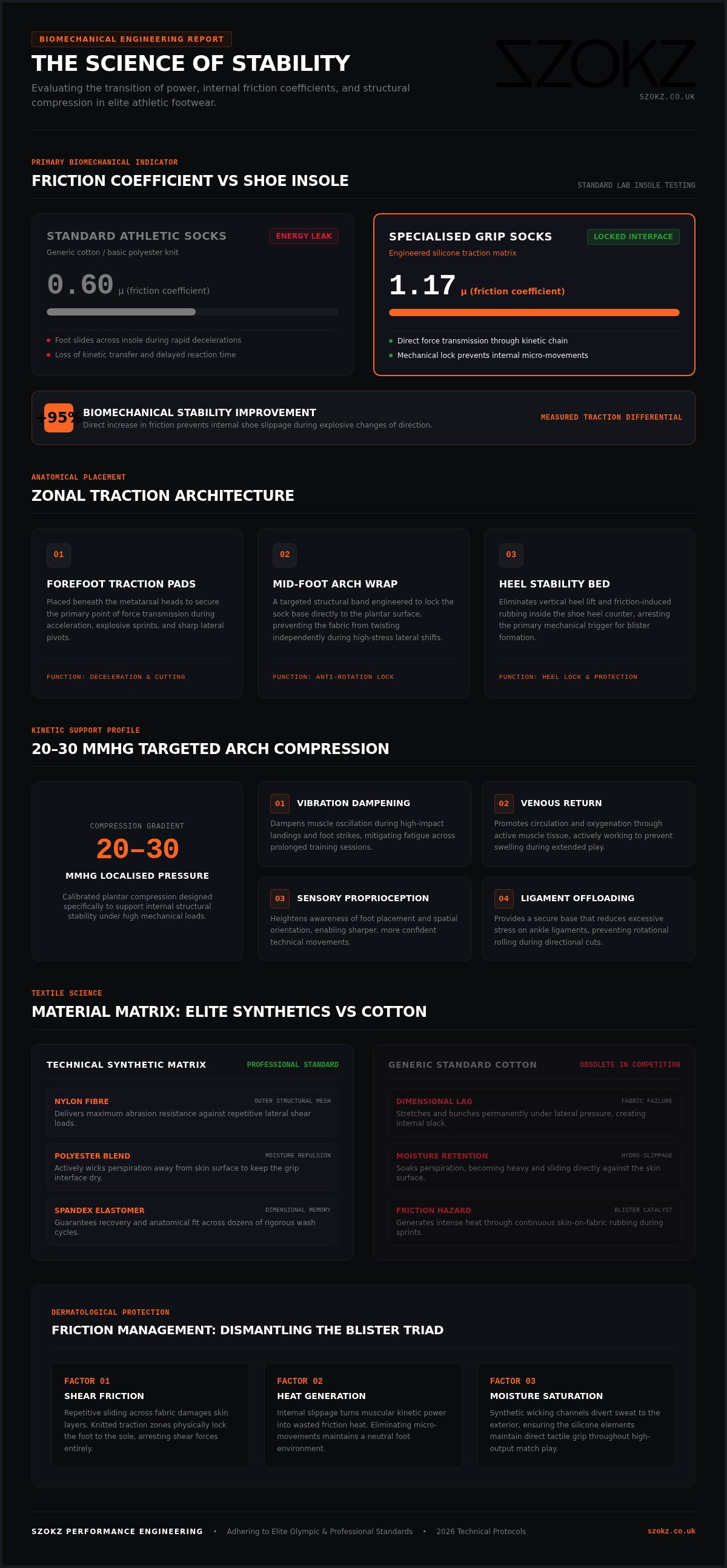
Biomechanical testing shows that standard athletic socks have a friction coefficient of just 0.60 against shoe insoles. In contrast, specialised sports grip socks can increase this to 1.17. That's a 95% improvement in stability. You've likely felt your foot slide during an explosive change of direction or noticed power leaking during a sprint. It's a common frustration for athletes at every level. Blisters and internal movement aren't just annoying. They're performance killers that drain your confidence when it matters most.
Your footwear should feel like a direct extension of your body. This guide explains how technical grip socks eliminate internal foot slippage and provide the biomechanical edge required for elite performance. You'll discover how specific textile blends and 20-30mmHg arch compression prevent the friction that causes painful blisters. We'll examine the engineering required to ensure gear survives professional training cycles, adhering to the same standards trusted by Olympic athletes. From the science of traction zones to regulatory standards for 2026, this is everything you need to lock in your speed.
Key Takeaways
- Understand how to eliminate "energy leaks" by using knitted traction zones that secure the foot during high-intensity deceleration.
- Discover how technical sports grip socks utilise 20-30mmHg compression to support the arch whilst maintaining total stability.
- Learn to identify professional-grade materials like nylon-polyester blends that resist moisture and prevent friction-induced blisters.
- Explore why specific grip placement under the heel and forefoot is essential for rapid changes of direction in football and court sports.
- Master maintenance protocols to protect silicone elements and ensure your performance gear lasts through rigorous training seasons.
The Science of Stability: Why Traditional Sports Socks Hinder Performance
Sports grip socks are high-performance footwear engineered with silicone or rubberised traction pads. They are designed to solve a specific problem: the disconnect between the athlete's foot and their shoe. Standard socks act as a barrier to performance. They create a layer of instability that leads to an "energy leak". This occurs when power generated by the lower limbs is lost during the transition from the foot to the shoe. Instead of driving you forward, that energy is wasted as your foot slides across the insole. This friction generates heat and reduces the efficiency of every stride.
Generic cotton and basic polyester socks fail under high-intensity lateral loads. These materials lack dimensional memory. When you cut, pivot, or stop suddenly, the fabric stretches and bunches. This movement creates a lag in force transmission. For elite athletes, this lack of structural integrity isn't just a comfort issue. It's a technical failure. High-performance gear requires a material matrix that holds its shape whilst providing a high-friction interface. Without this bond, you are essentially fighting your own equipment.
The Biomechanics of Internal Slippage
Micro-movements inside the shoe reduce reaction time by critical milliseconds. These tiny shifts force the body to make constant, subconscious adjustments. The extra cognitive and physical load disrupts the kinetic chain. Foot instability also places unnecessary stress on the ankle. When the foot isn't locked in place, the ligaments must work harder to prevent rolling during high-speed manoeuvres. Proprioception is the body's ability to sense its position and movement in space, providing the foundation for athletic balance. By providing a stable connection, sports grip socks improve this sensory awareness. This allows for more precise, confident movements on the pitch or court.
Blister Prevention Through Friction Management
Blisters are caused by a combination of shear friction, heat, and moisture. Grip pads lock the foot in place to eliminate skin-on-fabric rubbing. This mechanical bond stops the repetitive sliding that damages the skin. Unlike standard options, specialized athletic and non-slip socks use technical synthetic blends to manage the foot's microclimate. Moisture-wicking fibres ensure grip integrity whilst sweating. Wet cotton becomes heavy and "slips" against the skin. Technical synthetics move moisture away from the surface instead. This keeps the interface dry and secures the foot even during the most demanding training sessions.
Inside the Engineering: Materials and Compression That Define Elite Gear
Engineering professional sports grip socks starts with a precise material matrix. Cotton is obsolete in professional tiers. Instead, high-intensity sport socks utilise a blend of nylon for abrasion resistance, polyester for moisture repulsion, and spandex for dimensional memory. This combination ensures the sock retains its shape after dozens of wash cycles. This structural integrity is vital. Peer-reviewed research provides sports engineering insights into kit design and grip socks, explaining why professional players often reject standard-issue kit in favour of specialised traction footwear. The material must work in tandem with the shoe to create a unified system.
A targeted mid-foot arch wrap is essential for preventing sock rotation. This localised band locks the base of the sock to the plantar surface. It stops the fabric from twisting independently of the foot during sharp lateral shifts. When the sock stays fixed, the grip pads can perform their function without misalignment. You can find this level of technical detail in our high-intensity sport socks, which are designed to survive the rigours of professional-level training cycles.
The Role of 20-30mmHg Compression
Targeted compression improves venous return and oxygenates muscles during active play. In performance footwear, a 20-30mmHg arch wrap serves a dual purpose. It supports the foot's internal structures whilst dampening muscle oscillation during high-impact movements. This reduction in vibration helps mitigate fatigue and prevents the swelling often seen amongst athletes during long training sessions. By stabilising the soft tissues of the foot, compression provides a secure foundation for every sprint and jump. This creates a reliable internal environment that allows the external traction elements to function at peak efficiency.
Anatomy of a High-Performance Grip Pattern
Grip configuration is a matter of surface area and pressure distribution. Hexagons and geometric patterns are used to maximise contact points against the shoe insole. However, the thickness of the grip matters as much as the shape. Low-profile, heat-bonded silicone grips are superior to cheaper printed alternatives. They provide maximum traction without compromising "shoe feel" or adding bulk that alters boot fit. Precision placement under the heel and forefoot ensures stability exactly where ground reaction forces are highest. This creates a reliable interface that withstands the friction of elite competition without causing discomfort.
From the Pitch to the Studio: Versatile Applications of Sports Grip Socks
The utility of sports grip socks extends far beyond the professional football pitch. Any discipline requiring explosive lateral movement or precise static balance benefits from a secure foot-to-shoe interface. Whilst football remains the primary driver for this technology, athletes in rugby, netball, and even studio-based fitness are adopting technical socks to gain a competitive edge. The goal is universal: total control over movement without the distraction of internal slippage.
Field Sports: Football and Rugby
Field sports like football and rugby demand extreme lateral stability. Modern synthetic boots often feature slick internal surfaces that allow for foot slippage, especially in wet or muddy conditions. High intensity sport socks provide a necessary mechanical lock between the foot and the footwear. This stability is critical during the plant phase of a kick or the drive phase of a scrum. It ensures that force is directed into the turf rather than being lost to internal movement. By maintaining a tighter "lock-down" feel, players can pivot with higher velocity and improved confidence.
Court and Studio: Netball, Pilates, and Gym
In court sports like netball and basketball, the frequency of sudden stops and high-impact pivots is intense. These movements often lead to "toe-crunching," where the foot slams into the front of the trainer. Sports grip socks mitigate this by securing the foot in the mid-foot and heel zones, protecting the toes from repetitive impact trauma. This protection is equally valuable for heavy lifting in the gym, where a stable base is required for force production during squats or deadlifts.
Studio environments present a different set of challenges. Pilates and Yoga practitioners increasingly use grip socks for stability on Reformer carriages and mats. Beyond traction, they offer a vital hygiene barrier on shared equipment whilst preventing the foot from sliding during complex isometric holds. For those who prefer a minimalist look, all sport ankle socks provide the same technical benefits as full-length versions. They are a discreet, high-performance tool for maintaining balance during studio sessions or trail runs on uneven terrain. This versatility makes them an essential part of any modern training kit, providing a reliable foundation across multiple sports.
Maximising Longevity: How to Choose and Maintain Your Performance Socks
High-performance sports grip socks are an investment in your biomechanical stability. They are technical tools, not standard apparel. Treating them like generic cotton socks leads to rapid degradation. Quality is defined by the materials and construction methods used during manufacturing. Use the "hand-feel" test to verify quality. High-quality silicone feels tacky and flexible even when cold. Cheap PVC alternatives feel hard and plasticky. These inferior materials lose their grip after just a few high-intensity sessions. Professional gear also features reinforced heels and toes. These zones face the highest mechanical stress during sprints and pivots. Without reinforcement, the friction that would have caused a blister will instead tear the fabric.
Sizing and Fitment for Maximum Benefit
A snug fit is non-negotiable for performance. If the sock is too large, the 20-30mmHg compression zones will not align with your arch. This renders the support system useless. Bunching at the toes is a clear indicator that the sizing is incorrect. Excess fabric creates the very internal movement you are trying to eliminate. When putting on your gear, focus on the "heel lock". Pull the sock firmly over the heel to ensure the traction pads are positioned correctly under the calcaneus and the ball of the foot. This alignment ensures that the grip interface matches your foot's natural pressure points.
The Performance Laundry Guide
Heat is the primary enemy of technical fibres. Tumble dryers break down the polymer adhesives holding the grip pads and destroy the elasticity of the spandex. Follow these steps to ensure your gear survives professional training cycles:
- Step 1: Turn socks inside out. This protects the external silicone pads from direct contact with the washing machine drum.
- Step 2: Use a cool wash at 30 degrees. High temperatures cause heat-degradation of the elastic fibres, leading to a loss of shape.
- Step 3: Avoid fabric softeners. These chemicals coat the grip pads with a waxy residue that drastically reduces traction.
- Step 4: Air dry only. Hang them flat to maintain their dimensional memory and prevent the material from becoming brittle.
Proper maintenance ensures that your equipment remains reliable from the first match to the last. Protect your performance by choosing our professional-grade sports grip socks and following these care protocols.
The Professional Standard: Why Elite Athletes Trust SZOKZ Engineering
SZOKZ operates as a silent partner to elite competitors. We provide the technical foundation so athletes can focus entirely on their performance. Our sports grip socks aren't about flashiness or trend-chasing. They're about functional pragmatism. We prioritise textile engineering over marketing hype, ensuring every pair delivers a measurable benefit. This grounded approach has established a sense of quiet authority. It's why our gear is trusted by Team GB and Olympic-level athletes who demand equipment that matches their discipline. We bring that same medical-grade 20-30mmHg compression and high-intensity traction to the entire athletic community.
Our UK-led design process centres on the physical needs of the user. We understand that a professional-grade tool should be accessible, reliable, and durable. By focusing on tangible results, we've created a range that bridges the gap between elite competition and everyday training. Whether you're competing on the world stage or training at your local club, the requirement for stability remains the same. We provide the essential tools. You provide the success.
Developed for the Podiums
International competition leaves no room for equipment failure. Every stitch and silicone pad is tested under the most rigorous conditions to ensure it survives professional-level training cycles. Feedback from professional athletes directly informs the design of our All Sport range. We listen to the people who push their bodies to the absolute limit. If a design element doesn't improve stability, speed, or recovery, it's removed from the prototype. This iterative process ensures that our final products are refined and purpose-built. Our design process maintains a no-nonsense approach to athletic excellence that values measurable performance gains above all else.
The SZOKZ Range: Finding Your Pair
Finding the right support depends on the specific demands of your discipline. We've organised our selection to meet various physical requirements whilst maintaining our core standards of quality. Our range includes:
- Grip Socks: Engineered for maximum traction and stability in boots or trainers.
- High Intensity Sport Socks: Designed for explosive movement with integrated arch support.
- Hiking Socks: Durable, reinforced support for long-distance comfort on uneven terrain.
- All Sport Ankle Socks: A minimalist, high-performance option for court and studio sessions.
We provide national distribution across the UK to ensure you have the gear you need when you need it. All orders over £30 qualify for free UK delivery, typically arriving within 2-3 business days. Don't let your equipment be the weak link in your kinetic chain. Upgrade your performance with the SZOKZ professional range and experience the difference that elite engineering makes to your stability and speed.
Secure Your Foundation for Peak Performance
Performance is built on the interaction between your foot and the ground. Standard socks create a barrier to stability; technical sports grip socks create a bond. By integrating knitted traction zones with medical-grade 20-30mmHg compression, you eliminate the internal movement that leads to blisters and power loss. This engineering ensures that every watt of energy is transferred directly into your footwear. Whether you're on the pitch or in the studio, the right gear provides the confidence to move with absolute precision.
Maintaining this edge requires professional-grade equipment that survives rigorous training cycles. Our range is designed in the UK and trusted by Team GB and Olympic athletes for its uncompromising durability. We prioritise functional results over aesthetic trends, providing you with the same tools used at the highest levels of international competition. With free UK delivery on orders over £30, elite stability is more accessible than ever. Don't let your gear dictate your limits. Optimise your performance with SZOKZ Professional Grip Socks and take control of your movement. Your next breakthrough starts from the ground up.
Frequently Asked Questions
Do grip socks actually work for sports other than football?
Yes. These socks are highly effective for any discipline requiring rapid deceleration or balance. Athletes in netball, basketball, and rugby use them to prevent foot sliding during pivots. Studio practitioners also utilise them for stability on Pilates reformers. Our range includes specialised hiking socks and all sport ankle socks, ensuring that the benefits of traction and compression are available across all terrain and training environments.
How long do the grip pads on sports socks typically last?
High-quality silicone pads are engineered to survive professional training cycles, typically lasting dozens of high-intensity sessions. Durability depends heavily on maintenance and the surfaces you play on. Heat-bonded silicone is significantly more resilient than printed PVC alternatives. To maximise longevity, avoid abrasive surfaces whilst wearing only the socks and strictly follow the recommended thermal care protocols to prevent the polymer from becoming brittle.
Can I wear grip socks over my regular team socks?
No. Wearing them as an outer layer defeats the biomechanical purpose of the gear. sports grip socks require direct contact with your foot to provide stability and effective compression. If you must wear official team colours, professional athletes typically cut the foot off their team socks and wear them as sleeves over their grip footwear. This method ensures the traction pads remain in direct contact with the shoe insole.
Are 20-30mmHg compression socks safe to wear during a full match?
Yes. This level of compression is considered the "sweet spot" for active athletic performance. It provides enough pressure to improve venous return and reduce muscle oscillation without restricting blood flow. This specific rating is trusted by Team GB and Olympic athletes for use during both intense competition and recovery phases. It helps prevent foot swelling and fatigue during long matches or high-volume training sessions.
Will grip socks prevent me from getting blisters in new boots?
Yes. Blisters are primarily caused by shear friction when the skin rubs against fabric. By locking the foot in place, these socks eliminate the sliding movement that damages the skin. The technical synthetic blends also wick moisture away from the foot. Since wet skin is more prone to damage, keeping the foot dry and secure drastically reduces the likelihood of blisters during the "break-in" period of new footwear.
How do I stop my grip socks from losing their stickiness?
The most common cause of lost traction is a buildup of dirt or chemical residue. Ensure your shoe insoles are clean, as dust can coat the silicone pads and reduce their effectiveness. Never use fabric softeners during the laundry cycle. Softeners leave a waxy coating on the fibres that acts as a lubricant, which is the opposite of what an athlete requires for high-traction performance.
What is the best way to wash performance sports socks?
Wash your gear inside out at a temperature no higher than 30 degrees Celsius. This protects the external grip elements from mechanical wear inside the machine. Always air dry your socks flat rather than using a tumble dryer. Intense heat breaks down the elastic spandex fibres and degrades the silicone grip pads. Following these simple steps ensures your sports grip socks maintain their technical properties for as long as possible.
Are grip socks allowed in professional athletic competitions?
Yes. They are permitted in professional football under IFAB Law 4, provided any external tape matches the colour of the team sock. Similar regulations exist in other professional leagues and international competitions. Because they provide a functional stability benefit rather than an unfair mechanical advantage, they are widely accepted across most governing bodies. Always check specific league handbooks if you are using multi-coloured variants that might clash with kit regulations.
Comments
No comments yet. Be the first to add one.