


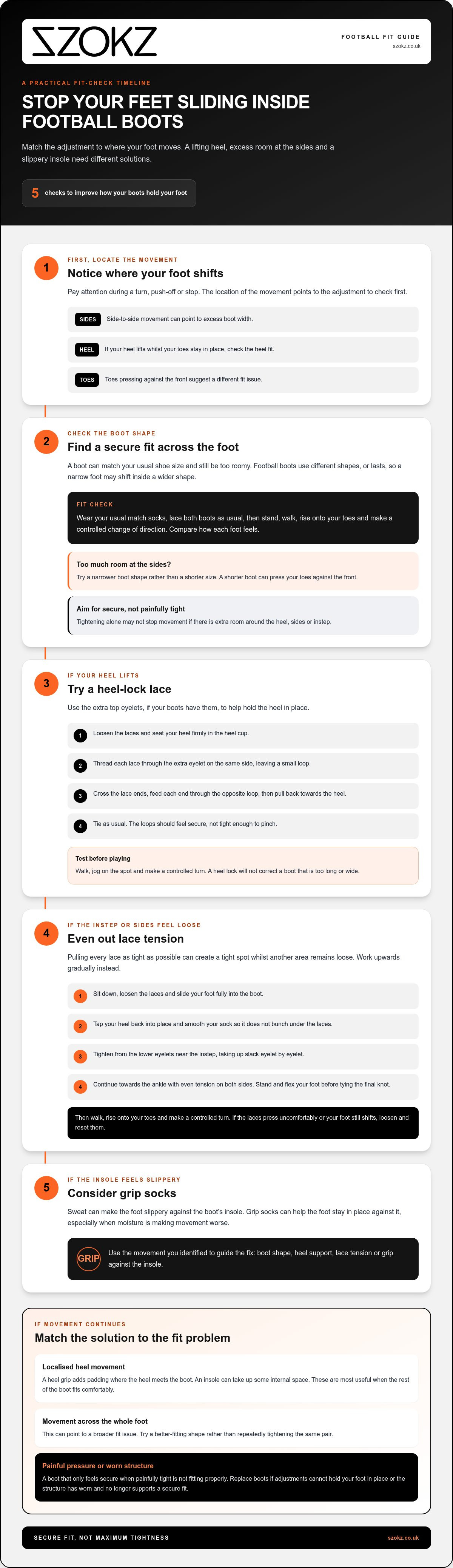
Five adjustments can help stop your feet moving inside football boots: choose a closer fit, try heel-lock lacing, even out lace tension, wear grip socks and manage sweat. If you’re working out how to stop feet sliding inside football boots, first identify where the movement happens. A lifting heel needs a different adjustment from a foot shifting across the sole.
It’s frustrating when your boots feel secure standing still but your feet move during turns, sprints or sudden stops. A snug fit matters, but tight lacing alone may not solve the problem if there’s extra room around the heel, sides or instep.
This guide covers five ways to improve the fit and reduce slipping, from checking boot shape to adjusting your lacing. You’ll also learn how sock grip and moisture affect the way your foot stays in place, so you can focus on the adjustment that matches the cause.
Key Takeaways
- Check whether excess room around the sides, instep or heel is letting your foot shift before changing your lacing.
- Use the extra top eyelets for a heel-lock lace to help hold your heel in place.
- Adjust lace tension eyelet by eyelet, starting near the instep, for a more even fit.
- Reduce rubbing and toe pressure by addressing movement inside the boot, not simply tightening the laces.
- Grip socks can help the foot stay in place against the boot’s insole, especially when sweat makes it slippery.
1. Football boots that are too wide
A boot can match your usual shoe size and still leave too much room. Football boots are built around different shapes, known as lasts. A narrow foot inside a wide last may shift at the sides or across the instep. That movement can feel like heel slippage, even when the heel fit is not the main problem. Notice where your foot moves during a turn, push-off or stop. Side-to-side movement points to excess width; toes pressing against the front suggest a different fit issue.
Check the boot shape before trying to correct the fit with tighter laces. Put on the football socks you wear for matches, then lace both boots as usual. Stand, walk, rise onto your toes and make a controlled change of direction. Your foot should feel held across the midfoot, without sliding to either side. If the boot feels roomy while standing, tightening the laces alone is unlikely to prevent movement during play.
Compare the fit on both feet, as one may sit differently from the other. Check whether the heel lifts, the instep has spare room or the sides feel loose. Then try a boot with a narrower shape rather than choosing a shorter size to compensate for width. A shorter boot can press your toes against the front, while a closer-fitting last may reduce excess room without squeezing them. Fit matters across the whole foot, not just at the toe.
Boots that are too loose can let your foot shift during sharp turns and sudden stops, increasing rubbing and making it harder to feel secure. Boots that are too tight can press your toes or instep and cause discomfort. Aim for a secure fit, not maximum tightness. If the laces press the upper painfully against your foot, loosen them and reassess the boot’s shape.
Replace football boots if fit adjustments cannot hold your foot in place, or if the boot’s structure has worn and no longer supports a secure fit. First check the lacing and try the boots with your usual match socks. If the movement persists, a better-fitting shape is more useful than repeatedly tightening the same pair. A boot that feels secure only when painfully tight is not fitting properly.
2. Heel slippage and heel-lock lacing
If your heel lifts while your toes stay in place, focus on the heel cup. A boot can feel secure across the forefoot yet still let the heel rise with each stride. Repeated movement can rub the back of your foot. First loosen the laces, seat your heel firmly in the heel cup, then lace the boot again. This makes it easier to assess whether the heel needs more support.
Many football boots have an extra eyelet near the top. Use it to make a heel lock, which draws the laces around the ankle opening to help hold the heel in place. Thread each lace through the extra eyelet on the same side, leaving a small loop. Cross the lace ends, feed each end through the opposite loop, then pull them back towards the heel. Tie the laces as usual. The loops should feel secure, not tight enough to pinch.
Test the result before playing a match. Walk, jog on the spot and make a controlled turn. If your heel still rises, loosen the knot and reseat your foot before trying again. A heel lock can help secure the heel, but it won’t correct a boot that is too long or wide.
Insoles and heel grips may help with specific fit problems. An insole can take up some internal space, while a heel grip adds padding where the heel meets the boot. They’re most useful when the movement is localised and the rest of the boot fits comfortably. Check that any added material lies flat and doesn’t push your foot forwards or crowd your toes.
Are football boot insoles or heel grips effective for preventing slipping? They can help when a small amount of extra space or heel movement is the cause. They’re less likely to solve movement across the whole foot, which suggests a broader fit issue.
Use this quick check after adjusting the laces or adding a heel grip:
- Keep your heel seated as you tighten the laces.
- Check for rubbing at the back of the heel.
- Make a controlled turn and notice whether your heel lifts.
- Remove any added padding that shifts your foot forward.
If your heel keeps lifting after these adjustments, the boot’s heel shape may not suit your foot. Trying a different fit is better than pulling the laces tighter, which can create pressure across the instep without securing the heel.
3. Lacing tension across the instep
Loose laces can leave extra room over the instep and sides of a football boot. That space lets your foot shift as you push off, turn or stop. Pulling every lace as tight as possible isn’t the answer: uneven pressure can create a tight spot while another area remains loose. Instead, adjust tension from the lower eyelets upwards, checking how the boot holds your foot at each point.
Sit down and loosen the laces before you begin. Slide your foot fully into the boot, then tap your heel back into place. Start near the instep and tighten each crossing eyelet by eyelet, spreading tension evenly along the laces. This helps you feel where support is needed, rather than pulling the top of the boot tight first. Tie the laces securely once the midfoot feels held without painful pressure.
- Settle your heel and smooth your sock so it doesn’t bunch under the laces.
- Tighten the lower eyelets near the instep first, taking up slack gradually.
- Continue towards the ankle, keeping the lace tension even on both sides.
- Stand and flex your foot before tying the final knot.
Test the adjustment with a short sequence: walk, rise onto your toes, then make a controlled turn. Notice whether your foot shifts across the insole or the laces press uncomfortably against the top of your foot. If movement remains, loosen and reset the laces. Pulling harder at the ankle won’t remove excess room around the instep.
Use the eyelets to tailor the pressure. If one crossing feels tight, ease that section slightly while keeping the neighbouring laces secure. A player with a high instep may need less tension over that area, while another may need more support across the midfoot. Aim for balanced contact, not laces pulled equally tight by force.
Recheck the fit after warming up. Your foot may settle inside the boot once you start moving, so pause and adjust if the laces feel loose. Keep the knot secure, with no long lace ends that could catch underfoot. A consistent lacing routine makes it easier to spot changes in fit from one session to the next.
A narrow foot in a football boot designed with a wide last may leave extra room around the instep and sides. If that describes your fit, assess how the boot holds your foot overall rather than assuming one tighter crossing will solve the problem. Check whether the space is concentrated over the instep, at the sides or in both areas. Adjust the laces gradually and notice where the pressure changes. The aim is to distinguish a local slack spot from a boot that feels roomy across the foot.
Keep the adjustment comfortable: adding tension across the instep should not cause painful pressure just to take up space at the sides. If you cannot get a secure, balanced feel without that trade-off, ease the laces and reassess how the boot sits on your foot. A narrow foot paired with a wide last can explain why the laces cannot hold every area evenly. Use that clue to guide your fit check, and judge the result by how the boot feels when you move.
4. Preventing blisters and sore toes
Rubbing usually appears at a specific contact point. Check your heel, little toe, big toe and the top of each toe after wearing your boots. A red or tender patch can point to a seam, a fold in your sock or pressure from the boot. Note the exact spot before changing anything. That detail helps you choose the right adjustment instead of tightening every lace.
Start with your sock. Pull it smoothly over your foot and check that the heel pocket sits on your heel. A twisted seam or bunched fabric near the toes can rub with every step. If the sock shifts inside the boot, try a closer-fitting pair that stays in place. Avoid adding a second pair just to fill space, as extra layers can crowd your toes.
Give your toes room to lie naturally. Put on your match socks, lace the boots, then stand and flex your toes. If the front presses against them, loosen the laces and reassess the fit. If your toes feel comfortable standing still but strike the front during movement, the boot may be too long or may not hold your foot securely. Don’t force a tight fit to solve that movement.
Look inside each boot before putting it on. Check for a folded insole, rough seam, trapped debris or a worn patch where your foot touches the lining. Smooth a displaced insole so it lies flat, and remove anything loose from the boot. Compare the left and right boots: if only one toe feels pressure, inspect that boot and sock for a local cause.
Use a short, controlled test before a match. Walk, jog gently and change direction, then pause to check for rubbing or toe pressure. If discomfort starts, stop and adjust your sock or lacing before continuing. A quick check can reveal a wrinkle or pressure point before a full session.
Use this sequence when a sore spot keeps returning:
- Identify the exact place that rubs or feels pressed.
- Check the sock for folds, seams or a slipping heel pocket.
- Inspect the boot lining and insole for uneven contact.
- Retest the fit with your usual football socks.
Repeated soreness in the same place calls for changing the cause, not just adding padding. A patch may reduce contact at one spot, but it won’t correct a boot that presses your toes or lets your foot slide. If the fit feels secure only when tightly laced, reassess the boot shape and internal space before returning to play.
5. Slippery socks and grip socks
A smooth sock can slide against a boot’s insole, especially during a sharp turn, push-off or sudden stop. Sweat can add to the movement by making your foot slippery inside the boot. If your boot feels secure but your foot shifts against the sole, check your socks as well as your lacing. Grip socks use anti-slip pads on the sole to grip the insole and help keep your foot in place.
Check how your socks fit before your next training session. The heel should sit over your heel, with no spare fabric bunching beneath your toes or arch. Make sure the grip pads sit against the boot’s insole, not folded under your foot. A breathable mesh structure on the instep can help absorb moisture and wick away sweat. This can help manage dampness, though it won’t correct a boot that’s too roomy.
How much do grip socks, insoles and heel grips cost in the UK? There isn’t one fixed cost for all three, as they’re different products. The price depends on which item suits the problem and the product you choose.
Wearing two pairs of socks may make a boot feel tighter, but it can also crowd your toes or create folds. Extra fabric can bunch beneath the arch or heel, adding friction instead of improving grip. Try your usual football socks first, then assess whether your foot still moves against the insole. A single, well-fitting pair is a better way to test the boot’s fit.
Use this check before play:
- Pull the sock smooth, especially around the heel and toes.
- Check that the sole’s grip pads meet the boot’s insole.
- Walk, turn and push off to notice where movement occurs.
- After play, air out damp socks and boots before wearing them again.
If your feet still slide with a snug-fitting sock, identify where the movement happens. A foot shifting against the insole may benefit from grip pads; a lifting heel may need a heel-fit adjustment. Don’t add extra socks to disguise a boot that presses your toes or feels loose across the whole foot. Match the solution to the cause.
Notice when your foot starts to move: a change of direction, push-off or sudden stop can reveal whether sweat contributes to slipping against the insole. Repeat the same movement for each check, so you can compare how the sock feels without changing several things at once.
If your foot slides during those actions, sweat inside the boot may be part of the problem. Keep this in mind when assessing grip and fit: the sensation alone doesn’t show that the boot is too loose. Notice when the movement occurs, and use that observation alongside your sock and insole checks.
SZOKZ: Grip Socks
SZOKZ Grip Socks are a practical option if your boots fit securely but your foot still shifts against the insole. Their grip-zone knit creates targeted traction at the ball and heel, helping to prevent movement inside the shoe. Choose grip socks to address movement between sock and boot, not to compensate for boots that are too wide or too tight.
SZOKZ also offers High Intensity Sport Socks and All Sport Ankle Socks for different sporting preferences. Choose according to the coverage and activity you want, then wear them with your football boots to assess the fit.
Visit szokz.co.uk to explore SZOKZ socks.
Make your next session feel more secure
Knowing how to stop your feet sliding inside football boots starts with noticing what changes when you move. Use your next training session to assess the fit, then adjust one thing at a time. This makes it easier to tell whether the cause is boot shape, lacing or contact between sock and insole.
If you want to address slipping with socks, SZOKZ offers Grip Socks, High Intensity Sport Socks and All Sport Ankle Socks. Choose the option that suits your activity and preferred coverage, then see how it feels in your boots. A well-matched setup can help you focus on your movement rather than distractions underfoot.
Choose the adjustment that suits your needs, then take that steadier feel into your next session.
Frequently Asked Questions
How should football boots fit to prevent feet sliding?
Football boots should hold your midfoot and heel while leaving your toes comfortable. Try both boots with your match socks, then stand and move as you would during play. Check whether either foot shifts when you push off or change direction. If one boot feels looser, assess each foot separately rather than assuming both need the same adjustment. A secure fit should not depend on painful lace pressure.
How to lace football boots to stop heel slippage?
Use the top eyelets for a heel-lock lacing pattern if your boots have them. After tying the laces, walk and make a controlled turn to see whether your heel stays seated. Pay attention to pressure around your ankle and instep: a firm hold should not cause pinching or numbness. If your heel still lifts, the boot’s heel shape may not suit your foot, even with adjusted laces.
Do grip socks help stop feet sliding inside football boots?
Yes, grip socks can help reduce movement between your foot and the boot’s insole. SZOKZ’s grip-zone knit creates targeted traction at the ball and heel. This may help if your boot fits well but your foot still shifts against the sole. Grip socks won’t correct a boot with the wrong shape or size, so treat them as one part of achieving a secure fit.
How can you prevent feet sliding in football boots when they get sweaty?
Choose socks that wick moisture away from your skin, and change out of damp socks after training. SZOKZ’s moisture-wicking fabric pulls sweat away from the skin. A breathable mesh structure over the instep can also help manage moisture. After a session, remove your boots and let them air out before wearing them again. Dry socks and boots reduce dampness that can make movement more noticeable.
Comments
No comments yet. Be the first to add one.