


The tightest sock isn’t automatically the best choice for a basketball game. Compression socks for basketball may suit players who prefer a close, supportive fit, but a stop-start game also calls for cushioning, moisture management and a secure feel inside your shoes. Compression, grip and cushioning are different features, and more pressure doesn’t automatically mean better support.
It’s reasonable to wonder whether compression makes a practical difference through repeated sprints, jumps and quick changes of direction. The answer depends on what you want from your socks: compression gives a close, pressured feel, while grip and cushioning address other preferences. A pair that feels restrictive or slips inside your shoe can distract from the game, whatever its specification.
This guide explains the realistic role of compression on court, how it compares with grip and cushioned performance socks, and what to consider when choosing pressure level, size, material and length. You’ll also learn how to assess fit without sacrificing comfort or movement, and where SZOKZ performance socks fit into the options. The aim is to help you choose a pair that suits your game and routine, rather than chase a bigger compression claim.
Key Takeaways
- Repeated jumps, sprints and stops put sustained demands on the lower legs. Know what socks can offer without treating them as injury protection.
- Understand how graduated compression works and why a stated mmHg level won’t feel the same to every player.
- Compare compression, grip and cushioning to identify which features match your priorities on court.
- Choose compression socks for basketball by following the product’s sizing chart, then assessing fit and comfort before playing.
- Explore how SZOKZ compression socks, grip socks and high-intensity sport socks offer different options for your game.
Why compression socks for basketball may suit the demands of the game
A basketball possession can move from a sprint to a sudden stop, a jump, a landing and a sharp change of direction in seconds. Then it happens again. The calves and lower legs help propel the body forward and upwards, steady the ankle as the foot meets the floor, and support quick adjustments across the court. They work through repeated bursts, not one steady movement.
Basketball compression socks are close-fitting socks that cover the foot and lower leg, applying pressure intended to provide support during play. They’re one clothing choice, not a substitute for a suitable warm-up, sound movement habits or recovery between sessions. They can’t remove injury risk, and wearing them doesn’t guarantee better performance.
What basketball asks of the lower legs
Picture a guard accelerating into space, braking to change direction, jumping for a rebound and landing ready to move again. The calf muscles help point the foot down to push off, while the ankle and lower-leg muscles help steady the foot and manage each landing. Repeated actions can leave the calves feeling tired over a game, particularly when the pace stays high.
That helps explain why some players look for a close, supportive feel around the lower leg. It doesn’t mean a sock can take over the muscles’ work or protect a player from every strain. Players differ in position, movement, training load and preferred fit, so the demands aren’t identical from one game to the next.
Compression socks versus ordinary basketball socks
The distinction starts with construction. Compression is pressure applied by the garment; the term alone doesn’t tell you how cushioned the foot feels or how securely the sock sits inside a particular shoe. For a general overview of compression stockings, including their types and uses, see the linked reference.
Other basketball socks may prioritise a cushioned sole, a familiar fit or coverage that works with a player’s footwear. Some compression socks also include cushioning, while some non-compression styles offer a snug fit. Features vary by product, so compare the details rather than assuming every sock in a category feels or performs the same way.
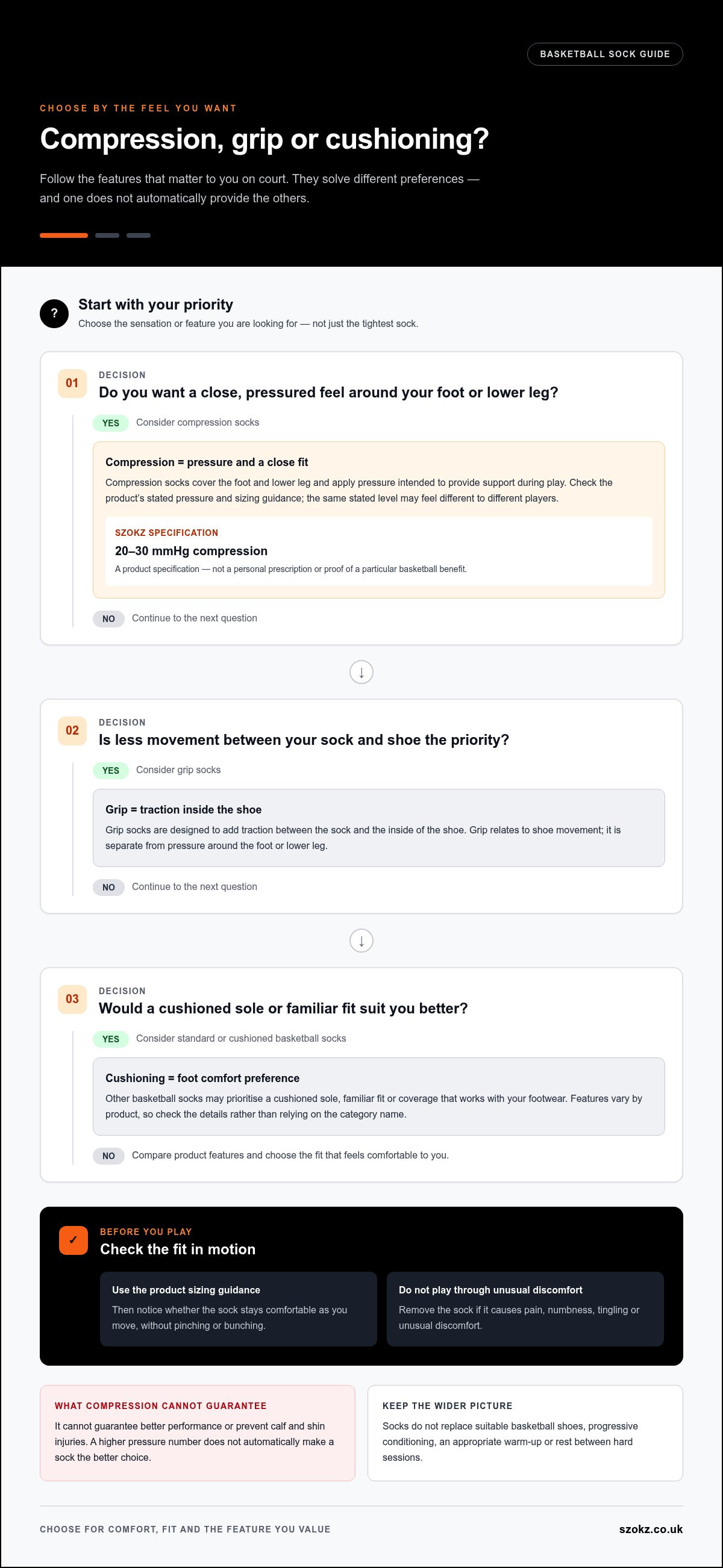
Grip is a separate feature. Grip socks are designed to add traction between the sock and the inside of the shoe; compression relates to pressure around the foot or lower leg. One doesn’t automatically provide the other. A player who wants less movement inside their shoe may value grip, while someone seeking a close, supportive feel may consider compression. Start with the sensation or feature that matters to you, then assess fit and comfort in motion.
How compression socks work, and what they can realistically do for basketball
Compression is a garment feature, not a performance result. When assessing compression socks for basketball, separate what the product is designed to provide from what you personally feel during training or a game. A stated pressure level describes a specification. It doesn’t prove that you’ll run faster, jump higher or recover sooner.
Many compression garments use graduated pressure. In plain English, they’re designed to feel tighter around the ankle and apply less pressure higher up the leg. Pressure is commonly measured in millimetres of mercury, written as mmHg. The number describes the garment, but it isn’t a direct rating of comfort, support or on-court benefit.
What a 20-30 mmHg label tells you
A 20-30 mmHg label indicates a pressure range. It doesn’t tell you whether the sock will feel comfortable inside your basketball shoes or suit your playing routine. Fit, garment construction and your own sensitivity to pressure all affect the experience. Two players can wear socks with the same stated level and describe the sensation differently.
SZOKZ compression socks offer 20-30 mmHg compression. Treat that as a product specification, not a personal prescription or proof of a particular basketball benefit. Read the product information and sizing guidance to understand the stated level and intended fit. A higher number doesn’t automatically make a sock the better choice for you.
Some players may prefer the close, held sensation of a compression garment during activity. Others may find it distracting, too restrictive or simply different from the feel they want in a game. Notice how it feels as you move, including whether the sock stays comfortable without pinching or bunching. Your experience matters, but it shouldn’t be mistaken for evidence that the sock has changed your speed, circulation or recovery.
What compression cannot guarantee on court
Compression socks can’t guarantee a performance improvement or prevent calf and shin injuries. They don’t replace basketball shoes that fit properly, progressive conditioning, an appropriate warm-up or rest between hard sessions. Those parts of preparation still matter, whatever socks you choose.
Think of compression as one optional part of your kit. If it feels comfortable and suits your routine, it may be a useful clothing choice. If it causes pain, numbness, tingling or unusual discomfort, take it off rather than trying to play through the sensation. A size or pressure level that feels wrong isn’t something you need to tolerate.
If you have a medical condition, ongoing leg symptoms or questions about whether compression is appropriate for you, seek guidance from a suitably qualified healthcare professional. A sports sock isn’t medical care. Once you know what you want from the fit, compare SZOKZ performance socks as part of choosing your on-court kit.
Compression, grip or standard basketball socks: compare the features
Choose a sock by the feature you want to feel, not by the category name alone. Compression, grip and cushioning address different preferences, and one pair may combine features. Use this comparison as a starting point, then check the construction and fit of the specific sock you’re considering.
| Feature | What it offers | What to consider for basketball |
|---|---|---|
| Compression | Applied pressure and a close-fitting feel around the foot or lower leg. | Consider it if you prefer that sensation. Check the stated specification and fit. |
| Grip | Grip elements intended to limit movement between sock and shoe. | Worth considering if your foot feels as though it shifts inside your footwear. |
| Cushioning | Extra padding in selected areas of the sock. | Choose according to comfort and your preferred underfoot feel, not as injury protection. |
| Coverage | Different lengths cover different amounts of the foot and lower leg. | Match the length to your kit, preference and how the sock sits in your shoe. |
| Intended use | May focus on pressure, traction, cushioning or a combination. | Read the product details: categories and features can overlap, but aren’t interchangeable. |
When compression is the feature to prioritise
Compression socks for basketball may suit players who like a close, held sensation around the lower leg during training or games. That preference is personal, not a requirement for playing well. Consider how the sock feels through a warm-up and while moving. If the pressure distracts you or makes you uncomfortable, another feature may be a better priority.
When grip or cushioning may matter more
Grip elements are designed to reduce movement between the sock and shoe. They don’t apply the same pressure as compression, so assess traction separately. For a closer look at how grip features are designed to support stability, see this sports grip socks guide.
Cushioning is about comfort and underfoot feel. Some players prefer more padding; others want a closer feel inside the shoe. Neither choice guarantees protection from impact or injury. Coverage matters too: a lower-cut sock covers less of the lower leg than a longer style. SZOKZ All Sport Ankle Socks are an option if you prefer a lower-cut style.
Whatever the feature, the sock must work with your basketball shoes. Try it with the footwear you play in. Check for bunching, slipping, tight spots or a crowded feel around the toes. A sock that feels good on its own may feel different once your foot is moving inside the shoe, so judge the full combination during practice before relying on it for a game.
How to choose and wear compression socks for basketball
Choosing compression socks for basketball is easier when you separate the decision into features, size and feel. A sock can have the right pressure specification on paper and still be uncomfortable in your shoes. Use this sequence to narrow down your options, then test the fit in motion before wearing a new pair for a full game.
- Identify the feature you want. Decide whether you’re looking for a close, supportive feel, grip inside your shoe or another feature. Compression and grip suit different preferences, so don’t assume one provides the other.
- Use the sock’s own size chart. Follow the measurements and instructions for that specific product. Shoe size alone may not capture the measurements used by a compression sock’s sizing system.
- Put the sock on smoothly. Arrange the fabric so it lies flat, without folds or twisted areas. Check that your foot and leg feel held rather than pinched.
- Test it in your basketball shoes. Walk, jog and move through a warm-up. Notice whether the sock slips, bunches, creates uncomfortable pressure or makes your footwear feel restrictive.
Sizing and fit checks before playing
Sizing methods can vary between products. One sock’s size label won’t necessarily match another’s, so check the relevant chart instead of guessing from your usual shoe size. A smooth fit should stay in place as you move, without folds that distract you or tight spots that feel uncomfortable. Try the socks during a warm-up or training session first; that gives you a chance to assess the feel before relying on them for a full game.
A comfortable, secure fit lies smoothly, stays in place, feels supportive without pinching, and lets you move freely in your shoes.
Care and comfort across training sessions
Follow the care label. Washing and drying instructions can help maintain the garment’s fit and fabric performance over repeated sessions. Before putting socks on, check for stretched areas, thinning fabric or damage. If the pair includes grip elements, look for signs that they’re worn or coming away. Changes in condition can affect how the sock feels and sits in your shoe.
Comfort should remain the test. If a sock causes persistent discomfort, stop wearing it and reassess the size or style rather than trying to push through. Remove it if it causes pain, numbness or tingling. For symptoms that concern you, or questions about wearing compression with a medical condition, seek appropriate healthcare advice.
Use the same checks whenever you try a different pair. A change in sock thickness or construction can alter the feel inside your basketball shoes, even if the size seems familiar. Test the complete combination in training before taking it into a game.
Explore SZOKZ compression and performance socks for basketball
The practical choice comes down to what you want from your socks. Start with the feature: a close compression feel, grip inside your shoe, or general sport-sock construction. Then check the product details, sizing guidance and comfort in your basketball shoes. No one feature is essential for every player, and a sock’s stated specification can’t promise a particular result on court.
SZOKZ offers compression socks, grip socks and high-intensity sport socks. These categories address different priorities. Compression socks provide a compression-focused option; grip socks are for players looking for traction between sock and shoe; high-intensity sport socks offer another performance-sock category to consider. Compare what each product is designed to do, rather than treating the categories as interchangeable.
Match sock features to your playing priorities
If you prefer a close, supportive sensation around your lower leg, compression may be the feature to explore. SZOKZ compression socks offer 20-30 mmHg compression. That figure is a product specification, not a comfort score or a promise of improved basketball performance. Read the product information and sizing instructions, then judge the feel for yourself.
If your priority is reducing movement between your sock and shoe, consider grip socks. If you want a sport-focused option without making compression or grip your main requirement, look at high-intensity sport socks. Your playing routine matters too. A sock that feels comfortable during a short warm-up may feel different over a longer training session, so assess it in the setting where you plan to wear it.
Try the socks with your basketball shoes. Look for a smooth fit that stays in place and doesn’t bunch, pinch or make the shoe feel tight. The right choice is the one whose features suit your preference and whose fit remains comfortable as you move. Compression socks for basketball are one option, not a requirement or a substitute for a comfortable fit.
Choose your next pair
SZOKZ socks are worn by Team GB and Olympic athletes. That is useful brand context, not a guarantee that a particular pair will deliver the same experience for every player or an endorsement for basketball specifically. Let your own fit and playing needs guide your choice.
Compare the compression, grip and high-intensity sport sock options, then use the product information to decide which features best match your routine.
Make your next sock choice a considered one
Use your next training session to learn what feels right for your game. Choose one feature to focus on, then notice whether it helps you feel comfortable and settled in your usual basketball routine. Keep the rest of your kit consistent so you can judge the sock on its own, rather than changing several things at once.
That simple approach can make choosing compression socks for basketball more personal and less dependent on broad performance claims. Your preferred fit may change with the shoes you wear, the length of a session or the feel you want on court. There’s no need to force a feature that doesn’t suit you. Comfort and confidence in your kit are useful guides for your next choice.
Explore the SZOKZ sock range and choose the pair whose features and fit suit your basketball routine.
Frequently Asked Questions
Are compression socks good for basketball?
They can suit players who find a close, supportive feel comfortable during play, but they aren’t essential for basketball. Try them during a training session that includes your usual movements, rather than judging them while standing still. If you notice distraction, pressure or discomfort once the pace picks up, another sock construction may suit you better. The best choice is personal and depends on how the sock feels in your footwear.
Do compression socks help basketball players recover?
They may be part of a player’s post-session routine if wearing them feels comfortable, but don’t rely on socks alone to speed recovery. Recovery also involves allowing enough rest between demanding sessions and keeping up with your usual nutrition and hydration habits. If you finish a game with persistent pain or unusual swelling, don’t use compression to mask the symptom. Seek appropriate healthcare advice instead.
Can you wear compression socks during a basketball game?
Yes, you can wear them during a game if they’re designed for activity and feel comfortable as you move. First try them in practice, ideally during drills that involve quick starts, stops and changes of direction. Check how they feel after your warm-up and during play, not just when you first put them on. Stop if you experience pain, numbness or tingling, and reassess the fit before wearing them again.
What compression level should I choose for basketball socks?
There isn’t one level that suits every basketball player. Athletic compression socks commonly state a pressure range in mmHg, and 15-20 mmHg is often cited for sport, but that doesn’t make it a universal recommendation. Read the specific sock’s product information and sizing guidance. If you have a health condition, take medication that affects circulation or are unsure which level is appropriate, ask a healthcare professional before use.
Should basketball compression socks feel tight?
They should feel close-fitting, not painfully tight. You shouldn’t need to tolerate pinching, numbness, tingling or a pressure point that worsens as you move. Check that the fabric lies flat and that the sock doesn’t create a restrictive sensation in your shoe. If discomfort continues after adjusting the fit, take the socks off. Persistent or concerning symptoms need medical advice rather than a change in sock size alone.
Are grip socks or compression socks better for basketball?
Neither is automatically better; choose by the issue you want to address. Grip socks are intended to limit movement between the sock and shoe, while compression socks focus on a close, pressured feel. If your foot shifts inside your shoe, grip may be the feature to investigate. If you prefer a held sensation around your lower leg, compression may appeal. Try each option with your basketball shoes to compare comfort.
Can compression socks prevent calf injuries in basketball?
No. Compression socks can’t guarantee prevention of calf injuries, and they shouldn’t be treated as protective equipment. They don’t replace building up training loads sensibly, warming up or responding to pain. If your calf feels strained, don’t use a sock to keep playing through it. Rest from aggravating activity and seek clinical advice if pain is severe, persistent or affects your ability to walk normally.
Comments
No comments yet. Be the first to add one.