


More padding does not automatically make a training sock more comfortable. Cushioned training ankle socks can soften contact during high-impact sessions, but extra thickness may crowd a close-fitting shoe or feel less stable during lifting. The right amount depends on your activity, footwear and preferred feel, not thickness alone.
If your socks bunch, slip or leave your feet feeling too warm, fit and fabric may be as important as padding. A good pair should feel secure without adding distracting bulk during your session.
This guide explains how to compare cushioning, fit and fabric for your training and shoes. You’ll learn when targeted padding may feel useful, how to check for a snug but comfortable fit, and which details can help you assess a pair. The aim is to make a practical choice based on your needs, not broad performance claims.
Key Takeaways
- Compare where the padding sits and how the sock fits inside your training shoes, not thickness alone.
- Use the fabric blend as a guide to stretch, feel and moisture management.
- Match cushioned training ankle socks to your session, whether it involves repeated impact, lateral movement or strength work.
- Use a simple checklist covering activity, shoe fit, padding, fabric and cuff before choosing a pair.
- Explore SZOKZ All Sport Ankle Socks and High Intensity Sport Socks as options for different training needs.
Cushioned training ankle socks: what cushioning does during a workout
Cushioning is padding in a sock that softens contact between your foot and shoe. Its effect depends on where the padding sits, how securely the sock fits and how much room your footwear has. Padding at the heel or forefoot feels different from uniform thickness across the sole. The same sock may also feel snug in one pair of trainers and restrictive in another.
A sock forms a layer between your foot and footwear, helping absorb perspiration and protect the skin. Cushioning adds padding to that layer, but it is only one part of how a sock feels in motion.
What does cushioning change inside a training shoe?
During repeated steps, jumps or changes of direction, padding can soften the sensation of contact in areas such as the heel and forefoot. Placement matters: targeted padding leaves other parts of the sock less bulky, while broader cushioning creates a more uniformly padded feel.
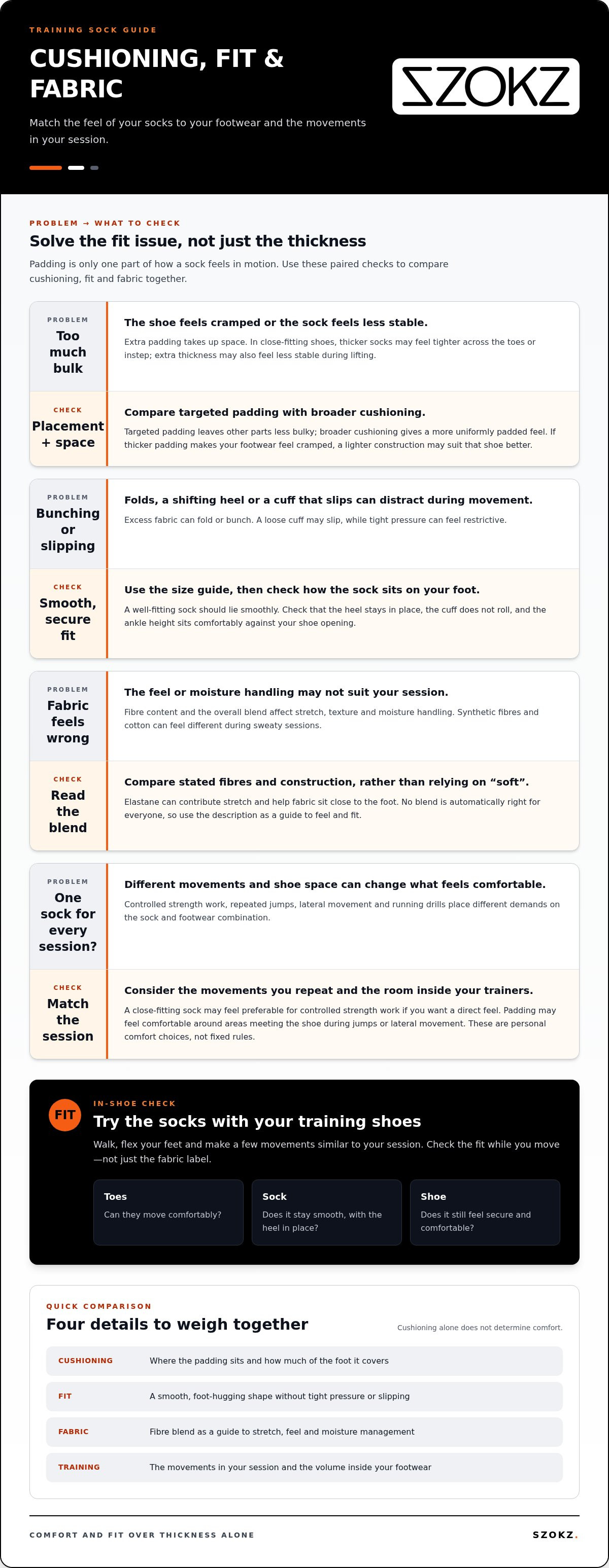
Cushioned training socks have added padding between the foot and shoe to soften contact during movement. That extra material also takes up space. If your shoes already fit closely, thicker socks may make them feel tighter across the toes or instep. A sock that shifts or folds can become uncomfortable, so assess how your whole foot sits inside the shoe.
Is more cushioning always better for training?
No. A thinner sock can preserve a closer, more direct feel inside a fitted shoe. More padding may feel softer, but it can reduce the space available in the shoe. Neither option suits every workout or every wearer. Consider your footwear, the movements you repeat and what feels comfortable during a session.
Cushioning is not the same as compression or grip. Cushioning means padding; compression describes a closer, supportive fit around parts of the foot or ankle. Grip features are designed to increase traction between the sock and shoe. One feature does not automatically provide the function of another. Cushioning is not a medical feature and does not guarantee protection from soreness or injury.
For a practical comparison, try the socks with the shoes you plan to train in. Check that your toes can move comfortably, the sock stays smooth and the shoe still feels secure. If thicker padding makes the footwear feel cramped, a lighter construction may suit that shoe better. If the fit remains comfortable, you may prefer the softer feel. Let comfort and fit guide your choice of cushioned training ankle socks rather than choosing by thickness alone.
How to compare cushioning, fit and fabric in training ankle socks
Compare cushioning, fabric and fit as a system. Padding changes the space inside your shoe, the fabric affects stretch and feel, and the ankle cuff needs to sit comfortably beneath the shoe opening. Use the product description to understand the construction, then assess comfort in the footwear you’ll train in.
| Feature | What to compare | Useful question |
|---|---|---|
| Cushioning | Padding placement and coverage | Is padding targeted or spread across more of the foot? |
| Fit | Size guidance, foot-hugging shape and cuff | Does the sock stay smooth without tight pressure? |
| Fabric | Fibre blend and stated fabric properties | What do the fibres suggest about stretch, feel and moisture management? |
| Training conditions | Workout movement and shoe volume | Will the sock suit your footwear and the session you have in mind? |
Which features matter most in cushioned training socks?
Look for a clear description of where padding sits and how much of the foot it covers. Construction varies, so do not assume every padded sock feels the same. Fibre content is another useful detail: elastane can contribute stretch and help fabric sit close to the foot, while the overall blend affects texture and moisture handling. Synthetic fibres and cotton can feel different during sweaty sessions, but no blend is automatically right for everyone. Treat descriptions such as “soft” as subjective, and compare the stated fibre content and construction.
Assess fit and padding together. The right amount of cushioning feels comfortable without compromising the sock’s position or your shoe fit.
How should training ankle socks fit?
Start with the brand’s size guide and match it to your measurements. A well-fitting sock should lie smoothly over your foot. Excess fabric can fold or bunch, tight pressure can feel restrictive, and a loose cuff may slip during movement. Ankle height is a matter of preference, so check where the cuff sits against your shoe opening and whether it gives you the coverage you want.
Try the socks with your training shoes. Walk, flex your feet and make a few movements similar to those in your session. Notice whether the heel stays in place, the cuff rolls or the shoe feels tighter than usual. This gives you more useful information than a fabric label alone. To compare SZOKZ socks for different training needs, browse the sock range.
Match cushioned ankle socks to your training and footwear
The right amount of cushioning depends on the movements you repeat and the room inside your trainers. A gym circuit with jumps and side steps places different demands on a sock from a controlled strength session. Running drills involve repeated foot strikes, so you may prefer a softer feel, provided the shoe still fits comfortably. These are personal comfort choices, not fixed rules for each sport.
What cushioning suits different training sessions?
Consider the movements in your session, not just its name. During a short strength workout with controlled movements, a close-fitting sock may feel preferable if you want a direct connection to the floor. In circuits with repeated jumps or lateral movement, padding may feel comfortable around the areas that meet the shoe. For running drills, consider how repeated impact feels and whether extra sock bulk changes the fit of your trainers. No single cushioning level is best for everyone.
| Training context | Shoe feel | Features worth prioritising |
|---|---|---|
| Gym circuit with jumps and side steps | Secure, with room for movement | Smooth fit that stays in place; padding that feels comfortable during repeated movement |
| Controlled strength session | Close-fitting or firm | A less bulky feel if extra thickness makes the shoe feel crowded |
| Running drills | Snug, with comfortable toe space | Consistent fit and cushioning that remains comfortable through repeated foot strikes |
How can you check cushioning works with your trainers?
Put on the socks with the trainers you plan to use. Check that your foot feels secure, without excess pressure across the toes or instep. Sock bulk can change the feel of a close-fitting shoe, even if the sock feels comfortable on its own.
Walk, jog lightly, bend your knees and try movements from your usual session. Notice whether the sock shifts, folds or feels restrictive. Test it during a familiar, shorter workout before relying on it for a longer session. The sports ankle socks guide offers more pointers on choosing a pair for training.
A practical checklist for choosing cushioned training ankle socks
Compare pairs against your training routine, not just broad claims on a product page. Useful details include fabric composition, size guidance, sock height and construction. Words such as “advanced” or “high performance” are harder to assess unless they come with practical information about the sock.
What should you check before choosing a pair?
Start with the sessions and shoes you wear most often, then work through these points:
- 1. Identify your activity. Consider the movements you repeat, such as lifting, lateral steps or running drills.
- 2. Check your shoe fit. Think about how much room your trainers have, especially across the toes and instep.
- 3. Compare the padding. Look for information about its placement and coverage. Be cautious of claims that do not explain the construction.
- 4. Review the fabric. Check the stated fibre blend and any clear details about stretch or moisture management. Softness is subjective, so descriptions alone cannot tell you exactly how a sock will feel.
- 5. Assess the cuff. Compare the ankle height with your shoe opening and check the size guide against your measurements.
Separate functional details from promises. A clear size guide or material list gives you something concrete to compare. General claims about comfort or performance cannot guarantee the same experience for every wearer. Also distinguish padding from compression: cushioning means padding between foot and shoe, while compression describes a close, supportive fit. Keep that difference in mind when comparing sock descriptions.
How can you assess comfort after training?
After a session, notice how the socks behaved. Did they stay in place? Was there bunching, a distracting seam or pressure that felt too tight? This is a simple comfort check, not a clinical test. One workout can offer useful clues, but footwear, movement and session length all affect how a sock feels.
Use what you notice to guide your next choice. If the cuff slipped, reconsider the fit or height. If your shoes felt crowded, look for a less bulky option. If the socks stayed secure and did not distract you, that is useful feedback too. Consider the conditions rather than assuming one session predicts every future workout. A careful checklist helps you choose cushioned training ankle socks using practical details instead of vague claims.
Choose SZOKZ training and ankle socks for your next session
Your choice comes down to how cushioning, fit and fabric work with your workout and trainers. Use the checks in this guide to decide what feels comfortable in your footwear, then compare the product details rather than relying on broad performance language. This matters with cushioned training ankle socks because extra padding can affect how much room your shoes have.
Which SZOKZ sock category should you explore?
If ankle height is your priority, start with SZOKZ All Sport Ankle Socks. They are the relevant category to explore if you want an ankle-height sport sock. If you are choosing by training focus, consider High Intensity Sport Socks as an option for high-intensity sport.
SZOKZ designs and sells high-performance grip and compression socks for athletes and everyday wear. The brand’s socks are worn by Team GB and Olympic athletes, which gives context to the range, but does not tell you how a particular sock will fit or feel in your trainers. Use product details alongside your own priorities, and do not assume a cushioning level that is not stated.
What is the next step in choosing your pair?
Think about the session you do most often, the trainers you wear for it and whether you prefer a close or softer feel. Compare the available details for each category, including sock height, materials, sizing guidance and any stated construction information. Check that the fit works with your shoes and the cuff sits comfortably where you want it.
This approach keeps the focus on practical fit rather than treating one sock as the right answer for every workout. Explore the categories that match your needs and use the product information to narrow your choice.
Choose socks that fit your next session
The right pair should work with your training and footwear, not simply feel thick in your hand. Choose cushioned training ankle socks by weighing padding alongside a secure fit and fabric that suits your preferences. Consider whether repeated impact calls for a softer feel or whether a closer fit matters more in your trainers. Product details help you compare, while your movement and shoe fit should guide your final choice.
SZOKZ offers All Sport Ankle Socks for those seeking an ankle-height sport sock, alongside High Intensity Sport Socks for high-intensity training. The range is designed with comfort in mind, and SZOKZ socks are worn by Team GB and Olympic athletes. Use the product details to find a pair that aligns with your session and preferred feel.
Choose with your workout, footwear and comfort in mind, then focus on the session ahead.
Frequently Asked Questions
Are cushioned training ankle socks good for gym workouts?
They can suit gym workouts if the padding feels comfortable and does not crowd your trainers. For circuits involving jumps or side steps, you may prefer a softer feel underfoot. During strength exercises, a closer, less bulky fit may feel more suitable. Try the socks with your training shoes and check that they stay smooth and secure as you move. Comfort depends on your footwear, session and personal preference.
How much cushioning should training ankle socks have?
Choose enough cushioning to feel comfortable without making your shoes feel cramped. There is no single thickness that suits every workout. Padding placement matters too: targeted padding can feel different from cushioning spread across more of the foot. Consider your session, the room in your trainers and the feel you prefer. If product details do not specify padding, do not assume a particular cushioning level from general performance claims.
Can cushioned socks make training shoes feel too tight?
Yes. Added fabric takes up space, which may make a close-fitting trainer feel tighter, particularly across the toes or instep. Try the socks with the shoes you plan to train in, then walk, bend and move as you would during a session. Your foot should feel secure without uncomfortable pressure. If the fit feels crowded, a less bulky sock may work better with those trainers.
What is the difference between cushioned and compression ankle socks?
Cushioned socks have padding between your foot and shoe to soften contact. Compression socks use a closer, supportive fit around the foot or ankle. These describe different features: padding does not automatically mean a sock is compressive, and compression does not tell you how much cushioning it has. Read product descriptions for specific construction details rather than treating the terms as interchangeable. Choose according to the feel and function you want.
Do cushioned training socks help prevent blisters?
Cushioning may change how your foot feels against the shoe, but it cannot guarantee that blisters will be prevented. Fit also matters: excess fabric can bunch and rub, while a shoe that feels too tight may create pressure. Keep socks smooth inside your footwear and notice whether they shift during movement. If rubbing occurs, consider how the sock and shoe fit together rather than relying on padding alone.
Can you wear cushioned ankle socks for running as well as gym training?
Yes, you can wear cushioned ankle socks for both, provided they feel comfortable and fit the footwear for each activity. Running involves repeated foot strikes, while gym sessions may include lifting, jumping or lateral movement. Those differences can affect your cushioning preference. Test the socks during normal movement in the relevant shoes before wearing them for a longer session. A comfortable choice for one pair of trainers may feel different in another.
Comments
No comments yet. Be the first to add one.