


Could the most cushioned sock be the wrong choice for your half marathon? A pair that feels comfortable at home may rub, bunch or slip once you’ve been running for miles. With half marathon running socks, a secure fit and comfort tested in training matter more than a long list of features.
If you’re unsure whether to prioritise cushioning, grip or compression, start with how the socks fit your feet and feel inside your shoes, not just what the label promises. A new pair should earn its place in training before race day.
This guide compares features that can make a practical difference, explains how to assess grip and compression, and shows you how to test a pair before the event. SZOKZ’s grip socks and high-intensity sport socks are options to consider, but your fit and comfort should lead the decision.
Key Takeaways
- Choose half marathon running socks by how they fit your feet and work with your footwear, not by features alone.
- Check heel placement, toe room and fabric for bunching. Treat cushioning as a personal comfort preference.
- Compare standard sport socks, grip socks and compression socks by their feel and intended function.
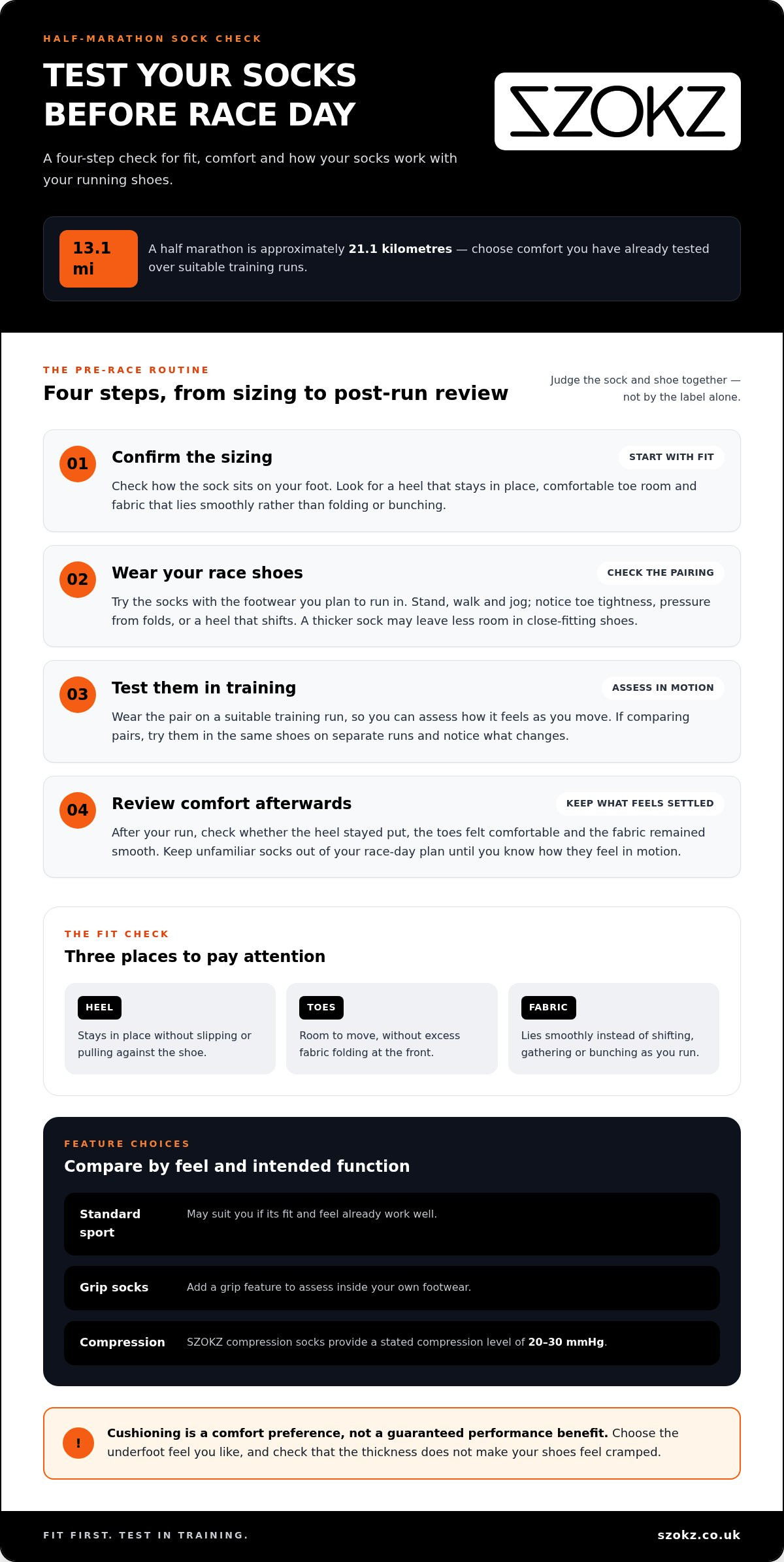
- Use a four-step check: confirm sizing, wear your race shoes, test the socks in training and review comfort afterwards.
- Match your priorities to SZOKZ grip socks or high-intensity sport socks. SZOKZ compression socks provide 20-30 mmHg compression.
Half marathon running socks: what matters over 13.1 miles?
A half marathon covers 13.1 miles, or approximately 21.1 kilometres. That’s long enough for small differences in how your kit feels to matter, but it doesn’t mean you need a technically complex sock. Choose a pair for sustained comfort, based on how it fits your foot and works with your shoes.
For a general overview of the half marathon, including its distance and history, see Wikipedia. For your sock choice, start with what you’ve noticed on your training runs. A feature is useful if it addresses a preference or a problem you’ve experienced. Extra cushioning, a particular height or a close-fitting feel won’t suit every runner.
Everyday running socks are chosen for regular runs; half marathon running socks should be chosen for comfort you’ve already tested over longer distances. That distinction matters more than a label. Keep familiar kit in your race plan where possible, and don’t rely on a new pair until you know how it feels in motion.
Why sock comfort matters across the distance
A seam, fold or slightly loose heel may seem insignificant when you first put a sock on. Repeated foot movement during a prolonged run can make that sensation more noticeable. The same goes for a cuff that feels too tight or fabric that gathers inside your shoe. Treat these as cues to assess your fit, rather than assuming every runner will have the same experience.
Use training runs to find out what feels steady and unobtrusive. Changing socks on race day can introduce an unfamiliar sensation when you haven’t had a chance to assess it. Choose a pair you’ve worn on suitable training runs and know how it feels with your race footwear.
Which runner needs which features?
Before looking for new features, think about your current socks. Notice where they feel loose, tight or uncomfortable, then consider whether the issue might come from the sock, the shoe or the way the two fit together. Aim for a combination that feels settled, rather than collecting features because they appear in a product description.
- Shoe fit: If your shoes feel close around the toes, consider how a thicker sock might reduce the available room.
- Sock height: Choose a height you find comfortable with your footwear and running kit. One length won’t suit everyone.
- Underfoot feel: Decide whether you prefer more cushioning or a closer feel underfoot. This is a comfort preference, not a guaranteed performance benefit.
- Fit through the foot: Notice whether your current socks stay in place or shift, wrinkle or feel restrictive as you run.
These observations give you a practical starting point. Prioritise a fit issue you’ve actually experienced, then judge any additional feature in your own shoes during training.
How fit, cushioning and fabric affect half marathon running socks
A sock may feel comfortable when you put it on, then behave differently once your foot is moving inside a running shoe. Fit depends on the sock and shoe working together. Check them as a combination, rather than judging a pair by its size label or product description alone.
Check the heel, toes and fabric movement. These details help show whether a sock sits smoothly inside your shoe. The heel should stay in place without slipping or pulling against the shoe. Your toes need room to move without excess fabric folding beneath them. Across the foot, the material should lie flat rather than gathering as you run.
Check sock fit inside your running shoes
Try the socks with the shoes you plan to wear for the half marathon. Stand, walk and jog in them. Check for tightness around the toes, pressure from folds or a heel that shifts. A sock may feel fine when you’re standing but move once you run, so assess it during training and after taking your shoes off.
If you’re unsure, compare pairs in the same shoes on separate runs. Start with your usual socks, then try the alternative. Notice whether the heel stays put, the toe area feels crowded or the fabric remains smooth. This is a more useful comparison than a quick try-on alone.
Choose cushioning and fabric feel to suit you
Cushioning changes how much material sits between your foot and the shoe. More padding may feel comfortable to one runner, while another may prefer a closer connection underfoot. Either way, check that the thickness doesn’t make your footwear feel cramped. Cushioning is a matter of fit and feel, not a guaranteed performance benefit.
Fabric descriptions can help you compare options, but focus on what the product label states. Look for named fibres and any stated moisture-management details, then consider whether they match what you want from a sock. Check the care instructions so you know how to wash the pair. Don’t assume all sport socks use the same construction or fabric blend.
- Heel: Check that it stays in place without pulling.
- Toes: Look for comfortable room, without loose fabric folding at the front.
- Fabric: Notice whether it stays smooth or shifts and bunches as you move.
Make your decision after a training run, not just from a fitting-room feel. If you’re comparing options, explore SZOKZ sport socks and assess how their fit and feel work with your running shoes.
Grip and compression socks for a half marathon: compare the trade-offs
Extra features can change how a sock feels, but they won’t make it the right choice for every runner. Standard sport socks, grip socks and compression socks have different features to consider. A standard sport sock may suit you if its fit and feel already work well. Grip socks add a grip feature to assess inside your footwear. Compression socks provide a stated level of pressure. Let your preferences, shoe fit and training experience guide your choice.
- Standard sport socks: Consider these if you prefer a straightforward option and are comfortable with your current sock-and-shoe combination.
- Grip socks: Try them if you want to assess a grip feature inside your footwear. Judge how it feels during a run.
- Compression socks: Compare the stated compression level and sizing guidance with your comfort preferences. The specification alone doesn’t promise a particular result.
When might a runner prefer grip socks?
Grip may appeal if you notice your foot moving inside your shoe and want to see whether a grip sock feels more secure. The experience depends on the sock and footwear together, so the sensation may vary between shoes. Try the combination in training and decide whether it suits you.
Grip is one part of sock design, not a replacement for a comfortable shoe fit. For more on how grip socks are designed, read this sports grip socks guide. Then assess the socks in your own running shoes.
What to know about compression socks
Compression describes pressure applied by the sock, with its level expressed in millimetres of mercury, or mmHg. SZOKZ compression socks provide 20-30 mmHg compression. This is a product specification, not a promise of medical benefits or improved race performance.
Consider fit as well as the stated level. Follow the product’s sizing guidance and assess whether the sock feels comfortable rather than restrictive. If you’re comparing compression with a standard sport sock, try the difference during training instead of choosing by the number alone.
Keep the decision practical. If your current socks feel secure and comfortable in your running shoes, a special feature may not add value for you. If you’re curious about grip or compression, test one change at a time. That makes it easier to identify what you prefer and whether the feature feels right over a longer run. The best half marathon running socks for you are the ones that suit your needs in practice, not simply the ones with the most technical claims.
How to test half marathon running socks before race day
A product label can describe a sock’s features, but a training run shows how it feels in your footwear. Give any new pair a proper trial before race day. This gives you time to spot fit issues and distractions and choose another option if needed.
Race-day socks should feel familiar because you’ve tested them in training, not just because they seemed comfortable during a quick try-on. Wear them with the shoes you plan to use for the event. Changing either part of the combination can affect how it feels.
A simple training-run sock test
Follow these four steps and note your impressions soon after the run, while the details are fresh. If anything feels uncomfortable, adjust your choice and test the revised combination during another suitable training run before relying on it for race day.
- Check sizing. Follow the product’s sizing guidance and put the socks on as you intend to wear them. Check that the heel sits in place and the fabric lies smoothly, without an uncomfortable tight feel or loose folds.
- Wear them with your race shoes. Lace up your intended footwear and stand, walk and jog briefly. Notice whether the sock feels comfortable inside the shoe, particularly around the heel and toes.
- Test during training. Choose a suitable run and wear the full sock-and-shoe combination. Pay attention to slipping, bunching or pressure points as you move. Don’t make race day the first proper test.
- Review comfort afterwards. Note where the sock shifted or felt uncomfortable, and whether its feel changed during the run. Use those observations to decide whether to keep the pair or test another option.
Race-week checks without last-minute surprises
In race week, choose a pair you’ve already worn successfully in training. Follow its care instructions, then make sure it’s clean and dry before setting it aside with your kit. Avoid introducing an untested pair or changing several pieces of clothing and footwear at once. Keeping your kit familiar makes it easier to identify what needs attention if something feels different.
Keep your notes simple: sock pair, shoes, run and any changes in comfort. If you noticed slipping later in the run, record that. If the fit stayed consistent, note that too. Your record doesn’t need to be technical. It helps you make a considered choice based on your experience, rather than a feature claim alone.
There’s no need to keep testing a sock that causes persistent discomfort. Set it aside and use a suitable training run to assess an alternative, leaving enough time to settle on a pair you trust. A little preparation makes race-week decisions more straightforward.
Choose SZOKZ socks for your half-marathon preferences
Start with your own priorities, not a feature checklist. SZOKZ offers grip socks and high-intensity sport socks, giving you distinct categories to compare with your preferences. Use the stated product information and sizing guidance to narrow your options, then assess fit and feel with your running shoes during training.
Match the sock category to your priorities
If you want to explore a grip option, start with SZOKZ grip socks. Consider whether you like the feel of grip socks in your footwear and assess the combination for yourself. Grip is a feature to consider, not a guarantee that every runner will prefer the sensation.
If you’re looking for a sport-sock option, consider SZOKZ high-intensity sport socks. The category can help you identify a relevant option, but your decision should still come down to the product details and how the socks feel when you run. Don’t assume features such as cushioning, fabric composition or a particular fit unless they’re stated in the product information.
SZOKZ compression socks provide 20-30 mmHg compression. Treat this as a specification, not a promise of medical benefits or a particular race-day result. If you’re considering compression, read the sizing guidance and assess comfort rather than relying on the number alone.
SZOKZ says its socks are worn by Team GB and Olympic athletes. This provides brand context, but doesn’t determine which sock is right for your half marathon. Your footwear, fit preferences and training experience are more useful points of comparison.
Make a considered choice and browse the range
Keep your decision order simple: fit first, tested comfort next, then features that match a preference you actually have. If you’re interested in grip, compare that option with your usual sock-and-shoe combination. If you’re considering high-intensity sport socks, review the product information and sizing details. For either option, test the pair during training before choosing it for race day.
This keeps your choice grounded in your own running, rather than assumptions about what every half-marathon runner needs. Read the information for the specific pair, follow its sizing guidance and give yourself time to assess it in your running shoes. A useful feature is one that suits your preferences and feels comfortable in practice.
Make your sock choice part of your race plan
Use your next suitable training run to make one final practical decision: which pair feels right for the way you run? With half marathon running socks, confidence comes from knowing what you’ll wear and not needing to rethink that choice on the start line.
Once you’ve settled on a pair, keep it with the rest of your race kit and avoid unnecessary changes. That leaves more attention for your pacing, warm-up and the experience ahead. If you’re still comparing options, focus on the pair that matches your preferences rather than adding features you don’t need.
Choose your pair, then explore the SZOKZ sock range and find an option to test in training.
Frequently Asked Questions
Are grip socks suitable for running a half marathon?
Yes, grip socks can be suitable if you find them comfortable in your running shoes. Check the feel during training on surfaces you expect to encounter, such as flat paths and gentle slopes. A sensation that feels secure on one surface may feel different elsewhere. If the grip feels distracting or changes how your foot sits in the shoe, choose a familiar alternative for the event.
Should I wear compression socks for a half marathon?
Compression socks are optional, not a requirement for completing a half marathon. SZOKZ compression socks provide 20-30 mmHg compression; that specification doesn’t promise a faster race or a particular health outcome. Consider whether you find the fit comfortable and follow the sizing guidance. If you’re thinking about compression for a health concern, seek advice from a qualified healthcare professional rather than relying on a product description.
How should half marathon running socks fit?
They should feel secure without pinching or restricting your toes. Check that the heel sits in the right place and that there’s no excess fabric under the forefoot. After putting your shoes on, take a few steps. If you feel a ridge, seam or fold through the sole, smooth the sock and see whether it stays comfortable as you move. Follow the stated size guidance.
Can new running socks cause discomfort during a race?
Yes, an unfamiliar pair may feel different once you’ve been moving for a while. A change in sock thickness can affect how roomy your shoe feels, while a different cuff or fabric can create an unfamiliar sensation. Discomfort isn’t inevitable, but this is a reason not to make race day the first time you wear a pair. If a sock feels wrong during a training run, don’t assume it will settle on the day.
What is the difference between grip socks and standard running socks?
Grip socks include grip as a design feature; standard running socks don’t necessarily emphasise it. The difference you notice depends on the specific sock and how it feels in your shoes. If your foot feels settled in standard socks, added grip may not be a priority. When comparing options, focus on the product’s stated features rather than assuming every grip sock is constructed in the same way.
How do I test socks before a half marathon?
Wear the candidate pair with the shoes and insoles you plan to use, then include them in a suitable training run. Afterwards, note any change in feel between the start and finish, and check for displaced fabric or pressure you didn’t notice at first. If you adjust your shoe lacing to accommodate the socks, assess that combination too. Choose a pair you’ve had a chance to evaluate, not one selected on appearance alone.
Can I wear the same socks for training and race day?
Yes. Wearing a pair that’s already comfortable during training is a sensible way to keep race-day kit familiar. Follow your usual care routine and check that the socks are in good condition before the event. If you pack a spare pair, choose another pair you’ve worn successfully rather than an untested replacement. That way, a last-minute change of socks won’t also introduce a new fit or feel.
Comments
No comments yet. Be the first to add one.