


The thickest sock isn’t always the best choice for HIIT. If yours bunches inside your trainers or lets your foot slide during quick changes of direction, it can distract from your workout. Choosing hiit workout socks uk starts with the movements you do, then comes down to fit, grip and cushioning that feel right in your training shoes.
It can be hard to tell which features matter and which are simply extra claims. You need a pair that stays comfortable through intervals, not a long list of technical-sounding details. This guide helps you match sock features to your sessions, from lateral drills and jumps to treadmill work.
We’ll look at grip, cushioning, fit and sock height, and explain when a standard sports sock may be enough. SZOKZ offers grip socks and high-intensity sport socks, with free UK delivery on orders over £30. By the end, you’ll have a practical way to choose a pair that feels secure without paying attention to features you don’t need.
Key Takeaways
- Start with the movements in your HIIT sessions and how your trainers fit, then narrow down the features that matter.
- Compare grip, cushioning and sock height against your workout rather than choosing the most feature-heavy pair.
- Decide whether grip socks or standard sports socks better suit your routine and preferred feel.
- Check the fabric description for each product; don’t assume every sports sock manages moisture in the same way.
- Explore SZOKZ grip socks and high-intensity sport socks, and choose based on your training needs.
What makes a sock suitable for HIIT workouts?
A suitable HIIT sock combines a secure, comfortable fit with features that match your session. It should sit smoothly inside your training shoes, without excess fabric folding underfoot or seams that distract you. The right choice depends on what you’ll do in those shoes, not simply whether the packaging says “sport”.
High-intensity interval training (HIIT) takes many forms, but sessions commonly alternate periods of effort and recovery. For your feet, that can mean repeated acceleration, jumping, floor transitions and sharp changes of direction. Socks contribute to comfort and the fit between foot and shoe. They don’t replace suitable footwear, a well-fitting trainer or sound training technique.
What does a HIIT session ask of your socks?
Fast, repeated movements can expose small fit issues. A sock that slips down, gathers at the toes or twists at the heel may become noticeable as you move from a burpee to a standing exercise. A seam that feels fine during a quick warm-up might also rub once the session gets going.
Think about the whole workout, not just its hardest move. A short circuit may give you little time to notice minor pressure points. A longer mixed session, with shuttle steps, squat jumps and floor work, puts more emphasis on comfort over time. HIIT classes vary, so match your choice to the movements in your own routine.
- Jumping and landing: notice whether the sock feels comfortable under the forefoot and heel.
- Direction changes: pay attention to movement inside the shoe during lateral steps.
- Floor transitions: check that the sock stays in place as you move between standing and ground-based exercises.
These are fit checks, not promises that a sock will prevent discomfort or injury. If the issue comes from your shoes or how they fit, changing socks alone may not resolve it.
Why fit matters during fast changes of direction
A close, comfortable fit can reduce excess fabric shifting inside a shoe as you accelerate, brake or step sideways. The sock shouldn’t feel so tight that it causes uncomfortable pressure, or so loose that material bunches around your toes or heel. Aim for a smooth feel across your foot, with no obvious folds inside your trainer.
Use the brand’s sizing information rather than guessing from a general label such as “athletic” or “performance”. Try the socks with the trainers you wear for HIIT. Stand, walk and practise a few controlled movements. If the shoe feels cramped or the sock shifts, consider how the sock’s fit and thickness work with that footwear.
In practice, hiit workout socks uk should feel secure and comfortable in your trainers, with features suited to your session. Start with fit, then judge each additional feature by whether it meets a real need in your workout.
Which HIIT sock features should you compare before buying?
Once you know how your socks should feel in your trainers, compare features in a practical order: fit and comfort first, then grip, cushioning and height. A label alone won’t tell you whether a pair suits your session. Check the product description for specific details and think about how each feature will work with your footwear and the movements you do.
For HIIT, compare fit, grip and cushioning with your workout and the way your trainers feel.
| Feature | Potential use | What to check |
|---|---|---|
| Fit and comfort | Useful in any session, especially repeated circuits. | Look for sizing guidance and details that help you judge the intended fit. |
| Grip | May suit your preferences for movement inside the shoe. | Check whether the description specifies grip and where it is positioned. |
| Cushioning | Can change how the sock feels underfoot during jumps or longer workouts. | Look for a clear description of cushioning, then consider the space inside your trainer. |
| Height and fabric | Coverage and fabric feel are personal choices. | Check the listed sock height and the product-specific fabric details. |
Grip, cushioning and sock height: what should you prioritise?
Grip is a feature to weigh against your shoe fit and movement preferences, not a guarantee of traction. If you’re comparing hiit workout socks uk for sessions with quick steps and direction changes, consider whether grip socks feel right with your trainers. Your shoes and the workout surface still matter.
Cushioning is about feel as much as function. A lighter-feeling sock may suit someone who prefers less material inside a close-fitting trainer; someone else may find a more cushioned feel more comfortable. Neither is automatically better. Avoid a combination that makes your shoes feel cramped.
Choose ankle or other coverage based on comfort, footwear and personal preference. Don’t assume a particular height or feature from a broad “sports sock” label. The product description should state what that specific pair offers.
Does compression belong in a HIIT sock buying guide?
Compression is separate from grip or high-intensity sport design. It isn’t a requirement for HIIT, so treat it as a personal preference rather than assuming it is necessary for a workout or recovery. SZOKZ compression socks offer 20-30 mmHg compression. That specification applies to its compression socks, not automatically to its grip or high-intensity sport socks.
Read fabric claims in the same product-specific way. Materials and features can differ between pairs, so don’t assume every sport sock has the same construction or moisture-management properties. Browse the SZOKZ sock range and compare each product description with the way you train.
Grip socks or standard sports socks: which suits your HIIT session?
There isn’t one right sock for every HIIT workout. Grip socks offer a feature to consider; standard sports socks may suit people who prefer a familiar feel without it. Compare how each option feels with your trainers, on your workout surface and during the movements you actually do.
| Option | Fit and intended feel | May suit readers who |
|---|---|---|
| Grip socks | Include a grip feature; check the product description for how it is designed. | Want to explore grip as part of their sock choice and are comfortable with how it feels alongside their footwear. |
| Standard sports socks | Offer a straightforward sports-sock option; fit and feel vary by product. | Prefer a familiar feel and don’t specifically want an added grip feature. |
This is a preference guide, not a promise that either type will prevent movement or suit every exercise. Grip on the sock is separate from the grip and fit provided by the trainer. The surface matters too: a gym floor, home workout or circuit across different stations may feel different underfoot. Consider the whole set-up, not just the sock.
When might grip socks be worth considering for HIIT?
Grip socks may be worth exploring if you want to find out how a grip feature feels during a session with quick steps or changes of direction. They won’t replace a suitable trainer, and the overall feel depends on how the sock, shoe and surface work together. SZOKZ offers grip socks for people considering this option. For more detail on how grip socks are designed, read the guide to sports grip socks.
Judge the combination in the environment where you train. A sock that feels comfortable in one pair of trainers may feel different in another. If your session includes both floor-based exercises and work in shoes, consider which activities you need the socks for and whether the grip feature suits that use.
When are standard sports socks the simpler choice?
If you prioritise a familiar fit and straightforward comfort, standard sports socks may be the simpler option. They can suit sessions where you don’t want an added grip feature. But “sports sock” is a broad category, not a guarantee of particular materials, cushioning or construction.
Read the description for the individual pair and match its details to your trainers and preferences. Sock height affects coverage and how the edge feels against your footwear, so consider that alongside fit. The sports ankle sock guidance can help you think through height and coverage. For hiit workout socks uk, choose based on your equipment and preferred feel, rather than assuming grip is essential or standard socks are all alike.
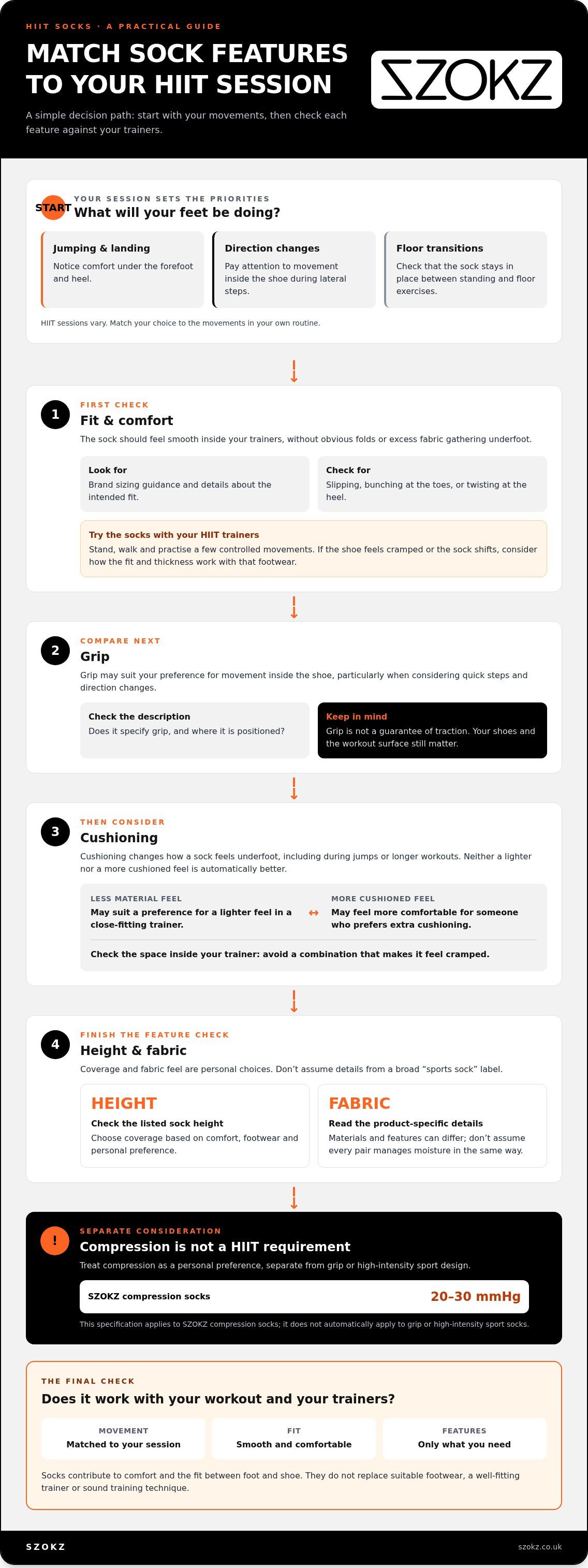
How to choose HIIT workout socks: a practical buying checklist
Use this checklist to turn your training needs into product criteria. Start with your workout and trainers, then compare features. This keeps your search for hiit workout socks uk focused on comfort and practical fit, rather than claims that may not matter to your sessions.
- Map your workout. Note whether it is jump-heavy, built around quick changes of direction, strength-focused or a mix. The movement pattern is a better starting point than a general “HIIT” label.
- Consider your training shoes. Think about how much room you have inside them and whether your current socks feel too thin, bulky or loose.
- Factor in session length. For longer mixed sessions, consider how the sock feels over time, not just during a quick try-on.
- Choose your preferred coverage. Decide whether you want ankle coverage or another height offered by the product. Check that it works with your shoes and clothing.
- Compare cushioning and grip. Choose based on comfort, movement and footwear, rather than assuming more features are always better.
- Read the product information. Check the stated features, fabric details and sizing guidance before placing an order. Follow the garment care instructions between sessions.
Match the sock to your shoes and workout format
Where practical, try the socks with the shoes you use for training. Sock thickness can change how much room you feel inside a trainer, while height affects coverage and how the top edge sits. A jump-heavy circuit may make underfoot comfort a priority; a strength-focused session may lead you to prefer a different feel. Neither calls for one universal sock choice.
Illustrative example: For a circuit that includes jumps and quick steps, compare a grip option with a standard sports sock, then consider cushioning and shoe space. This is a way to structure your choice, not a recommendation that applies to every circuit or person.
Check fit, care and repeat-use needs
Use the available sizing guidance and choose for fit, not appearance alone. If you can try a pair on, check how the material sits at the toes, heel and ankle inside your training shoes. Before ordering online, read the product description for its stated features and follow its garment care instructions. A sound buying decision starts with the details for that specific pair.
A simple final test: can you wear the sock comfortably with your HIIT shoes, and does its stated design match the session you have in mind? If either answer is no, revisit the fit or feature choice before ordering.
Explore HIIT-ready socks from SZOKZ
Find HIIT-ready socks in the SZOKZ range
Once you’ve considered your workout, footwear and preferred feel, narrow your search to the sock category that fits those priorities. SZOKZ offers grip socks and high-intensity sport socks, giving HIIT shoppers two relevant categories to explore. The right fit for your routine comes down to the features described for each pair and how you want your socks to feel during training.
Which SZOKZ sock category fits your priorities?
Grip socks are the category to consider if you specifically want grip as a feature. Think about how they’ll feel with your trainers and the surface you train on. Grip is one part of your set-up, not a substitute for suitable footwear or a guarantee of traction.
High-intensity sport socks are the category most directly aligned with HIIT. Use the product information to assess each pair against your session and preferences. Don’t assume every feature you might want is shared across all socks in a broad category.
If ankle coverage is a priority, SZOKZ also offers All Sport Ankle Socks. Consider this category if its coverage suits your preference, and use the individual product description for details about the pair. The category name can help narrow your search, but it doesn’t replace checking the product information.
SZOKZ socks are worn by Team GB and Olympic athletes. This is brand-level context, not a claim that a particular HIIT sock is endorsed by those athletes. Choose based on your training needs and the details of the product you’re considering.
Make the final choice with confidence
Keep your decision grounded in four checks: the movements in your sessions, a comfortable fit with your training shoes, the features you actually prefer, and the information provided for the specific pair. When comparing hiit workout socks uk, don’t choose on a label alone. A grip feature may matter to one shopper; another may put greater weight on comfort and coverage.
Before ordering, review the sizing and product details so your choice is based on fit and stated features, not appearance alone. UK delivery is free on orders over £30.
Set up your next session with confidence
Choose a pair for the training you actually do, then notice how it feels with your shoes during a full session. That practical feedback can guide your next choice better than adding features you don’t need. With hiit workout socks uk, comfort and a secure fit should support your routine, not distract from it.
SZOKZ socks are worn by Team GB and Olympic athletes, which provides brand context rather than an endorsement of a specific HIIT sock. Free UK delivery applies on orders over £30. Use the collection to compare the available sock categories and find an option that fits your training priorities.
Make your choice, lace up and give your next interval your full attention.
Frequently Asked Questions
Are grip socks good for HIIT workouts?
Grip socks can be an option for HIIT, particularly if you want to explore a grip feature during sessions with quick lateral steps. Their suitability depends on how they feel with your trainers and on your workout surface. Try them during a familiar warm-up before wearing them for a full session. The grip feature doesn’t guarantee traction, and it doesn’t replace footwear suited to your training.
What socks are best for HIIT training?
The best socks for HIIT are the pair that feel comfortable in your training shoes and suit your routine. For hiit workout socks uk, compare product details rather than relying on broad labels: check the stated fit, cushioning, grip and fabric. Wear them during a familiar session and notice whether seams, pressure or excess material distract you as the workout progresses.
Can I wear running socks for HIIT?
Yes, running socks can be suitable if they feel comfortable with your trainers during the movements in your HIIT session. Running socks vary, so don’t assume they include grip or a particular level of cushioning. Check the description for the features you want, then try them during a short circuit that reflects your training. If they feel bulky or uncomfortable in your shoes, another sock style may suit you better.
Should HIIT socks be ankle length or crew length?
Choose the height that feels comfortable with your footwear and gives you the coverage you prefer. An ankle-height sock may suit someone who wants less coverage; a crew-height style may feel more comfortable if you prefer fabric higher up the lower leg. Consider where the sock edge sits against your trainer and whether it rubs during movement. Check each product description, as sock heights vary between styles.
Do compression socks help during a HIIT workout?
Compression socks aren’t essential for HIIT, and they’re a different choice from grip or high-intensity sport socks. SZOKZ compression socks offer 20-30 mmHg compression. Treat that as a product specification, not a promise of a particular training or recovery outcome. If you’re considering compression for a health-related reason, seek advice from a qualified healthcare professional about what’s appropriate for you.
How should workout socks fit inside training shoes?
Workout socks should feel smooth inside your shoes, without folds under the toes or a heel that shifts as you walk. Check that your toes still have comfortable room and that the sock doesn’t make the trainer feel unusually tight. Lace up as you normally would, then try a few controlled steps and squats. Use the product’s sizing guidance, since size labels and fit can differ between brands.
How do I look after grip socks so they last?
Follow the care instructions supplied with your particular pair, as washing guidance can vary by fabric and construction. After a workout, avoid leaving damp socks bundled in a gym bag; let them air before storing them. Follow the garment label rather than guessing at wash settings or using treatments that aren’t recommended. If the grip surface looks worn or the sock’s fit changes, reassess whether it still feels suitable for training.
Comments
No comments yet. Be the first to add one.