
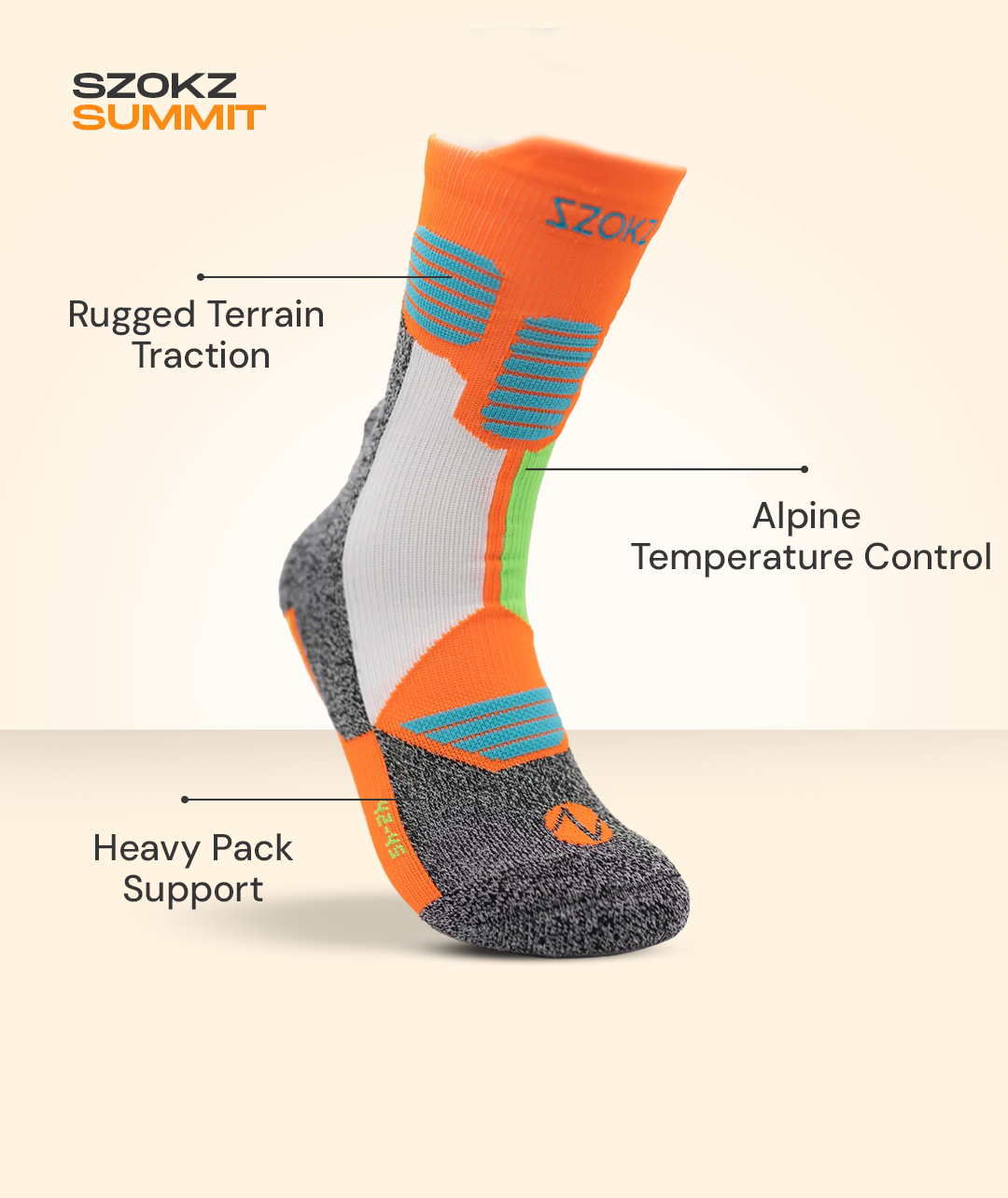

Short answer: most walking blisters come from friction, and friction comes from two things a sock can influence: moisture, and the sock moving inside the boot. Cushioning softens impact but doesn't stop either. A walking sock does its job by keeping the foot dry, staying in position over a long day and not wearing through at the heel. Boot fit and lacing do the rest. This guide covers what causes blisters on a walk, what a sock can and can't change, how a walking sock should fit, and where the SZOKZ Summit sits in that — and, if you specifically want in-shoe grip for a boot, which SZOKZ sock actually has it.
Where walking blisters come from
A blister is skin that has been rubbed repeatedly in the same place while warm and damp. On a walk, three things drive that:
- Moisture. Wet skin is softer and rubs raw faster. Sweat, rain and river crossings all count. This is the biggest one, and it's why cotton walking socks are a bad idea.
- Movement. The foot slides inside the sock, or the sock slides inside the boot. Every step repeats the rub at the same point — usually the heel, the ball of the foot, or the side of the big toe.
- Pressure points. A boot that's too tight, a lace pressing on the instep, a seam over a toe.
Cushioning addresses none of these directly. A thick padded sock can feel more comfortable at the start of a day and still blister you by the end, because thickness doesn't keep the foot dry and, if it's cotton, it holds sweat.
What a walking sock can change
- Moisture. A moisture-wicking synthetic blend moves sweat off the skin and dries quickly if it gets wet. This is the single most useful thing a walking sock does.
- Sock migration. A sock that slides down or bunches at the toe rubs. An arch band that holds the sock in position over the mid-foot reduces that. It doesn't stop the foot moving in the boot — that's fit — but it stops the sock going with it.
- Wear. Walking socks fail at the heel and toe first. A reinforced heel and toe means the sock is still the right shape after a season, which matters because a worn, thin heel is where blisters start.
What a sock can't change:
- A boot that's the wrong size or shape. If your toes hit the front on descents or your heel lifts a centimetre, no sock fixes that. Sort the boot first.
- Wet feet from outside. A wicking sock dries fast; it isn't waterproof. If water gets into the boot, you need gaiters or a waterproof boot.
- Cold. A lightweight technical sock is not an insulated winter sock. For sub-zero days you want a heavier sock, possibly with a liner.
Fit guide for walking
- Size to the chart. SZOKZ sizes are S (UK 3–5), M (UK 6–8), L (UK 9–11) and XL (UK 12–14). Don't size up for "room" — a long sock bunches at the toe.
- Wear them when you try boots on. Boot fit changes with the sock. Try boots in the sock you'll walk in.
- Arch band snug, not tight. It holds the sock in place over a long day. If it leaves a deep mark or your foot feels constricted, size up.
- Crew height. A boot cuff needs a sock that sits above it. The Summit is crew length.
- Lace for the terrain. Loosen slightly for climbs; lock the heel (a heel-lock or "runner's loop" through the top eyelets) for descents. Lacing does more for foot movement than any sock.
- Avoid cotton. Cotton holds sweat against the skin, which is exactly the condition blisters need.
What's in the Summit
The Summit is SZOKZ's walking sock. It's a crew-length compression sock: a moisture-wicking, odour-resistant fibre blend, a reinforced heel and toe, and an arch band that gives 20–30 mmHg compression through the mid-foot to keep the sock in position on long descents. It's a localised arch wrap, not a graduated leg compression sock.
It does not have grip zones. The Summit is designed around moisture and fit rather than in-shoe traction. It is also a synthetic sock: not merino, not waterproof, not an insulated winter sock. What it offers is a sock that dries fast, stays where it should and doesn't wear through.
If you want in-shoe grip for a boot
SZOKZ makes one range with knitted grip zones under the ball and heel: the High Intensity Sport Socks. They're crew-length, in plain colours, with the same arch band, fabric and reinforced heel and toe as the Summit, plus the grip. They were built for sports where the foot is fixed or driving hard — rowing, gym, cricket, football — but nothing stops you walking in them, and if your specific problem is the sock sliding against a smooth boot lining, they're the SZOKZ sock that addresses it.
The honest guidance: for most walkers, moisture and boot fit are the problem, and the Summit is the right sock. If you've sorted both and the sock still creeps in the boot, try the grip socks.
Which SZOKZ socks for walking
- Summit Walking Socks — the walking sock: compression, reinforced heel and toe, no grip.
- High Intensity Sport Socks — the grip option, if in-shoe grip is what you're after.
- The hiking collection.
Prices: £7.99 for a single pair, £24.00 for a 4-pack (£6.00 per pair) or £30.00 for a 6-pack (£5.00 per pair). Free UK delivery on orders over £30, delivered in 2–3 business days.
Common questions
Will the Summit stop me getting blisters?
It removes one of the main causes — a wet sock — and reduces another — the sock migrating. It doesn't fix a badly fitting boot, water from outside, or a seam pressing on a toe. Most people who blister in cotton socks in a boot that fits will do noticeably better; someone in the wrong boot won't.
Is the Summit a grip sock?
No. It's a compression walking sock. The only SZOKZ socks with grip zones are the High Intensity range.
Are they warm enough for winter walking?
The Summit is a lightweight, quick-drying sock. For cold days it works as a base under a heavier sock, or on its own in mild conditions. It isn't an insulated winter sock.
Can I use them for trail running?
Yes. Moisture-wicking and an arch band that keeps the sock in place both apply at running cadence.
Do I need a liner sock?
Not with a wicking sock in a boot that fits. A liner is a separate approach to the same problem. Wearing a thin liner under the Summit is fine, but check the boot still fits with both.
How do I wash them?
Machine wash at 30°C, inside out. Do not tumble dry or iron. Air dry flat. Care details are in the FAQ.
Hazel Gleed writes the SZOKZ Journal.
Comments
No comments yet. Be the first to add one.