


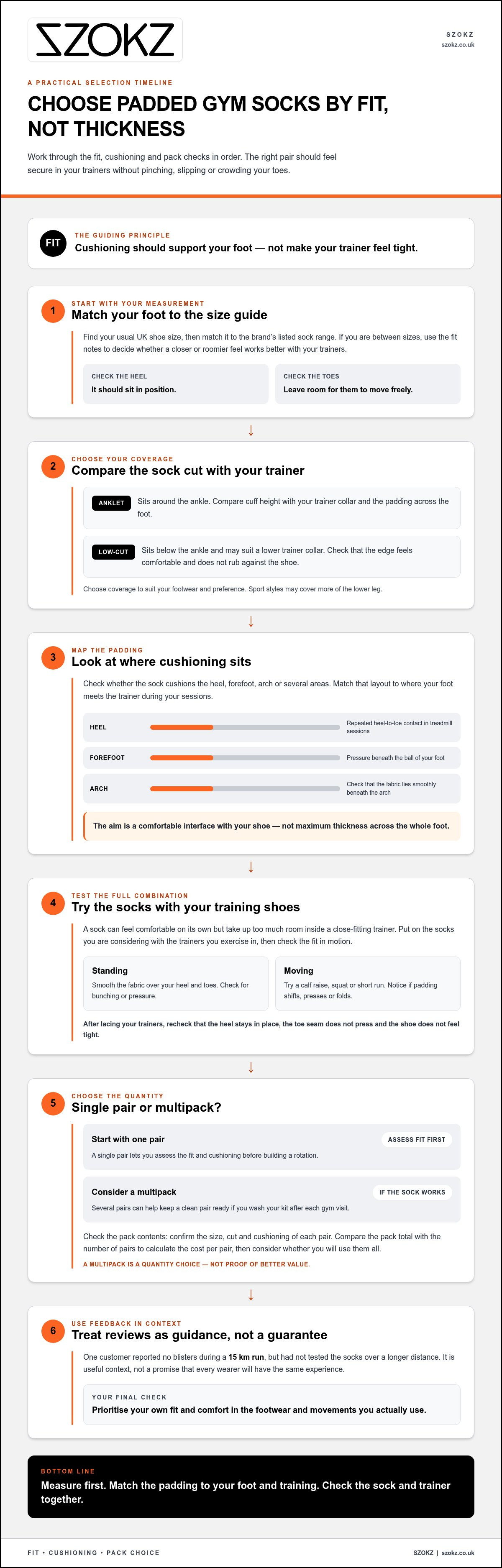
Fit matters more than extra padding. Choose padded ankle socks for the gym by matching your foot measurement to the size guide, then check that the sock feels secure without pinching or slipping inside your trainers. Cushioning should feel supportive, not bulky.
It’s easy to judge a sock by how thick it feels in your hand. During training, fit and cushioning placement matter just as much: they affect how the sock sits against your foot as you move. Reviews can provide useful context, but your own fit and comfort are what count.
This guide explains how to choose a size, compare cushioning and pack options, and use reviews when deciding what suits your sessions. It also covers how to compare prices for padded gym ankle socks without treating one figure as the measure of value. You’ll have a clearer basis for choosing a pair that works with your training routine.
Key Takeaways
- Match your foot measurement to the size guide, then check that the sock stays secure without pinching or slipping in your trainers.
- Compare where cushioning sits and how it feels in your footwear, rather than choosing by thickness alone.
- Weigh single pairs against multipacks by considering how often you train and how many pairs you’ll use.
- Use comfort feedback as a guide, not a guarantee: one customer reported no blisters during a 15 km run, but hadn’t tested the socks over a longer distance.
- Compare prices alongside pack size and intended use to judge which option offers practical value for your routine.
What type of socks are best for sports?
For gym training, choose socks that fit your footwear and movements. Ankle length is one style option, while the placement of cushioning distinguishes padded designs.
Padded anklet and sport styles
Anklet socks sit around the ankle, whilst sport styles may cover more of the lower leg. Compare the cuff height with your trainer collar and the areas of padding across the foot. For padded ankle socks for gym sessions, a close fit can help limit excess fabric inside the shoe. Ankle socks may also provide muscle support by encouraging circulation.
Choose your size using your foot measurement and the brand’s UK shoe-size guide, not a guess based on another pair. Find your usual UK shoe size, then match it to the listed sock range. If you’re between sizes, use the fit notes to decide whether a closer or roomier feel suits your trainers. When trying the pair on, check the heel position and toe space.
For a women’s sports sock range, use the same fit checks rather than assuming every range has identical sizing. Compare the size chart with your UK shoe size, then consider your trainers’ shape and how much room remains at the toes. A sock that bunches at the forefoot can feel distracting during lunges or treadmill work.
Recycled materials are another detail to compare. Read the fibre composition and look for an explicit description of recycled content in the product information. Material choice affects feel and construction, so consider it alongside fit and cushioning. Don’t assume a fabric is recycled based on its colour or texture.
Low-cut sock options
Low-cut socks sit below the ankle and may suit trainers with a lower collar. Compare the cut with the shoe opening: the edge should feel comfortable and avoid rubbing against the trainer. If you prefer more ankle coverage, an ankle-length style may suit you better. Choose based on your footwear and preferred coverage.
Compare the sock and trainer together before choosing. Check that the heel stays in place, the toe seam doesn’t press, and the padding doesn’t make the shoe feel tight. A snug trainer may suit a less bulky sock, while a roomier shoe can accommodate more cushioning. These checks help you narrow down styles by fit, coverage and intended use.
Padded sock cushioning and protection
Cushioning affects how a sock feels between your foot and trainer. Compare its placement and thickness alongside the fit, rather than treating padding as a single feature.
Cushioning for support and comfort
Padded zones add fabric beneath areas such as the heel or forefoot. That extra layer can soften contact with the shoe during treadmill running or repeated jumps. Check whether the padding sits where your foot meets the trainer. A cushioned heel may not help much if your main pressure point is beneath the ball of your foot.
Use your movements in training to judge the cushioning layout. Treadmill sessions involve repeated heel-to-toe contact, while circuits may include lateral steps and lunges. Look for padding where your foot and shoe meet during those movements. The aim is a comfortable interface, not maximum thickness across the whole foot.
Fit still matters. Padding takes up space inside a trainer, so a sock that feels comfortable on its own may make a close-fitting shoe feel tight. Try the pair with the trainers you exercise in. Check that your toes can move freely and that extra fabric doesn’t create pressure at the heel or forefoot.
Cushioned arch sports socks
Cushioned arch socks combine underfoot padding with fabric around the midfoot. Check how the arch section sits against your foot rather than assuming extra compression or thickness will suit you. A secure, smooth fit should not fold beneath the arch. Test the feel while standing, then during a movement such as a calf raise.
Padding can also affect friction by changing the contact between your skin, sock and shoe. A wrinkle or loose section may rub during repeated movement, even if the cushioning feels soft at first. Smooth the sock over your heel and toes before training. Recheck the fit after lacing your trainers, as shoe pressure can change how the fabric sits.
For a practical comparison, focus on the sock’s construction rather than claims alone. Note whether cushioning covers the heel, forefoot, arch or several areas. Then match that layout to your training and footwear. A padded forefoot may feel different in a narrow trainer than in a roomier pair, so assess the complete combination.
Choose cushioning that supports a stable fit without crowding the shoe. If a padded section bunches, shifts or presses during a squat or short run, try a different thickness or layout. Comfort is a useful guide, but padding doesn’t replace well-fitting footwear or the right sock size.
Single-pair and multipack options
A single pair lets you assess fit and cushioning before building a rotation. A multipack can make sense when the same sock works for your regular training sessions.
Start with your laundry routine and weekly training pattern. If you wash your kit after each gym visit, several pairs help keep a clean pair ready. If your sessions vary, buying one pair first can help you avoid a drawer full of socks that don’t suit every shoe. Treat a multipack as a quantity choice, not proof of better value.
Check the pack contents before comparing options. Confirm that every pair has the same size, cut and cushioning. Some packs contain identical pairs, while others may offer different colours or styles. These details affect usefulness: matching ankle socks suit a consistent routine, while mixed cuts may work across different trainers.
A multi-buy discount can lower the cost per pair, but compare the final total with what you’ll actually wear. Divide the pack total by the number of pairs to calculate the unit cost. Then consider whether every pair suits your fit and training needs. A lower cost per pair offers little practical value if some remain unused.
Read promotion terms carefully, too. Check whether the discount applies automatically, requires a minimum purchase or covers selected products only. For example, a multi-buy offer may exclude a colour or cushioning style you prefer. Compare eligible options and the total checkout cost before deciding. Don’t assume every multipack includes a discount.
For gym use, consider how often you train and whether you rotate footwear. A single pair can help you test a new cushioning layout with your usual trainers. If the fit works across your sessions, a multipack of the same style may simplify kit preparation. If you alternate between running shoes and strength-training shoes, compare how the sock feels in both.
Use this quick comparison before choosing:
- Single pair: useful for testing a new fit or cushioning layout.
- Multipack: practical when you already know the style suits your routine.
- Multi-buy offer: compare the total, pair count and promotion conditions.
- Mixed pack: check that each cut or colour has a clear use.
Keep storage and rotation in mind, too. Several pairs of the same style make it easier to choose matching socks on busy training days. With a mixed pack, separate pairs by cut or intended footwear after washing. That simple step helps you find the right option without interrupting your routine.
Choose the smallest purchase that meets your needs. Try a single pair if you’re unsure about the fit; choose a multipack when the same style already works. Compare pack contents, promotion terms and how often you’ll wear the socks. This gives you a clearer sense of value than focusing on the headline discount alone.
Customer feedback on comfort and blister prevention
Customer comments help reveal how socks feel during actual movement. One customer reported comfortable cushioning and no blisters during a 15 km run, but hadn’t tested the socks over a longer distance. That account offers a useful example, not a universal result. Read the activity, distance and conditions alongside each comfort claim.
Use reviews to find details you can compare with your own training. Feedback about treadmill comfort differs from comments after a long outdoor run. Look for descriptions of where the sock felt comfortable, whether it moved inside the shoe and how it performed during exercise. Specific observations offer more context than a simple rating.
Blisters can develop when repeated rubbing affects the skin. The right ankle socks can absorb sweat, reduce chafing and help prevent blisters. Fit remains relevant: a loose heel can shift, while a tight toe area can create pressure. Reviewers mentioning these points help you assess how sock construction and shoe fit interact.
Separate useful evidence from broad praise. “Soft” describes an immediate sensation; “stayed smooth during a circuit” describes how the sock felt in motion. A review mentioning a gym session, trainer fit and heel rubbing offers several points to compare. A short comment that gives no activity provides less practical detail.
Check the distance or duration described before applying a review to your routine. The 15 km report gives a clear running distance, but doesn’t tell you how the same pair feels across longer mileage. Gym sessions also differ: cycling keeps the foot in a repeated position, whilst jumps and lunges involve varied movement. Match feedback to the activity you plan to do.
Use this simple review-reading sequence:
- Identify the activity: running, weights or circuit training.
- Note the fit detail: heel movement, toe pressure or fabric folds.
- Find the comfort point: cushioning, sweat or rubbing.
- Compare the conditions: distance, session type and footwear.
After reading reviews, test your pair during a familiar session. Check the heel and toe area before training, then notice whether either shifts or rubs as you move. If discomfort appears, stop and inspect the sock and trainer together. A fold at the heel, for example, can feel different from pressure caused by a tight shoe.
Comfort feedback is most useful when it explains what happened and during which activity. Combine that detail with fit observations, rather than treating one positive review as a prediction. The 15 km customer account is a helpful reference point; your footwear, movement and preferred fit shape your own experience.
Prices of padded sport and anklet socks
Compare padded sport socks by what you get, not just the headline price. A single pair and a multipack are different purchases, so check the pair count, sock style and cushioning before judging value. This makes comparisons more useful for gym training.
First decide whether you’re buying one pair to test or replacing several pairs. A single pair keeps the initial purchase smaller and lets you assess the fit with your usual trainers. A multipack may suit a regular training rotation, especially when every pair matches the same activity and footwear.
To compare a multipack fairly, divide its total price by the number of pairs. Then compare the per-pair cost with another pack or a single-pair option. Check that both options have similar ankle coverage and cushioning. A lower per-pair cost may not help if the pack includes styles you won’t wear.
Read multi-buy discounts carefully, too. Check the qualifying products, required quantity and final basket total. A discount on selected colours won’t help if your preferred option is excluded. Assess the actual items in your basket instead of assuming every padded style qualifies.
Construction also affects how you assess value. Compare the placement of padding, the sock’s cut and how it fits in your trainers. If two options differ in cushioning, they aren’t direct comparisons. Match the features first, then consider pack size and promotion terms. This keeps your decision focused on what you’ll use.
Before buying, use this comparison checklist:
- Pair count: calculate the cost for each pair in a multipack.
- Style: compare ankle height and cushioning placement.
- Discount: read which products qualify and how the offer applies.
- Use: consider whether every pair fits your training routine.
A single pair may suit someone trying padded ankle socks for gym sessions for the first time. A multipack may be more practical for someone who already knows the fit works. In either case, judge value by how much you’ll use the socks, not just the total or any discount shown.
Prices can vary with pack size, product features and promotions. Compare the same type of sock across the options available, and use the final basket total in your calculation. The key takeaway: buy a multipack for pairs you’ll wear, not simply for a lower unit cost.
SZOKZ: Grip Socks
SZOKZ offers Grip Socks for training where grip is a priority. If ankle coverage matters more, consider All Sport Ankle Socks. High Intensity Sport Socks suit demanding sports sessions, while Hiking Socks are designed for a different use.
Let your workout and footwear guide your choice. For gym sessions in trainers, compare All Sport Ankle Socks with your preferred fit and coverage. If your training calls for a different sock type, consider the relevant style instead. SZOKZ offers options to assess against the criteria in this guide, but don’t assume every style has the same construction or feel.
Visit szokz.co.uk to explore SZOKZ socks and choose an option for your training needs.
Choose socks that support your next session
Use your next gym session to assess how your socks work with your trainers. Notice whether the fit stays comfortable through your usual movements. That practical feedback can help you decide what to prioritise in your next pair.
For padded ankle socks for gym training, match your choice to your preferred coverage and workout. SZOKZ offers Grip Socks, High Intensity Sport Socks and All Sport Ankle Socks. Each is a different category to consider as you plan your kit.
Keep your routine in view. A sock suited to one activity may not be your first choice for another, so focus on the sessions and footwear you use most. A considered choice makes it easier to build a training kit that works for you.
Find a fit that lets you focus on your training.
Frequently Asked Questions
What size do I need?
Choose the sock size that matches your usual UK shoe size on the size guide. If your shoes differ between brands, use the pair you wear for training as your reference. Compare the sock fit with your gym trainers, not just your everyday shoes. The heel should sit in place, and the toe area shouldn’t feel compressed. A comfortable fit helps prevent bunching inside the shoe.
Which padded ankle socks are best for gym training in the UK?
The right option suits your workout, trainers and preferred ankle coverage. For a general gym session, compare ankle socks with sport styles and check where the cushioning sits. SZOKZ offers All Sport Ankle Socks, High Intensity Sport Socks and Grip Socks. Consider the activity first: strength training, circuits and running place different demands on your footwear and sock choice.
What cushioning thickness and placement are best for gym ankle socks?
Choose cushioning placement to suit the contact points inside your trainers. For treadmill work, notice how the heel and forefoot feel during repeated steps. For weight training, check that extra fabric doesn’t make your shoes feel restrictive during a squat or lunge. No single thickness suits every trainer. Compare the sock in your gym footwear and notice any pressure or bunching as you move.
Are cotton or synthetic ankle socks better for workouts?
Neither fibre is automatically right for every workout. Compare the fabric composition and how the sock feels against your skin, especially during a warm session. Cotton-rich fabric may suit someone who prefers a softer, familiar feel; synthetic blends are often used in sportswear construction. The finished sock also depends on its knit and fit. Check the product’s material details and assess comfort with your usual trainers.
How should gym ankle socks fit, and what sizes are available?
Gym ankle socks should sit smoothly, with the heel pocket aligned and no loose fabric beneath the toes. The cuff should stay comfortably in place without digging into your ankle. Size ranges vary by product, so use the size guide alongside your UK shoe size. If you’re between listed sizes, consider your preferred fit and how much room your trainers leave.
How much do padded gym ankle socks cost in the UK?
The cost depends on whether you choose a single pair or a multipack, as well as the sock’s style and construction. Compare the total price with the number of pairs, then consider whether you’ll use every pair in your training rotation. A lower per-pair cost adds value only if the fit and style suit your needs. Promotions may have conditions, so include those when comparing the final basket total.
Comments
No comments yet. Be the first to add one.