


Could the right socks help you feel more secure during a standing balance or Reformer movement? If you’re wondering whether pilates grip socks are expected in class, or whether their soles will feel comfortable as you move, start by checking your studio’s guidance. Requirements vary, and the surface, fit and movements in your session can all affect how a pair feels.
This guide explains how grip socks work, when they may be useful and what to check before choosing a pair. Compare grip coverage, fit, fabric and toe style with your class setup, then use a simple pre-class check to see how the socks feel in movement. No one design suits every person or Pilates setting.
Key Takeaways
- Check your studio’s guidance before deciding whether to wear socks or practise barefoot.
- Grip socks may support contact with the mat or Reformer during controlled movements, but they cannot guarantee stability.
- Compare fit, grip coverage and comfort. Your socks should stay in place without restricting your toes.
- Inspect your socks and test how they feel before moving into more demanding exercises.
- Use your class setting, fit and preferred sole grip to guide your choice, including when exploring SZOKZ grip socks.
Why wear Pilates grip socks for mat or Reformer practice?
If you’re new to Pilates, you may be unsure whether a class calls for socks, bare feet or a particular type of footwear. There isn’t one answer for every session. Studio rules, your instructor’s guidance and your comfort all matter, so check before class if you’re uncertain.
Pilates grip socks have grippy areas on the sole, designed to increase traction between your feet and a practice surface. Unlike smooth everyday socks, they have textured or patterned sections underneath. Their placement and coverage vary, so check the sole rather than assuming all grip socks work in the same way.
What makes a sock a Pilates grip sock?
The grippy sections contact the mat or equipment as you place your feet. That added contact may help your feet feel less prone to sliding, depending on the surface, the sock and the movement. It does not lock your foot in place or replace controlled technique. For a broader introduction to the method and its principles, read about Pilates.
When might grip socks be useful in a class?
Grip socks may be useful during controlled standing work, balance exercises or movements that involve deliberate foot placement and repositioning. On a Reformer, your contact points change with the exercise and equipment setup. Grip beneath the foot may offer extra traction, but it cannot guarantee performance or prevent a slip or injury.
Follow your instructor’s directions, especially if they ask the class to work barefoot or recommend socks for a particular exercise. Studio policies vary. If socks are allowed, notice how they feel as you move. You should still be able to place your feet carefully and adjust your position without distraction.
Grip is relevant beyond Pilates, but each activity has different demands. SZOKZ’s article on grip socks for cricket footwork explores a different movement setting. For Pilates, focus on your class surface and the movements your instructor plans.
Think of grip socks as an option, not a requirement for every practice. If you’re comfortable barefoot and your studio permits it, that may suit you. If you prefer socks, choose a pair that feels secure and does not bunch or slide. Next, assess fit, sole coverage and comfort against your class setup.
How Pilates grip socks support contact with the mat or Reformer
Traction comes from the contact between the grip areas on a sock’s sole and the surface beneath your foot. As you press into a mat or make contact with Reformer equipment, those areas may help reduce unwanted sliding. This may make it easier to focus on controlled placement, rather than adjusting a foot that feels as though it is shifting.
Grip may support foot contact, but it cannot guarantee stability, improve every movement or prevent injury. The result depends on more than the sock. A loose fit can let fabric move beneath your foot, while dust, moisture or worn grip may affect contact. The direction and speed of a movement matter too. Treat grip as one part of your setup, not a substitute for careful technique or instructor guidance.
Grip placement and foot contact
Turn the sock over and inspect the sole. A patterned upper or grippy-looking fabric does not show where the grip areas sit or how much of the sole they cover. Compare the placement with the foot positions used in your class. A movement that presses through the forefoot may rely on a different contact area from one where your heel stays grounded. No single pattern suits every exercise or person.
Fit affects how the grip works. If the sock twists, bunches or slips on your foot, the grippy sections may not meet the surface as intended. Check the sole before class and again if your feet feel as though they are shifting. For broader context on how grip socks are designed for different activities, read the guide to sports grip socks.
Mat Pilates and Reformer Pilates are different settings
In mat work, your feet may press against the floor or mat as you move between positions. On a Reformer, contact can involve a footbar, a moving carriage or a platform. These surfaces and contact points are not interchangeable, so consider the equipment and movements in your session when assessing sole coverage. Follow studio rules, your instructor’s directions and any relevant equipment manufacturer’s guidance.
For general professional context, the Pilates Method Alliance (PMA) offers information about the Pilates field. Your instructor remains the best source for guidance on a specific class or piece of equipment.
Use these contact points to compare options. You can also browse the available sock categories and check whether a pair’s details suit your practice. Do not assume every grip sock is designed specifically for Pilates.
How to choose Pilates grip socks: fit, grip and comfort
Your choice depends on how the sock sits on your foot and where you plan to use it. Mat classes and Reformer sessions can involve different contact points, so check studio guidance and match the sock’s fit and sole coverage to your practice. Use this comparison to narrow down what to look for.
| Factor | What to check | Why it matters |
|---|---|---|
| Fit | Close, even contact at the heel and toes, with no folds beneath the foot. | A sock that bunches or shifts can distract from movement. |
| Sole grip coverage | Look at the underside and note where the grippy areas sit. | Coverage should make sense for the foot positions and equipment in your class. |
| Comfort | Check fabric, seams and whether your toes can move freely. | You should feel secure without pressure or restriction. |
| Practice setting | Consider whether you’ll use a mat, footbar, carriage or platform. | Different surfaces and movements may call for different grip placement. |
What should a comfortable fit feel like?
Choose a close fit that follows the shape of your foot without pulling tightly across your toes. Smooth the heel and toe areas as you put the socks on. During a gentle warm-up, check that the heel stays in place, the fabric does not fold beneath your sole and your toes can spread and flex. If the socks twist or slide, pause and adjust before continuing.
Use the maker’s current size guide rather than guessing from your usual shoe size, as product sizing can vary. For SZOKZ grip socks, check the current product information for sizing guidance, then let comfort during movement guide your choice.
How should you compare grip coverage and fabric?
Turn the sock over and compare the visible grip areas with the positions used in class. A mat session may involve contact with the floor as well as the mat, while Reformer exercises can bring your feet against a footbar or moving carriage. There is no single grip pattern that suits everyone. Check the product listing for material and care details too. For a different activity context, see grip socks for the gym. Pilates has its own movements and equipment, so use your instructor’s guidance when choosing.
Ordinary socks may feel familiar, but a smooth sole may offer less traction than a sock with grippy areas. Barefoot practice may suit some people and studios. Follow the class rules and choose what feels comfortable. This guide to why you need Pilates grip socks offers another perspective on their use. A considered fit matters more than appearance.
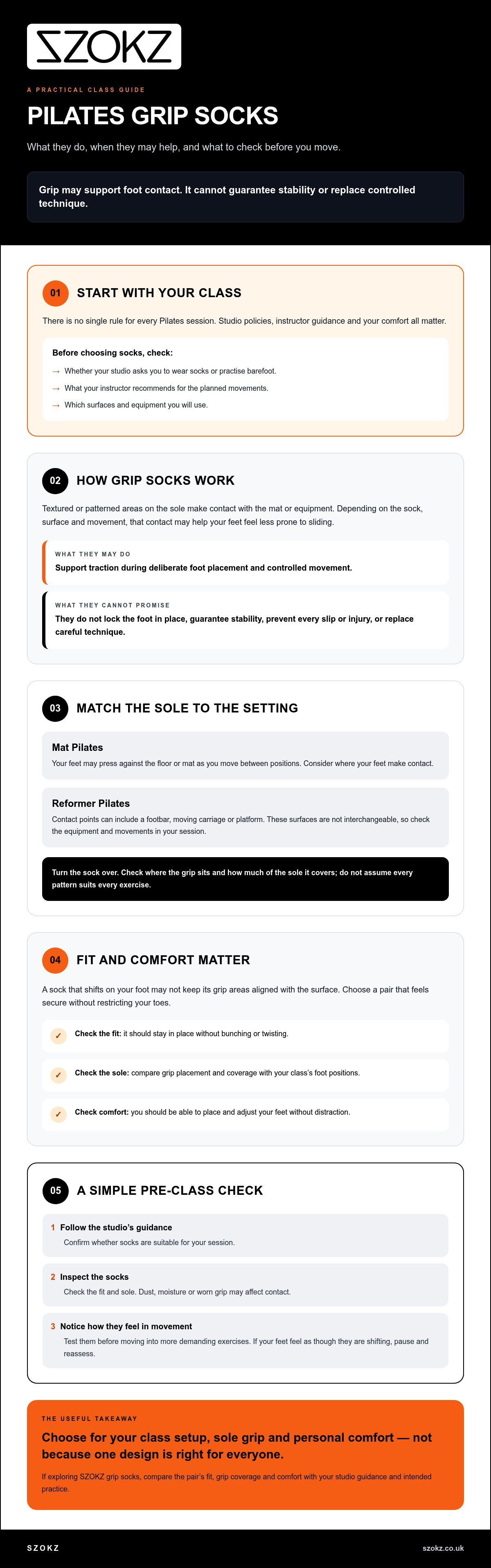
How to wear and care for Pilates grip socks
A quick check before class can help you spot a poor fit or worn grip before your movements become more demanding. Use this routine for pilates grip socks, whether you’re practising on a mat or using a Reformer.
A simple pre-class routine
- Check the class guidance. Find out whether your instructor or studio requires, recommends or restricts grip socks. Do not assume the same rule applies to every class.
- Inspect the soles. Check that the grip areas are clean, dry and free from obvious damage or debris. Dampness, dust and built-up dirt may affect contact with the surface.
- Put them on smoothly. Align the heel and toe sections, then smooth out any twists or folds underfoot. Bunched fabric can feel distracting and may shift as you move.
- Test your foot placement. Try a few gentle movements or controlled weight shifts. Notice whether the socks stay in place and feel comfortable on the mat or equipment.
Make adjustments before moving into more demanding exercises. If a sock slips, twists or feels restrictive during the warm-up, pause and fix the fit. If it still does not feel right, follow your instructor’s advice rather than trying to work around it.
Keeping grip socks in usable condition
Care varies by product, so use the care label as your reference for washing and drying. Do not assume a method that suits one pair is right for another. Follow the maker’s instructions and let the socks dry fully before wearing them again. A damp sole or debris caught in the grip areas may change how the sock contacts a surface.
Check the sole regularly, especially if you use the same pair often. Look for visible wear, peeling or areas where debris has collected. Pay attention to the fabric as well. Stretched material that no longer holds the heel or foot securely can affect how the grips sit beneath you.
There is no fixed replacement schedule that suits every pair. Use how the socks fit and feel as your guide. If the grip looks noticeably worn, or the socks no longer stay in place during gentle movement, consider replacing them rather than relying on them for class.
The pre-class check is straightforward: follow studio guidance, inspect the soles, put the socks on without folds, then test your movement. These small checks help you start with a setup that feels comfortable and suited to the session.
Choosing SZOKZ grip socks for your Pilates routine
Choosing pilates grip socks comes down to three practical checks: your class setting, a comfortable and secure fit, and sole grip that suits the foot positions you use. Start with your routine rather than assuming one design will suit every class or piece of equipment.
Match the sock choice to your actual practice
Think about whether you mainly attend mat classes, Reformer sessions or a mix of both. The surfaces and contact points can differ, so consider how you place your feet during class. Then check that the sock fits closely without bunching or restricting your toes, and compare its visible grip coverage with your setup.
Before ordering, read the current product details and sizing guidance. Check the information for that specific pair, including any details about fit, materials, sole construction and care. If something is unclear, do not guess. A comfortable fit and a suitable match for your practice matter more than a particular look or the assumption that more grip is always better.
- Class setting: Will you practise on a mat, a Reformer or both?
- Secure fit: Does the size guide point you towards a close fit that stays put without restricting movement?
- Sole grip: Does the visible grip placement seem appropriate for your foot contact in class?
Explore the available SZOKZ grip socks
SZOKZ sells grip socks as part of its performance sock range. Use the checks above to assess the current product information rather than assuming a particular pair is Pilates-specific or has a feature that is not stated. If you’re comparing options, check the sole and fit details, then consider how the socks feel during gentle movement before using them for a full session.
SZOKZ says its socks are worn by Team GB and Olympic athletes. This is a brand proof point, not a claim of endorsement or a guarantee of how any pair will perform in your Pilates class. Your comfort, movements and studio requirements should guide your choice.
If the class setting, fit and grip details look right for your routine, explore the available range at your own pace.
Choose socks that suit your next Pilates class
The right pilates grip socks depend on your class, not just the grip on the sole. Check studio guidance, consider whether you’ll practise on a mat or Reformer, and look for a close fit that stays comfortable without bunching or restricting your toes. Grip areas may support contact with a surface, but cannot guarantee stability. Check the soles before class and follow the care instructions to keep your socks in usable condition.
Compare options using those checks, then let comfort during gentle movement guide your decision. SZOKZ sells grip socks through its UK e-commerce store and says its socks are worn by Team GB and Olympic athletes. This is a brand proof point, not a promise of results in Pilates or an endorsement.
Check your studio’s guidance, compare the fit and grip details, and explore SZOKZ’s sock range to find an option to assess for your next class.
Frequently Asked Questions
Do you need grip socks for Pilates?
Not always. Whether you need grip socks depends on your studio’s policy, your instructor’s guidance and what feels comfortable for your practice. Some classes allow barefoot work, while others may require or recommend socks. If you’re unsure, check before attending rather than assuming. Grip socks have grippy areas on the sole that may support contact with a mat or equipment, but they are not a substitute for careful movement or instruction.
Are Pilates grip socks better than bare feet?
Neither option is automatically better for everyone. Bare feet may suit your comfort and technique, provided your studio permits them. Grip socks may offer added traction between your sole and the surface, which some people prefer during controlled foot placement. They cannot guarantee stability or prevent injury. Follow your instructor’s advice and notice how each option feels during gentle movement before settling into your usual practice.
Can you wear ordinary socks for Reformer Pilates?
You can wear ordinary socks if your studio allows them, but smooth-soled socks may offer less traction than socks with grippy areas. On a Reformer, your feet may contact a footbar, carriage or platform, so consider how the socks feel on the equipment used in class. Check studio guidance first. Do not assume ordinary socks provide the same grip, or that any grip sock suits every Reformer setup.
How should Pilates grip socks fit?
Pilates grip socks should feel close and secure without squeezing your toes or restricting their movement. Check that the heel sits in place and that there is no loose fabric or bunching underfoot. During a gentle warm-up, notice whether the sock twists or slips as you reposition your feet. Use the maker’s current size guide, since sizing can vary between products, and let comfort in movement guide your final choice.
Are Pilates grip socks suitable for mat and Reformer classes?
They can suit either setting if the studio permits them and the fit and sole grip work for your movements. Mat work involves contact with the floor or mat, while Reformer exercises may bring your feet against a footbar, carriage or platform. These settings differ, so check the visible grip placement and follow your instructor’s guidance. Do not assume one pair will feel the same across every surface or exercise.
How do you wash Pilates grip socks without damaging the grip?
Follow the care label for the specific pair. Washing and drying guidance can vary, so do not assume one temperature or method suits every sock. Check the soles for accumulated dirt before washing, then inspect the grip for peeling or visible wear. Let the socks dry as directed before wearing them again. If the product listing provides additional care details, use them alongside the label rather than relying on generic advice.
When should you replace Pilates grip socks?
Replace them when the grip is visibly worn or peeling, or when the socks no longer fit securely. A stretched heel, fabric that bunches beneath your foot or grips that feel less dependable are practical signs to check. There is no fixed lifespan for every pair, since use and care differ. Inspect the soles regularly and do not rely on worn socks if they no longer feel suitable for class.
Comments
No comments yet. Be the first to add one.