
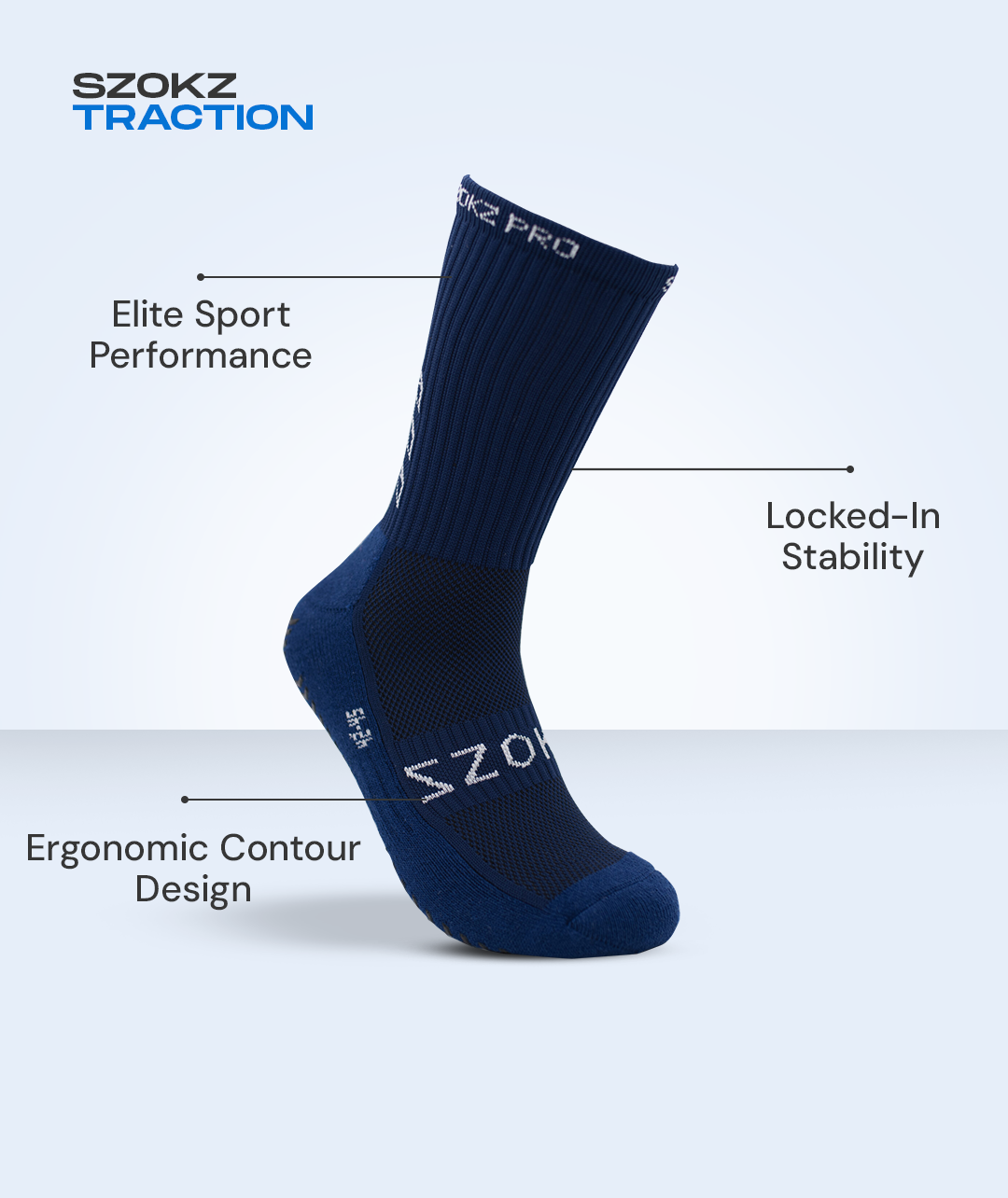

Short answer: cricket is a long day on your feet in a stiff boot, often in warm weather, with short bursts of hard movement in between. The two things that make a difference to your feet are keeping them dry and keeping the sock from moving inside the boot. A grip sock with knitted traction under the ball and heel does the second; a moisture-wicking blend does the first. In the SZOKZ range, only the High Intensity Sport Socks have grip zones — and they come in white, which matters for cricket. This guide covers what happens to your feet over a day's cricket, what a grip sock changes and what it doesn't, how to fit one to a cricket boot, and which SZOKZ socks work for whites and coloured kit.
What a day's cricket does to your feet
Unlike most sports, cricket alternates long periods of standing with sudden, short, hard efforts. Over six hours that pattern produces three specific problems:
- Sweat and heat. Cricket boots are closed, often leather or synthetic leather, and you're wearing them from the first over to the last. A cotton sock is soaked by lunch and stays that way.
- The sock migrating. Every sprint, dive and stop shoves the foot forward in the boot. A plain sock goes with it and bunches at the toe or slips under the heel. You then spend the afternoon pulling it back up in the field.
- Rubbing at the heel and ball. The two points that take the load when you push off and plant. Damp skin plus repeated movement at the same spot is how blisters start, and a batter with a heel blister is a batter thinking about their heel.
What a grip sock changes
Knitted grip zones under the ball and heel increase the friction between the sock and the inside of the boot at the points that take the load. The sock stays where you put it when you sprint, plant or push off.
Where you'd expect to notice it:
- Fielding. The sprint start from standing still, and the hard stop or dive at the end of it, are where a sock moves most. A sock that stays seated doesn't need pulling up between balls.
- Running between the wickets. Turning at the crease drives the foot into the toe box; the heel grip keeps the sock with the boot.
- Long sessions in the same boot. The later in the day, the wetter the sock and the more a plain sock slides. A moisture-wicking grip sock holds up better as the day goes on.
What it doesn't do: improve your batting. Foot placement at the crease is technique. A sock that stays still in the boot removes one small variable — it doesn't add power to a drive or timing to a pull, and we're not going to claim it does.
Fitting a grip sock to a cricket boot
- Size to the chart. SZOKZ sizes are S (UK 3–5), M (UK 6–8), L (UK 9–11) and XL (UK 12–14). Too long a sock puts the grip zones under the arch and bunches at the toe.
- Check where the grip sits. Standing in the sock, the grip zones should be under the ball of the foot and the heel. If they aren't, it's the wrong size.
- Try boots on in them. Cricket boots are stiff and don't stretch much. If you bought a half-size up to allow for thick cricket socks, a thinner grip sock may leave the boot loose — in which case the sock is doing more work and the fit at the lace matters more.
- Crew length. The grip socks are crew (mid-calf), which is right for cricket: batting boots come up over the ankle and a crew sock stays above the collar.
- Spikes or rubbers doesn't matter. The grip works between sock and boot lining. Sole type is irrelevant.
- Avoid cotton. For a full day in a closed boot in summer, cotton is the worst option available.
Whites or coloured kit
For whites, most clubs and leagues expect white socks. White High Intensity Sport Socks are the grip sock in white.
For coloured kit and T20, the High Intensity range covers the common club colours: navy, red, blue, yellow and neon yellow. The full range is here.
The patterned All Sport socks are compression socks without grip zones. They keep feet dry and stay up, but they don't address the sock sliding in the boot, and most cricket kit rules won't allow polka dots anyway.
Prices: £7.99 for a single pair, £24.00 for a 4-pack (£6.00 per pair) or £30.00 for a 6-pack (£5.00 per pair). Free UK delivery on orders over £30, delivered in 2–3 business days.
What's in the sock
SZOKZ High Intensity Sport Socks use a grip-zone knit construction: the traction is knitted into the sock at the ball and heel rather than printed on, so it works against the inside of the boot. The fabric is a moisture-wicking, odour-resistant 65% nylon blend with a reinforced heel and toe, which are the areas a cricket boot wears through first.
The arch band gives 20–30 mmHg compression through the mid-foot. Over a long day its job is to hold the sock in place and keep the grip zones where you put them; it's a localised arch wrap, not a graduated leg compression sock, and it doesn't restrict ankle or foot movement.
Common questions
Do grip socks work with spiked cricket boots?
Yes. The grip is between your foot and the inside of the boot. It has nothing to do with the sole.
Will the arch compression affect my movement at the crease?
No. It's a band around the mid-foot, not around the ankle or calf. It's there to stop the sock migrating, not to brace the foot.
Are all SZOKZ socks grip socks?
No. Only the High Intensity range has grip zones. The patterned, ankle-cut and Summit socks are compression socks.
How many pairs for a season?
For weekend club cricket, two or three pairs in rotation means you always have a dry pair, and none of them gets washed every week. Buy a 4-pack if you're playing twice a week or train midweek.
Can I wear them under batting pads and thigh guards?
Yes. Crew length sits under a pad strap without adding bulk.
How do I wash them?
Machine wash at 30°C, inside out to preserve the grip zones and colour. Do not tumble dry or iron. Air dry flat. Care details are in the FAQ.
What about grip socks vs normal socks generally?
Covered in Grip socks vs ordinary sport socks.
Hazel Gleed writes the SZOKZ Journal.
Comments
No comments yet. Be the first to add one.