


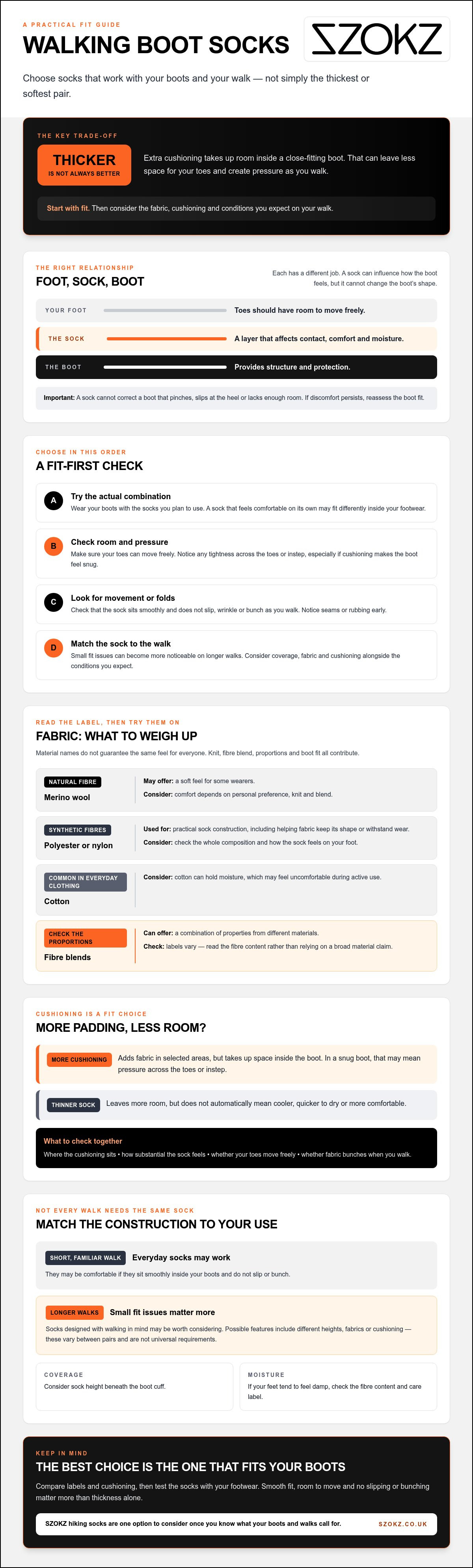
The thickest sock isn’t always the most comfortable choice. In a close-fitting boot, extra cushioning leaves less room for your toes and can create pressure as you walk. The right walking boot socks should work with your footwear, not simply feel soft on their own.
If you’re unsure how much thickness your boots can accommodate, or your feet feel damp on longer walks, you’re not alone. Fabric labels and cushioning claims can make the choice harder than it needs to be. Fit, moisture management and the conditions you walk in all matter.
This guide explains what to look for in walking boot socks, from fabric and cushioning to sock height and fit. You’ll learn how to match construction to your boots and walking conditions, spot rubbing or excess pressure, and care for your socks between walks.
Key Takeaways
- Choose walking boot socks by how they fit inside your boots, not by thickness alone.
- Compare fibre blends and cushioning on the product label to find a suitable balance for your walks.
- Try your boots with the socks you plan to wear, and check for pressure or slipping before a longer walk.
- Check for wrinkles, seams or bunching early, as these can affect comfort as you walk.
- Once you know what your boots and walks call for, explore hiking socks from SZOKZ as one option.
Walking boot socks: what they do and why ordinary socks may feel different
A walking boot sock is defined by how you use it, rather than one standard shape or fabric. It’s a sock chosen to work with walking footwear, where fit, coverage and comfort matter over repeated steps. Some pairs have extra cushioning or a taller leg; others are lighter or simpler. Check the individual product rather than assuming every walking sock has the same features.
In brief: a walking boot sock is the layer between your foot and boot, helping manage contact, comfort and moisture. The boot provides the structure and protection. A sock can influence how the inside of a boot feels, but it can’t change the boot’s shape or correct a poor fit.
How walking boot socks differ from everyday socks
Everyday socks are generally chosen for routine wear. Socks intended for walking may instead prioritise coverage beneath the boot cuff, a secure fit and features such as cushioning or moisture management. These are possible design choices, not universal requirements. This overview of ordinary socks describes the basic role of socks, including absorbing sweat.
- Everyday socks: suited to general use, though their construction may not be designed for the fit or duration of a walk in boots.
- Walking socks: may offer different heights, fabrics or cushioning to suit walking footwear and conditions. Features vary between pairs.
That doesn’t mean every walker needs a specialist pair. For a short, familiar walk, comfortable everyday socks may work well if they sit smoothly inside your boots and don’t slip or bunch. Longer walks can make small fit issues more noticeable, so socks designed with walking in mind may be worth considering.
What a walking boot sock can and cannot do
Fit matters as much as the label. A loose sock may wrinkle or move against the skin, while a tight or bulky one can feel restrictive inside a close-fitting boot. Fabric also affects how the sock feels against your foot and handles moisture. If your feet tend to feel damp, check the fibre content and care label rather than relying on broad claims about a material.
A suitable pair can contribute to comfort by sitting smoothly and reducing movement or rubbing caused by a poor sock fit. It can’t correct a boot that pinches, slips at the heel or lacks enough room. Try the boots with the socks you expect to wear, then check for pressure, slipping and folds as you walk. If discomfort persists, reassess the boot fit instead of expecting a different sock to solve it.
Walking boot sock fabrics and cushioning: how each affects comfort
Fabric and cushioning affect how a sock feels, but neither works in isolation. The fit of your boot, the length of your walk and the conditions you expect to encounter all matter. Compare the product label and how the sock sits inside your footwear instead of choosing by material name or thickness alone.
Natural and synthetic fibres in walking socks
Merino wool is a natural fibre often used in walking socks. It can feel soft against the skin, though personal preference, the knit and the blend all influence comfort. Synthetic fibres such as polyester and nylon are used in sock construction for practical reasons, including helping fabric keep its shape or withstand wear. Neither fibre type guarantees a particular experience for every walker.
Many socks combine fibres to balance different properties. The proportions matter, so check the product label for the exact composition. Use this comparison to decide what details to investigate:
| Fibre or feature | Potential benefit | What to consider |
|---|---|---|
| Merino wool | Natural fibre with a soft feel for some wearers | Feel and performance depend on the knit and blend |
| Polyester or nylon | Synthetic fibres used in durable sock fabrics | Check the overall composition and how the sock feels on your foot |
| Cotton | Common in everyday clothing | It can hold moisture, which may feel uncomfortable during active use |
| Fibre blend | Can combine properties of different materials | Read the label; blends and proportions vary |
Cushioning, thickness and moisture management
Cushioning adds fabric in selected areas, but it also takes up room inside the boot. A thicker sock may make a snug boot feel tight across the toes or instep. A thinner sock leaves more space, but that doesn’t automatically make it cooler, quicker to dry or more comfortable. Fibre content, knit and boot fit all contribute.
Try the sock with your walking boots. Check that your toes can move freely and that the fabric doesn’t bunch when you walk. When comparing cushioning, look at where it sits as well as how substantial the sock feels overall.
For more on the relationship between padding and rubbing, read our guide to hiking socks and blister prevention. When you’re ready to compare options, you can also browse SZOKZ socks. Check each product’s label for its specific materials and construction.
How to match walking socks to your boots and conditions
Choose socks as part of your footwear system. The best match depends on the room in your boots, how long you’ll be walking and the conditions you expect. Use this check before settling on walking boot socks for regular walks.
- Start with boot fit. Put on the socks you expect to wear, then lace your boots as usual. Check that your heel feels secure and your forefoot stays in position without pressure or bunching.
- Assess the cushioning. Walk around and flex your feet. Extra padding should feel comfortable, not force your toes together or press against the top of your foot. If your foot shifts or the sock folds, try a different thickness or fit.
- Match the sock to the walk. On a longer outing, small issues with slipping, rubbing or dampness can become more noticeable. Consider the duration and terrain, then choose fabric and cushioning based on how they feel in your boots.
- Factor in conditions and preference. Weather, walking pace and how warm your feet tend to feel can all influence your choice. There isn’t one thickness or fibre that suits every UK walk, so use the product label and your own experience as guides.
Check sock thickness against boot fit
Test the pairing before relying on it for a long walk. Walk on level ground and up and down stairs, paying attention to heel lift, toe room and pressure across the forefoot or instep. If a thicker sock makes your boots feel tight, try a thinner sock, adjust the lacing or reassess the boot fit. Don’t assume the sock alone is the problem.
Choose for walk length, terrain and conditions
For a short walk, a familiar, comfortable pair may be enough. On longer routes, look for a consistent fit that stays smooth as you move. Muddy or wet conditions, a brisk pace and personal preference can affect which fabric feels right. Try your intended socks on a shorter walk first, then note any rubbing, bunching or dampness before choosing them for a longer outing.
For more practical advice on choosing and wearing socks for hill walks, see our hillwalking socks guide. Testing a pair with your own boots can help narrow the options without relying on thickness or material claims alone.
How to wear and care for walking boot socks
A quick check before setting off can catch small fit problems before they become a distraction. Start with clean, dry socks and the boots you plan to wear. The same pair may feel different after washing or with another boot, so check the combination rather than relying on memory.
A simple pre-walk sock and boot check
Pull each sock smooth over your foot. Make sure the heel sits at your heel and the toe fabric lies flat, without a seam pressing against your toes. Put on your boots and fasten them as usual. Check for folds, twisted fabric or pressure across the toes, forefoot and instep.
Then walk around for a short while. Notice whether your heel lifts, the sock slips or the boot feels tighter than expected. If you’ve changed sock thickness or are trying a new pair, take a short test walk before relying on that combination for a longer outing. You can then adjust the fit or change socks while you’re still close to home.
Pay attention early in the walk, too. A wrinkle or seam that feels minor at first may become more noticeable with repeated steps. If you feel rubbing, stop somewhere safe, remove the boot and smooth the sock rather than walking on and hoping it settles.
Washing and replacing walking socks
Follow the care label. Fibre blends and knit structures vary, so don’t assume every pair should be washed or dried in the same way. The label gives product-specific instructions and helps you avoid applying a care routine that isn’t suitable for that sock.
Check your walking boot socks regularly for wear. Look for thinning at the heel or toe, holes, stretched areas that no longer sit securely, and damaged seams. Any of these can affect how the sock feels inside your boot. There’s no fixed replacement timetable: how quickly socks wear depends on how often you use them, the walks you take and how they’re cared for.
If a familiar pair starts slipping, bunching or feeling uncomfortable, reassess its condition and fit. Also check whether your boots or usual lacing have changed. Persistent discomfort is a reason to review the whole sock-and-boot combination, not to assume the sock can fix every issue.
Choosing SZOKZ hiking socks: a practical next step
Use the order that matters most: start with boot fit, then consider fabric, cushioning and how you’ll use the socks. Walking boot socks should sit smoothly inside footwear that already fits, without making it tight or leaving your foot loose. Product details can help narrow your options, but testing the socks with your own boots is the practical check.
SZOKZ offers hiking socks alongside its other sock categories. The right choice depends on your preferences and footwear, not on an assumption that one pair suits every walker. Check the current product information before deciding, as materials, care guidance and other details can differ between products.
What to check before choosing a pair
Before buying, compare the product details with the way you walk and care for your kit. Focus on information that helps you judge whether the pair is a sensible match:
- Materials: Read the stated fibre composition and consider how those materials feel against your skin.
- Care instructions: Check the label or product information so you know how the socks should be washed and dried.
- Thickness: Think about the room inside your walking boots. If they’re already fitted for a particular sock thickness, a bulkier pair may change the fit.
- Use: Consider your usual walk length and conditions, then look for product details that correspond with your needs.
Once you have a candidate pair, try it with your boots and usual lacing. Check for pressure across the toes or instep, movement at the heel, and fabric that folds or bunches. If the fit feels wrong, don’t assume a sock can compensate for a boot that doesn’t fit properly.
Explore hiking socks and related walking advice
SZOKZ hiking socks may be one option if the product details match your criteria. Don’t choose on the category name alone: check the current listing for specific materials and care information, then assess the fit with your footwear. For more practical advice, read the guide to hillwalking sock fit and use.
If you’d like to compare categories at your own pace, you can browse SZOKZ socks.
Make your next walk more comfortable
The best walking boot socks are the ones that work with your boots and the walk ahead. Check fit first, then compare fabric, cushioning and care details against your preferences. A smooth, secure fit matters more than simply choosing the thickest pair, and trying socks with your boots can reveal pressure or movement before a longer outing.
SZOKZ offers hiking socks as one option to consider. SZOKZ socks are worn by Team GB and Olympic athletes. Check the current product information for specific materials and care details, then decide whether a pair suits your boots and intended use.
With a considered fit and a pair suited to your plans, you can focus less on your feet and more on enjoying the miles ahead.
Frequently Asked Questions
Are walking boot socks different from ordinary socks?
They can be, but there’s no single design that defines them. Walking boot socks may be made with boot coverage, a secure fit, moisture management or cushioning in mind, whilst everyday socks are usually chosen for general wear. Features vary between pairs, so check the product details and try them with your boots. If your everyday socks fit comfortably and stay in place, specialist socks aren’t essential for every walk.
Should walking boot socks be thick or thin?
Choose a thickness that works with your boots, rather than assuming thicker is better. A cushioned sock may feel comfortable, but it also takes up more room and can make a close-fitting boot feel tight. A thinner pair leaves more space, but may not feel as comfortable to you. Try the socks with your usual lacing and check for toe pressure, heel movement and bunching before a longer walk.
Are merino wool socks good for walking boots?
Merino wool socks can be a good option for walking boots if you like how they feel and they fit your footwear well. Merino is a natural fibre, but comfort depends on the knit, the blend and your own preference. Check the label for the full fibre composition, as walking socks may combine wool with synthetic fibres. Try a pair on a shorter walk before wearing it for a longer outing.
How high should walking boot socks come up?
As a practical guide, choose socks that reach above the boot cuff so the boot edge isn’t rubbing directly against bare skin. The right height depends on your boots, leg and preference. Put the socks on with your boots and check that the top stays in place as you move. If it slips down or the cuff causes pressure, try a different height or fit.
Can walking boot socks prevent blisters?
No sock can guarantee that you won’t get blisters. A well-fitting pair may help reduce rubbing caused by loose, wrinkled or bunched fabric, but boot fit, foot movement, moisture and walking conditions also matter. Check for pressure or rubbing early in a walk and adjust your socks or footwear if needed. Persistent discomfort is a reason to reassess the fit, not to rely on socks alone.
Can I wear two pairs of socks in walking boots?
You can, but two pairs may make your boots feel too tight and leave less room for your toes. Extra fabric can also bunch or shift, so it isn’t automatically more comfortable. If you want to try layering, test both pairs together with your usual boots and lacing on a short walk first. Check that your feet feel secure, your toes can move and there are no pressure points.
Comments
No comments yet. Be the first to add one.