
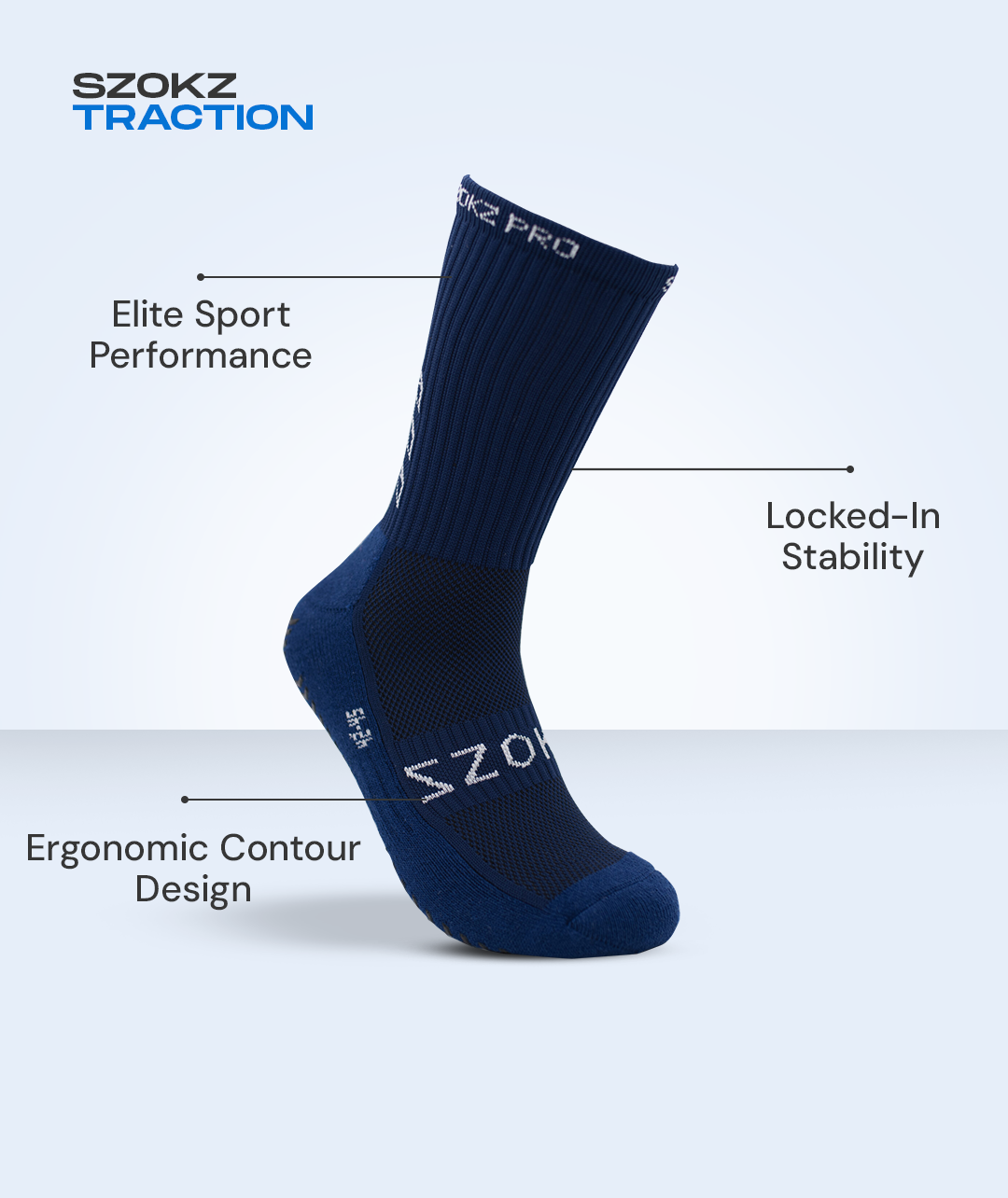

Short answer: grip socks reduce the movement of your foot inside a rowing shoe or erg strap. They do this with knitted grip zones under the ball of the foot and heel, which are the two points that press into the footplate during the drive. They don't add power and they won't fix technique. What they do is keep the foot where you put it, so the drive you generate goes into the plate rather than into a few millimetres of sock slipping. In the SZOKZ range, only the High Intensity Sport Socks have grip zones; the other ranges are compression socks without grip.
This article covers the erg and the boat separately, because the footwear is different, then gives a fit checklist and the SZOKZ socks that suit rowing.
Why rowing is different from other sports
In most sports, if your foot shifts you re-plant it. In rowing your feet are strapped or fixed to the footplate for the entire stroke, so there's no re-plant. Any slip that happens at the catch stays with you through the drive.
Two things can move:
- Your foot inside the sock.
- The sock inside the shoe.
Ordinary athletic socks control neither. A grip sock puts a high-friction surface on the outside of the sock at the ball and heel, which reduces the second kind of movement. The knit and fit of the sock reduce the first.
How much this matters depends on your shoe, how tight you strap, and how much you sweat. If your feet are already locked solid in well-fitted shoes, the difference will be small. If you row in shared boat shoes that are a size out, or you erg in trainers with loose straps, it's noticeable.
On the erg
On an erg your foot sits on a plate with a heel cup and a strap over the forefoot. Most people erg in trainers. Two things cause movement here:
- Strap tension. A loose strap lets the heel lift and the forefoot slide forward at the catch.
- Trainer fit. Running shoes are built to let the foot roll; they aren't designed to hold the foot still under a horizontal push.
Grip socks help most with the second. The heel grip zone holds the heel in the shoe as you come up to the catch, and the ball-of-foot zone keeps the forefoot from creeping under the strap on the drive.
What they won't do: compensate for a strap that's too loose. Set the strap over the widest part of your foot, tight enough that the heel can lift a little on the recovery but the forefoot can't move.
In the boat
Boat shoes are fixed to the foot stretcher and are usually shared, so fit is often poor — a size or more out, worn heels, stretched laces or velcro. This is where sock grip does the most, because it's the only variable you control.
In sweep and sculling the drive mechanics are the same as the erg, but the consequences of slip are wider: foot movement changes where your weight sits, which affects set. A stable foot makes it easier to keep the boat level through the drive.
What they won't do: make a badly sized boat shoe fit. If the shoes are two sizes out, sort the shoes first.
Fit checklist for rowing
Fit matters more than any feature. Use this before you buy.
- Size to your foot, not your shoe. If you row in oversized boat shoes, don't size the sock up to match. SZOKZ sizes are S (UK 3–5), M (UK 6–8), L (UK 9–11) and XL (UK 12–14).
- Grip zones must sit under the ball and heel. If the sock is too long, the grip lands under the arch and does nothing.
- Crew length. The grip socks are crew (mid-calf), which is what you want: it stays put under an erg strap and doesn't slide down in a boat shoe.
- Avoid cotton. You sweat inside a closed boat shoe. A cotton sock holds it; a moisture-wicking blend moves it.
What's in the sock
SZOKZ High Intensity Sport Socks use a grip-zone knit construction: the traction is knitted into the sock at the ball and heel rather than printed on, so it works against the inside of the shoe. The fabric is a moisture-wicking, odour-resistant 65% nylon blend with a reinforced heel and toe.
The arch band gives 20–30 mmHg compression through the mid-foot. On a long erg piece its job is to hold the sock in place and keep the grip zones where you put them; it is a localised arch wrap, not a graduated leg compression sock.
Which SZOKZ socks for rowing
The grip socks. These are the six plain-colour crew socks in the High Intensity range:
Full range: High Intensity Sport Socks.
The patterned All Sport socks, the ankle-cut socks and the Summit are compression socks with the same arch band and fabric but no grip zones. They're fine socks for the erg in a well-fitted trainer, but if the reason you're here is foot slip, they aren't the answer.
Prices: £7.99 for a single pair, £24.00 for a 4-pack (£6.00 per pair) or £30.00 for a 6-pack (£5.00 per pair). Free UK delivery on orders over £30, delivered in 2–3 business days.
Common questions
Do I need grip socks if my technique is good?
Technique decides where you put your foot; the sock helps keep it there. Good technique in a shoe that lets the foot move still loses something at the catch. Bad technique in a grip sock is still bad technique.
Will they work with any rowing shoe?
They work by friction against the inside of the shoe, so they help in most closed shoes. They help less in shoes with a very slick lining, or shoes so oversized that the foot moves regardless of sock. If yours behaves differently, tell us.
Are the ankle socks grip socks?
No. The ankle-cut range is compression only. For rowing you want the crew grip socks anyway, so nothing is lost.
Do they help recovery?
We don't claim that. The arch band reduces the feeling of mid-foot fatigue during a long piece for some people. That's during, not after.
How do I wash them?
Machine wash at 30°C, inside out to preserve the grip zones and colour. Do not tumble dry or iron. Air dry flat. Care details are in the FAQ.
What about grip socks vs normal socks generally?
Covered in Grip socks vs ordinary sport socks.
Hazel Gleed writes the SZOKZ Journal.
Comments
No comments yet. Be the first to add one.