
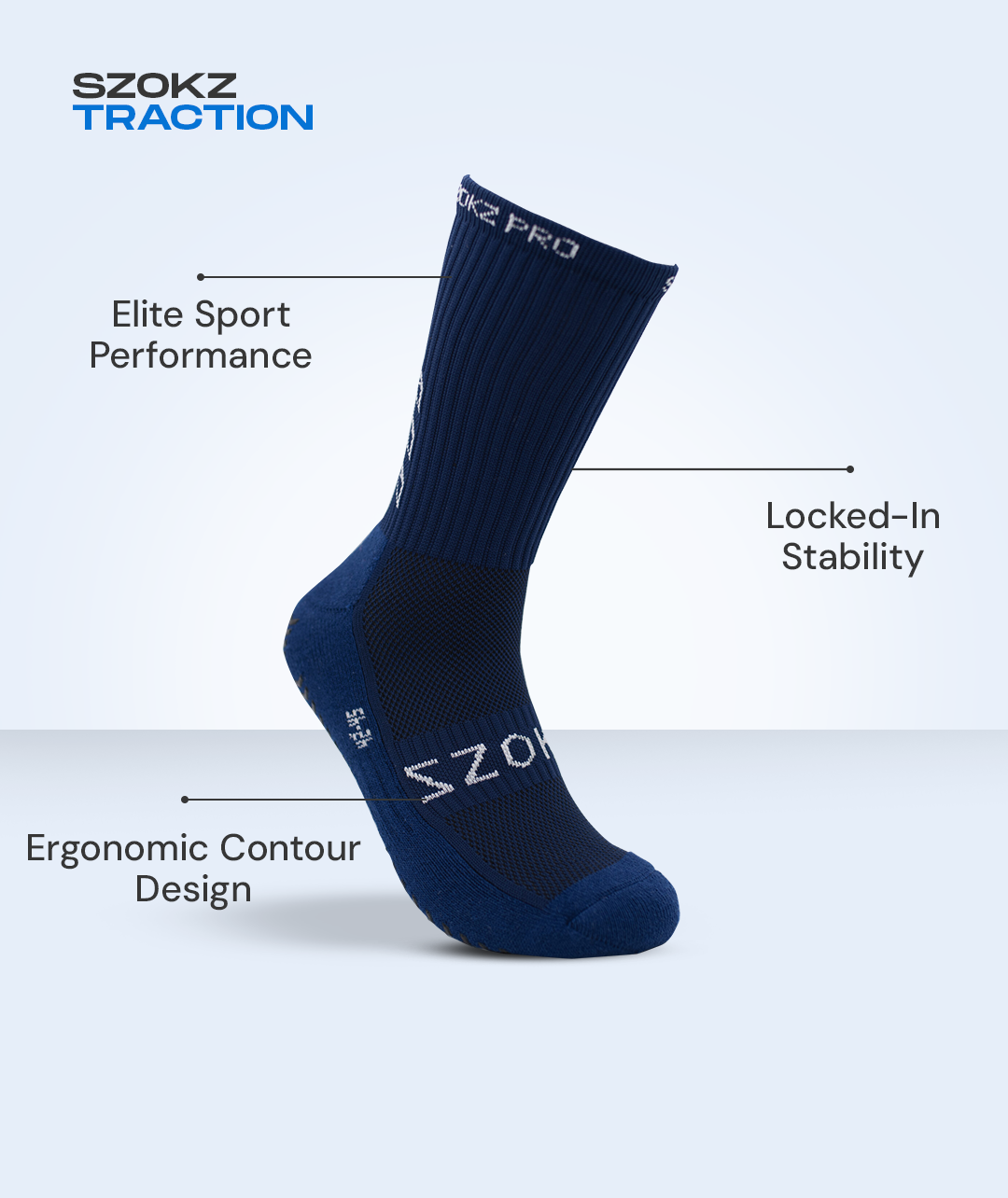

Short answer: if you train in trainers or lifting shoes, you want in-shoe grip socks — grip zones under the ball and heel that stop the sock sliding inside the shoe. If you do barefoot floor work (Pilates, reformer, some yoga and mobility classes), you want studio grip socks with rubber on the outside of the sole. SZOKZ makes the first kind, and only in one range: the High Intensity Sport Socks. The rest of the SZOKZ range is compression socks without grip. This guide explains the difference, how a grip sock should fit, and where in a gym session in-shoe grip is noticeable and where it isn't.
Two products called "grip socks"
Searching "gym grip socks" turns up both, and they don't do the same job.
| In-shoe grip socks (SZOKZ High Intensity) | Studio / floor grip socks | |
|---|---|---|
| Worn | Inside a trainer, lifting shoe or boot | Barefoot, on a mat or studio floor |
| Grip is on | The sock, under ball and heel, pressing against the shoe lining | The outside of the sole, pressing against the floor |
| Purpose | Reduce foot movement inside the shoe | Stop you sliding on a smooth floor without shoes |
| Doesn't help with | Barefoot floor work | Anything you do in shoes |
If your gym session is weights, conditioning and classes in trainers, in-shoe is the one. If it's reformer Pilates, studio socks. If it's both, you need both; one sock doesn't do both jobs.
What in-shoe grip changes when you train
Inside a trainer, two things can move: the foot inside the sock, and the sock against the shoe lining. A plain cotton or polyester sock controls neither. Knitted grip zones under the ball and heel reduce the second; a snug knit and an arch band reduce the first.
Where you'd expect to notice it:
- Heel lift in the shoe during lunges, step-ups and calf raises — the heel grip zone keeps the heel from lifting away from the insole.
- Forefoot creep in lateral or change-of-direction work — shuffles, box jumps, agility ladders — where the foot slides forward or sideways on the plant.
- Sweat mid-session. A cotton sock gets wet and slick; a moisture-wicking sock with grip stays put longer. This is the most common reason people say a grip sock "felt more stable" — it's the sock not moving when wet, not extra traction.
Where you probably won't notice it:
- Machine and isolation work. Foot position barely changes; there's nothing for the grip to do.
- Heavy barbell lifts in a well-fitted flat shoe. If the shoe already holds your foot and you set your feet before the lift, the sock adds little. Lifting shoes and flat trainers do most of the work here.
We're not going to tell you grip socks fix knee cave, deadlift bar path or squat depth. Those are technique, mobility and footwear questions. A sock that stays still in your shoe removes one small variable. That's the claim.
Fit guide
A grip sock that moves is just a sock. Fit does more than the grip pattern.
- Size to the chart, not up. SZOKZ sizes are S (UK 3–5), M (UK 6–8), L (UK 9–11) and XL (UK 12–14). Too big and the grip zones sit under the arch instead of the ball and heel.
- Check the grip lands under the ball and heel when you stand in them. If it doesn't, it's the wrong size.
- Crew length. The grip socks are crew (mid-calf). That suits gym use: it stays up under a trouser leg and doesn't roll under the heel counter. If you'd prefer an ankle sock, be aware the SZOKZ ankle range is compression only, without grip.
- The arch band should feel snug, not tight. It's there to keep the sock in place. If it leaves a deep mark or pinches, size up or choose a different sock — don't push through.
- Avoid cotton. For gym use specifically, a cotton sock is the worst option because it holds sweat and then slides.
What SZOKZ grip socks are made of
SZOKZ High Intensity Sport Socks use a grip-zone knit construction: the traction is knitted into the sock at the ball and heel rather than printed on, so it works against the inside of the shoe. The fabric is a moisture-wicking, odour-resistant 65% nylon blend with a reinforced heel and toe.
The arch band gives 20–30 mmHg compression through the mid-foot. Its job here is to hold the sock in place and keep the grip zones where you put them; it is a localised arch wrap, not a graduated leg compression sock.
Which SZOKZ socks for the gym
For grip, the High Intensity range — six plain-colour crew socks:
- White, navy, blue, red, yellow, neon yellow.
- Full range: High Intensity Sport Socks.
If foot slip isn't your problem and you just want a sock that stays up and dries fast, the patterned All Sport compression socks and the ankle-cut compression socks share the arch band and fabric without the grip zones.
Prices: £7.99 for a single pair, £24.00 for a 4-pack (£6.00 per pair) or £30.00 for a 6-pack (£5.00 per pair). Free UK delivery on orders over £30, delivered in 2–3 business days.
Common questions
Do grip socks replace lifting shoes?
No. Lifting shoes raise the heel and give a rigid, flat sole; that changes squat mechanics. Grip socks only reduce movement inside whatever shoe you're wearing. They can be worn inside lifting shoes.
Can I wear SZOKZ socks for Pilates or barefoot classes?
Not for grip. The grip zones are designed to work against a shoe lining, not a studio floor. For barefoot floor work use a studio grip sock with rubber on the outside of the sole.
Are the ankle or patterned SZOKZ socks grip socks?
No. They're compression socks — same arch band and fabric, no grip zones. Only the High Intensity range has grip.
Do I need them for machine work?
Probably not. Foot position doesn't change much on machines, so there's little for the grip to do.
Do they help with knee cave / bar path / squat depth?
Not directly. Those are technique, mobility and footwear issues. The sock removes one small variable — the foot moving inside the shoe.
How do I wash them?
Machine wash at 30°C, inside out to preserve the grip zones and colour. Do not tumble dry or iron. Air dry flat. Care details are in the FAQ.
Grip socks vs normal socks in general?
Covered in Grip socks vs ordinary sport socks.
Hazel Gleed writes the SZOKZ Journal.
Comments
No comments yet. Be the first to add one.