


Blisters are not caused simply by surface rubbing. They are driven by mechanical shear, where internal micro-movements tear tissue beneath the skin when your foot slides across the shoe liner. If you are searching for the most reliable anti blister running socks uk runners trust for endurance, standard cushioned socks will never solve that underlying movement.
Every distance runner knows the frustration. Deep into a long run, perspiration softens your skin, the sock bunches or slips, and intense friction forces you to alter your gait. You want blister-free marathons, absolute foot stability, and the muscular support that targeted compression provides from start to finish.
In this 2026 performance guide, you will discover how to eliminate friction and moisture using the UK’s most advanced anti-blister textile technologies. We examine the functional science of moisture management, compare traditional dual-layer systems against stability-focused grip engineering, and help you choose the right pair to keep your feet locked in place.
Key Takeaways
- Understand the blister triangle; friction blisters stem from moisture-induced skin softening and internal shear strain rather than simple surface rubbing.
- Prioritise modern technical builds featuring hydrophobic synthetic yarns, zonal ventilation, and anatomical tailoring to prevent fabric bunching.
- Learn why mechanical grip technology provides superior foot-to-insole lockdown compared to traditional dual-layer designs when choosing anti blister running socks uk athletes rely on.
- Match sock cuff height and targeted sole padding to your specific terrain to protect against debris and eliminate in-shoe heel slipping.
- Benefit from targeted 20-30mmHg compression to stabilise the plantar arch, control micro-movements, and speed up recovery across endurance distances.
The Science of Friction: Why Blisters Ruin UK Runs
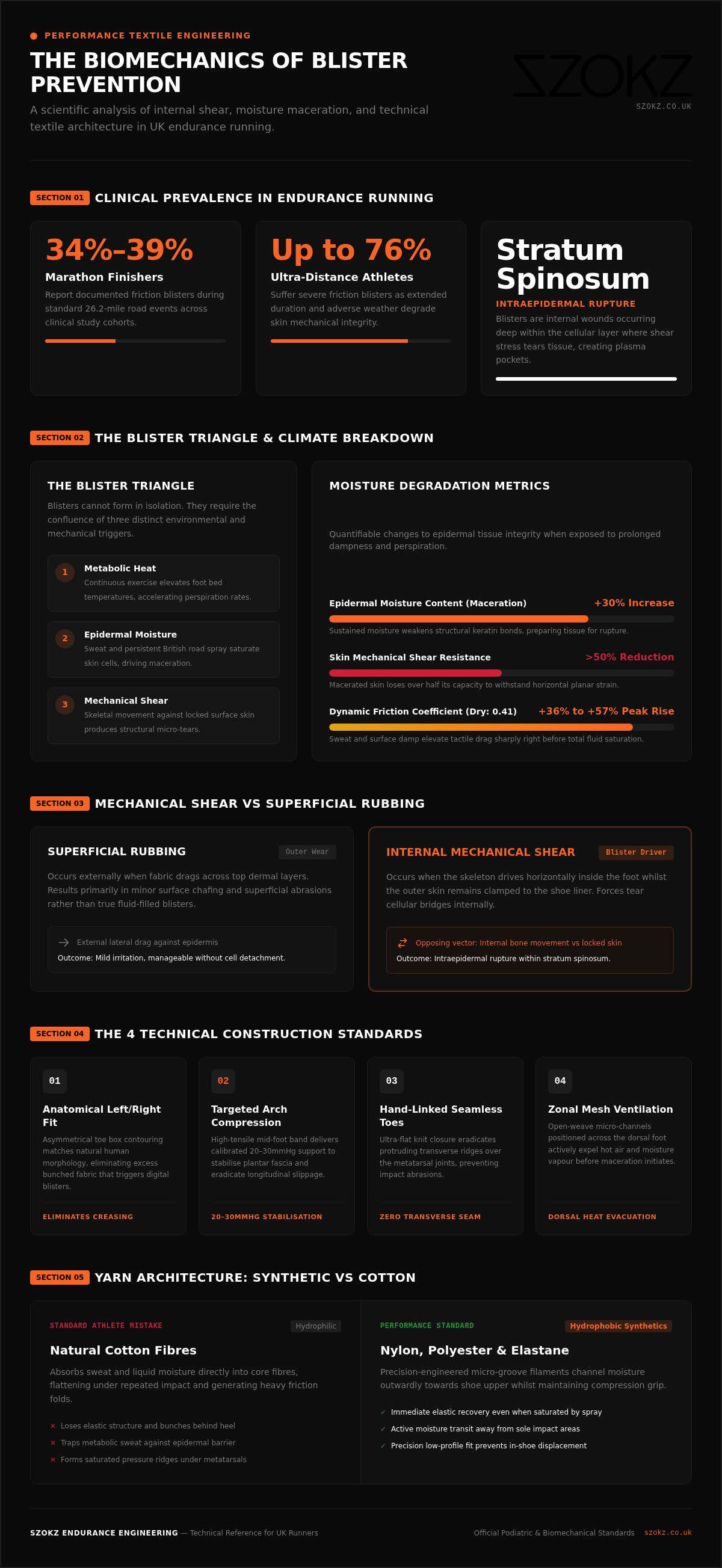
A blister is an internal injury. Medically, it is an intraepidermal tear within the stratum spinosum layer of your skin. It forms when bone moves inside the foot while the outer skin remains clamped against a shoe liner. This produces mechanical shear. Clinical data shows that friction blisters affect 34% to 39% of marathon finishers and up to 76% of ultra-distance competitors. To prevent them, you have to disrupt the blister triangle: heat, moisture, and friction.
Standard cotton socks collapse under endurance conditions. Cotton is naturally hydrophilic; it absorbs sweat and traps it against your epidermis. Once wet, cotton fibres flatten, lose elasticity, and bunch behind the heel or under the metatarsals. These saturated folds generate concentrated pressure points. Modern anti blister running socks uk runners rely on in 2026 eliminate cotton entirely. Instead, they combine synthetic yarn architectures with mechanical traction to stabilise the foot.
The Role of Moisture in the British Climate
British road and trail running presents unique climate challenges. High ambient humidity, constant surface spray, and saturated terrain guarantee wet feet. When your skin absorbs sustained moisture, it undergoes maceration. Prolonged dampness increases epidermal moisture content by over 30%, which weakens keratin bonds and reduces your skin's mechanical shear resistance by more than 50%.
Dry skin maintains a baseline friction coefficient of around 0.41 against athletic textiles. Sweat and road spray cause this to rise by 36% to 57%, creating peak friction right before total saturation. Breathable uppers alone cannot solve this problem. If your sock cannot actively wick liquid away from the plantar surface, your skin softens and breaks down under normal impact forces.
Shear Force vs. Rubbing
Most athletes confuse superficial rubbing with internal shear stress. Superficial rubbing causes minor abrasions. Real running blisters occur when horizontal forces pull surface skin in one direction while your skeletal structure drives in another. Citing podiatric research on shear stress and friction blisters, this lateral displacement stretches epidermal cells until they rupture and fill with plasma-like fluid.
Adding thick cushioning does not stop this process. Excessive padding introduces bulk, creating an unstable platform where the foot slides inside the shoe. Extra bulk also traps metabolic heat, accelerating skin maceration. True protection requires a precision fit. Modern anti blister running socks uk athletes choose for long-distance training use targeted arch compression and low-profile profiles to achieve a true second-skin fit, eliminating the internal slippage that drives blister formation.
Technical Features to Look for in 2026 Running Socks
Endurance footwear has evolved rapidly. Carbon plates and responsive super-foams dominate modern race shoes, yet runners frequently pair them with inadequate socks. When evaluating anti blister running socks uk athletes need designs that eliminate internal movement and actively counter damp British climates. Look for four essential construction standards:
- Anatomical left/right fit: Asymmetrical shaping mirrors the natural contour of your toes, eliminating the bunched fabric that triggers digital blisters.
- Targeted arch compression: High-tensile mid-foot bands anchor the sock firmly against the plantar fascia, stopping longitudinal slip.
- Hand-linked seamless toes: Flat-knit closures remove the bulky transverse seams that rub against the tips and joints of the toes.
- Zonal mesh ventilation: Open-weave panels over the dorsal foot vent heat and water vapour before skin softening can begin.
Material Science: Beyond the Basics
Technical knitwear in 2026 prioritises rapid moisture transit over artificial fabric softness. Plush, soft-touch fibres often hold moisture against the epidermis. Technical synthetics, engineered from precise blends of nylon, polyester, and elastane, use micro-groove filaments to pull sweat outward towards the shoe upper. Official NHS guidance on preventing blisters emphasises wearing properly fitted sports socks that wick moisture away during repetitive exercise. High elastane ratios ensure immediate elastic recovery, meaning the sock stays tight against the skin even after encountering persistent road spray.
Zonal Cushioning vs. Total Padding
Thick, heavily padded socks create dangerous bulk inside modern performance footwear. Modern running trainers have snug heel counters and narrow toe boxes; adding thick fabric crowds the foot, elevates heat, and increases shear strain. Zonal cushioning resolves this problem by placing dense, micro-knit loops only where friction and impact peak, specifically beneath the metatarsal heads and along the Achilles tendon.
This targeted approach maintains vital ground feel and preserves shoe volume while protecting high-wear zones. Pairing low-bulk profiles with secure mid-foot tension, professional-grade technical running sock collections keep your feet completely stable against the insole across every training mile.
Double Layer vs. Grip Technology: Which Prevents Rubbing?
Double-layer socks operate on a sacrificial friction model. Two independent fabric layers slide against each other, aiming to absorb movement before shear forces reach the skin. While this system mitigates surface rubbing, it introduces functional trade-offs. Heat gets trapped between the fabric layers, accelerating foot sweating. The extra material also packs out the forefoot in low-volume trainers. Examining why cushioning alone doesn't stop blisters highlights the central flaw: dual layers manage movement, but they don't actually stop it.
Grip technology uses an entirely different mechanical strategy. Instead of facilitating slip, it eliminates it. Ergonomic silicone grip pads mechanically lock the sock to the shoe insole, whilst high-tensile yarns lock the sock to your skin. Slippage stops entirely. For tempo runs and marathon efforts, this direct connection eliminates dead space, improves power transfer, and prevents the heat build-up common in layered fabrics.
The Grip Advantage for Trail and Road
Steep descents and aggressive corners drive the foot forward into the shoe upper. That repetitive collision causes bruised toenails and severe friction blisters across the toes. Bottom-sole grip pads halt this forward momentum on impact. The foot stays seated. Elite road and trail runners in 2026 increasingly favour mechanical traction because true stability neutralises shear forces across uneven cambers and wet road surfaces.
Compression: The Hidden Anti-Blister Hero
Lockdown requires more than sole traction; it requires mid-foot tension. Certified 20-30mmHg compression bands wrap the arch to hold the sock rigidly in place. Long-distance running causes natural foot swelling and arch flattening. When tired feet spread, loose socks wrinkle and generate concentrated hot spots.
Clinical advice highlighted in NHS guidance on preventing friction blisters recommends supportive, moisture-wicking gear to protect vulnerable tissues. A firm compressive wrap limits plantar arch deflection and controls fluid accumulation over high-mileage runs. When selecting the best compression socks for sport 2026 runners look for integrated stability profiles. By locking down the mid-foot, the best anti blister running socks uk athletes choose protect the skin by eliminating the micro-movements that trigger blistering.
The Runner's Checklist: Choosing Your Perfect Pair
Selecting the right technical footwear demands more than picking an appealing colourway. Match your sock architecture directly to your training demands. Follow this four-step diagnostic before buying:
- Step 1: Identify terrain demands. Road running involves repetitive, linear impacts that punish the metatarsals. Trail running introduces off-camber foot strikes, steep descents, and loose mud, demanding absolute rotational stability to prevent lateral shearing.
- Step 2: Match cuff height to footwear. Low-cut trainers work well with ankle-height socks featuring an Achilles tab. Off-road trail shoes or wet winter runs demand mini-crew or crew lengths to keep grit, peat, and puddle splash off the skin.
- Step 3: Evaluate your sweat profile. UK winter humidity requires ultra-fast wicking synthetics that shed surface water quickly. Summer endurance efforts need high-ventilation open-mesh dorsum panels to dissipate heat.
- Step 4: Assess lower-limb swelling. If your feet expand noticeably past kilometre 20, choose certified medical-grade 20-30mmHg compression to support the plantar fascia and maintain tight fabric contact.
Sizing for Success
Never size up to create extra room. A loose sock folds over itself inside the shoe, instantly creating a hot spot. When testing anti blister running socks uk athletes should aim for a compressive, skin-tight fit. Pull the sock on and inspect the toe box: the fabric must sit flat across the metatarsals without loose webbing between the toes. If the heel cup extends up your Achilles tendon, the chassis is too large.
Maintenance and Longevity
Technical synthetic blends require disciplined care to maintain their elastic memory and traction. Wash them inside out at 30 degrees Celsius. Avoid fabric softeners entirely, as conditioning chemicals coat synthetic yarns and kill their moisture-wicking properties. Hang them to air dry instead of using a tumble dryer; excessive drum heat degrades internal elastane threads and silicone grip pads.
Retire your socks the moment the forefoot weave visibly thins or the heel fabric loses its rebound. Worn fibres become stiff and abrasive, which sharply elevates friction against damp skin. Premium technical socks yield superior durability, giving you reliable, blister-free mileage throughout hard marathon cycles.
SZOKZ: Professional-Grade Stability for UK Runners
High-performance athletes do not rely on standard retail sportswear. Built specifically to eliminate in-shoe shear, the SZOKZ line brings elite pitch-level traction to road and trail running. By applying football and rowing traction engineering to endurance running, SZOKZ functions as a dedicated stability partner. The range includes All Sport Ankle Socks for streamlined road workouts and High Intensity Sport Socks for demanding, multi-terrain mileage. To understand the transition from heavy turf sports to running, read the ultimate guide to sports grip socks.
Every pair integrates verified 20-30mmHg medical-grade compression directly into the arch wrap. This pressure stabilises the plantar fascia, accelerates venous blood return, and stops the sock from shifting during hard efforts. It is this standard of stability that earns the trust of Team GB and Olympic athletes, who depend on unyielding gear under severe physical loads.
Engineered for the High-Intensity Athlete
Generic socks rely on external shoe volume to stay seated; SZOKZ creates an active internal lock. The engineered silicone array grips the shoe bed firmly, neutralising the micro-movements that tear tissue. Whether you select ankle-height cuts for tempo sessions or extended crew profiles for rough trail runs, the construction remains consistent: zero cotton, seamless toe links, and a targeted chassis that eliminates excess volume inside modern trainers.
Elite competitors choose SZOKZ because mechanical grip solves friction at the interface. Standard dual-layer alternatives slide and hold sweat, whereas direct grip keeps your foot anchored to the sole. For road racers targeting personal bests without hot spots, these are the anti blister running socks uk runners trust when performance cannot be compromised.
The SZOKZ Promise
SZOKZ remains a dedicated British sports science innovator focused on precision textile engineering. There is no needless marketing jargon, just functional gear tested at the highest tiers of international competition. High-mileage athletes can order direct with complete confidence, benefiting from free UK delivery on orders over £30. Experience authentic foot lockdown on your next training run and shop the range today.
Eliminate In-Shoe Friction and Lock In Performance
Blisters don't have to dictate your training volume or derail your race day goals. Solving friction requires stopping the microscopic internal slippage that tears deep epidermal tissue. By stepping away from bulky dual layers and adopting advanced synthetic weaves with mechanical traction, you eliminate the shear strain that compromises your stride. Finding the right anti blister running socks uk conditions demand comes down to securing absolute foot stability, fast moisture wicking, and targeted mid-foot support.
SZOKZ delivers this engineering standard directly to your training block. Built with verified 20-30mmHg medical-grade compression and worn by Team GB and Olympic athletes, every pair locks your foot securely against the insole. Protect your feet, recover faster, and enjoy free UK delivery on all orders over £30. Step up to your next starting line completely focused on your pace.
Frequently Asked Questions
Are double-layer socks better than single-layer for blisters?
Not necessarily. Double-layer designs manage friction between two textile sheets, but the dual fabric traps metabolic heat and adds volume. In snug modern trainers, that excess material crowds your toes and accelerates perspiration. A precision single-layer technical build with targeted grip anchors your foot without retaining heat, offering superior blister prevention without unnecessary bulk.
How do grip socks prevent blisters during running?
Grip socks eliminate the micro-movements that tear delicate epidermal layers. Ergonomic silicone arrays under the heel and ball of the foot grip the trainer's footbed mechanically. This prevents your foot from sliding forward on descents or slipping laterally on turns. When looking for anti blister running socks uk athletes choose grip models to eliminate shear strain entirely.
Can compression socks help with running blisters?
Yes. True medical-grade compression keeps the chassis firmly bound against the foot and lower leg. By applying 20-30mmHg of graduated pressure across the arch and calf, compression stabilizes the plantar fascia and reduces the lower-limb swelling that occurs on long runs. This stops loose material from wrinkling, preserving a flush fit that prevents hot spots.
What is the best material for anti-blister running socks in the UK?
Hydrophobic synthetic blends engineered with nylon, polyester, and elastane perform best in wet, unpredictable UK weather. Cotton absorbs water and holds it directly against your skin, causing rapid maceration. Fully synthetic yarns pull moisture away from the sole toward the breathable upper of the shoe, maintaining low surface friction even when navigating damp road spray or sodden grass.
How often should I replace my running socks to prevent blisters?
Replace your running socks every 300 to 500 miles, or roughly every six months of consistent mileage. Even if there are no visible holes, repetitive impacts compress the knitted micro-loops and stiffen the synthetic fibres. Once the heel and forefoot zones thin out or lose their elastic recovery, the fabric becomes abrasive and creates elevated friction against softening skin.
Do I need different socks for trail running and road running?
Yes, because the physical stresses and ground variables differ substantially. Road running demands low-profile cushioning with dense arch support to withstand repetitive, linear pounding on hard tarmac. Trail running involves uneven cambers and wet debris, requiring higher cuff heights to block gravel alongside specialised outsole grip that stops internal sliding during abrupt downhill braking.
Is it worth paying more for professional-grade running socks?
Investing in professional-grade gear is vital for long-term comfort and consistent training. Premium technical socks utilise hand-linked flat toe seams, certified 20-30mmHg compression wraps, and durable silicone pads developed for high-intensity athletes. Cheap multi-packs use abrasive transverse seams and cheap elastic that slackens quickly, which leads to painful blisters and secondary gait compensation injuries.
How should I wash my performance socks to keep them effective?
Wash technical socks inside out on a gentle 30-degree cycle using standard liquid detergent. Never use fabric softeners or conditioning agents. Conditioners leave a waxy chemical film over synthetic fibres, which clogs the micro-channels and ruins breathability. Always air dry your socks naturally, as aggressive tumble-dryer heat degrades elastic yarns and damages silicone grip structures.
Comments
No comments yet. Be the first to add one.