


Clinical research confirms that compression gear won't shave seconds off your race pace. Where it genuinely delivers is the moment your training session ends. If you battle persistent calf soreness, lower-leg heaviness, and deep muscular fatigue after high-mileage runs, using dedicated compression socks for running recovery transforms your physical reset. You already know the frustration of delayed-onset muscle soreness stalling your training cycle, whilst conflicting advice regarding active socks versus static recovery wear often leaves runners guessing.
Eliminating downtime requires verified physiological mechanics, not generic elastic compression. True muscle restoration relies on an engineered pressure gradient to assist the calf-muscle pump and accelerate venous blood flow. In this 2026 guide, you'll discover how graduated compression speeds up the clearance of metabolic waste, why the firm 20–30 mmHg profile remains the gold standard for endurance athletes, and how to select the right fit to banish lower-leg tightness before your next hard session.
Key Takeaways
- Understand the vascular mechanics of compression socks for running recovery to accelerate venous return and clear post-run metabolic waste efficiently.
- Learn why the 20–30 mmHg graduated pressure rating serves as the proven athletic benchmark for deep muscular repair over mild elastic support.
- Identify the critical operational differences between dynamic in-run footwear and static post-run garments to prevent fluid pooling.
- Master precise anatomical calf measurements to guarantee laboratory-grade pressure retention without restrictive pinch points.
- Implement a structured recovery protocol trusted by elite athletes to systematically cut downtime between strenuous training sessions.
The Science of Compression Socks for Running Recovery
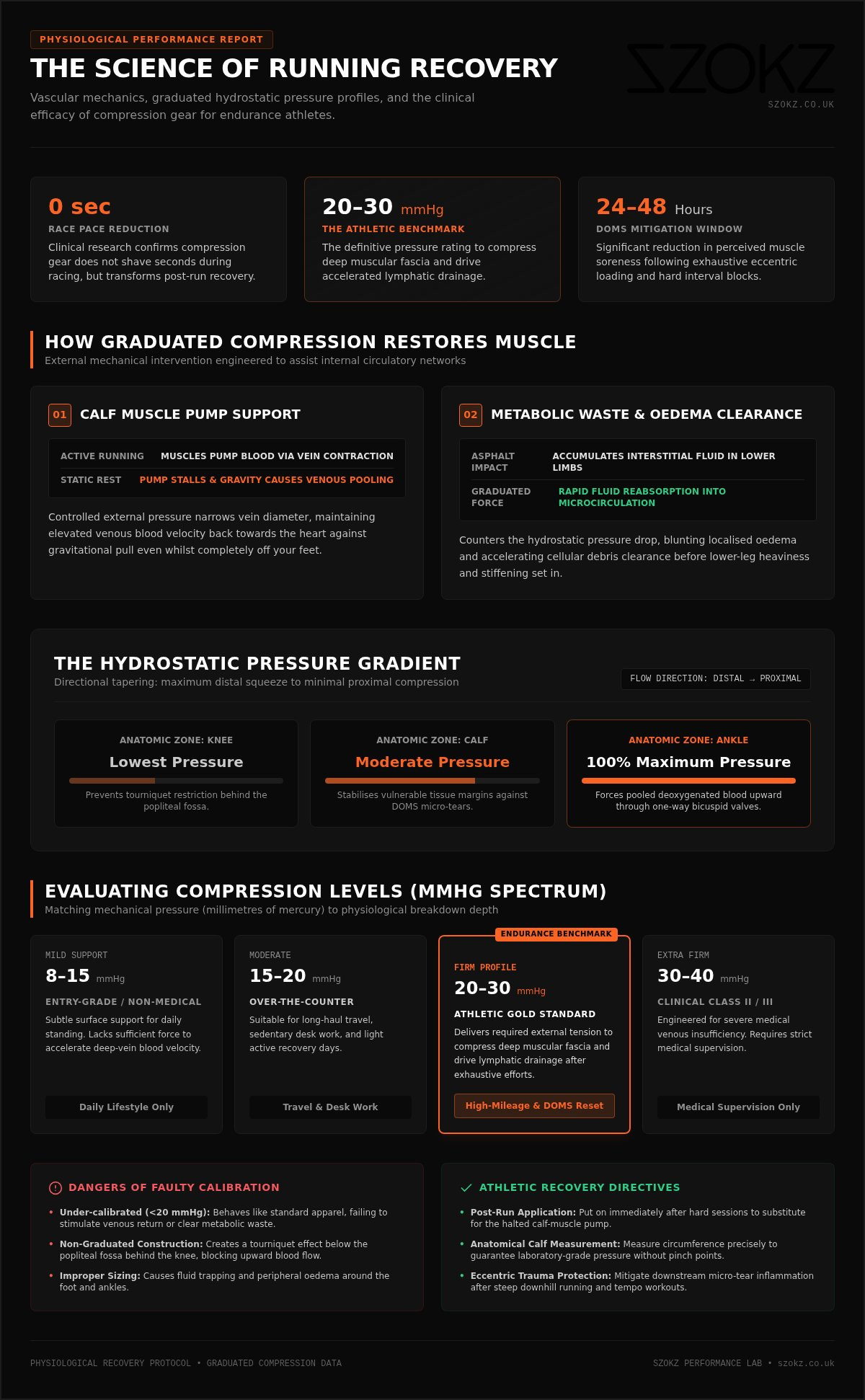
Elasticated fabric alone does not stimulate recovery. True vascular restoration demands a precise hydrostatic pressure gradient. Technical graduated compression garments apply their maximum mechanical pressure at the ankle, easing progressively as the textile travels up the calf. By tapering the external squeeze from distal to proximal tissue, graduated compression stockings accelerate venous blood flow back towards the heart against gravitational pull. Graduated compression therapy is an external mechanical intervention that applies controlled, tapering hydrostatic pressure from ankle to knee to accelerate metabolic waste clearance and blunt post-run DOMS.
This mechanical gradient supports both deep-vein blood flow and the lymphatic network. Repetitive pounding on asphalt increases interstitial fluid accumulation, leaving lower limbs heavy, swollen, and stiff. Applying calibrated compression socks for running recovery counters this hydrostatic pressure drop, facilitating rapid reabsorption of fluid into the microcirculation and clearing cellular debris before swelling sets in.
Venous Return and the Calf Muscle Pump
Your lower legs possess an internal circulatory engine: the calf muscle pump. During running, repeated contractions of the gastrocnemius and soleus compress deep intramuscular veins, propelling deoxygenated blood through bicuspid one-way valves. The moment you stop moving, this natural pump stalls. Gravity takes over, leading to venous pooling and fluid retention around the ankles. Controlled external pressure narrows vein diameter, which maintains elevated venous blood velocity even whilst you rest completely off your feet.
Mitigating Delayed Onset Muscle Soreness (DOMS)
Hard training efforts, especially downhill sections and tempo efforts, inflict micro-tears across muscle fibres through intense eccentric loading. This initial mechanical trauma triggers secondary inflammation, swelling, and delayed-onset muscle soreness. Sustained post-exercise compression stabilises vulnerable tissue margins, blunting localised oedema and reducing inflammatory markers.
Clinical data confirms that graduated pressure profiles significantly reduce perceived soreness 24 to 48 hours after hard efforts. By assisting waste clearance and limiting tissue disruption, dedicated compression socks for running recovery ensure your muscular system rebounds rapidly before your next scheduled interval block.
Evaluating Compression Levels: Why 20–30 mmHg Is the Athletic Benchmark
Compression pressure is quantified scientifically in millimetres of mercury (mmHg). This unit indicates the exact mechanical force applied to vascular walls at specific anatomical markers. Not all compression is equal. Light elastic sports socks often provide surface-level skin tightness without generating the hydrostatic push needed to clear intramuscular congestion. For endurance athletes seeking real physiological repair, matching the pressure rating to the depth of tissue breakdown is critical.
Deconstructing the Compression Rating Spectrum
Understanding pressure categories separates everyday lifestyle wear from dedicated athletic gear:
- 8–15 mmHg (Mild): Entry-grade, non-medical compression. It offers subtle surface support and minor relief from daily standing, but lacks sufficient force to accelerate deep-vein velocity.
- 15–20 mmHg (Moderate): The over-the-counter threshold suitable for long-haul travel, sedentary desk work, and light active recovery days.
- 20–30 mmHg (Firm): The definitive athletic benchmark for endurance runners. It delivers the precise external tension required to compress deep muscular fascia and drive lymphatic drainage after exhaustive efforts.
- 30–40 mmHg (Extra Firm): Clinical-grade Class II and Class III hosiery. These garments manage severe venous insufficiency and require medical supervision.
The Danger of Inadequate or Excessive Pressure
Precision fit matters. Under-calibrated socks act as standard apparel; they fail to stimulate venous return or accelerate the clearance of post-run metabolites. Conversely, improperly engineered or non-graduated socks risk creating a tourniquet effect below the popliteal fossa behind the knee, impeding upward blood flow and causing peripheral oedema around the foot. Reviewing established clinical guidelines for wearing compression stockings reinforces that therapeutic efficacy hinges entirely on a graduated profile that tapers upward from the ankle.
For high-mileage road training and trail runs, adopting genuine 20–30 mmHg compression socks for running recovery bridges the gap between passive rest and active repair. Runners seeking optimal calibration standards can explore the detailed 20-30 mmHg compression socks UK buying guide 2026 to evaluate certified pressure tolerances. If you want laboratory-grade support engineered specifically to cut post-training downtime, you can explore our technical compression range to secure verified graduated profiles for your training schedule.
During the Run vs Post-Run Recovery: Timing and Protocols
Active running footwear and passive recovery gear solve two distinct mechanical problems. In-shoe athletic socks prioritise moisture management, blister reduction, and forefoot stability inside a moving trainer. Dedicated compression socks for running recovery serve a purely vascular objective; they deliver uninterrupted, graduated hydrostatic pressure across resting muscular tissue once dynamic motion has ceased.
In-Run Oscillation Control vs Static Fluid Clearance
Each ground impact sends shockwaves rippling upward through the tibia. This impact forces muscle fibres to oscillate, compounding structural micro-tears across the calf complex. Active compression dampens this oscillation mid-stride, limiting energy leakage during training blocks.
Once you finish your miles, the operational requirement shifts entirely. Muscular contractions stop, which leaves deoxygenated blood and extracellular fluid susceptible to gravitational pooling. Authoritative analysis on how compression socks aid muscle recovery highlights that external hydrostatic pressure substitutes for the dormant calf pump, actively preventing swelling and flushing stagnant metabolites whilst you sit at a desk or rest on the sofa.
Optimal Time Windows: How Long Should You Wear Them?
Circulatory restoration is most receptive immediately following hard physical output. Clinical observations confirm the critical therapeutic window opens within the first 90 minutes post-run. Pull on your 20–30 mmHg compression socks for running recovery straight after your post-run shower, keeping them on for two to four continuous hours during passive downtime.
Overnight wear remains an option for severe multi-stage soreness, though it is rarely mandatory. Once you lie horizontally, gravity stops impeding venous blood flow, meaning simple leg elevation often provides comparable relief. If you choose overnight use, ensure your socks feature flat, non-constricting cuffs that will not pinch peripheral tissue as you shift during sleep. Explore our best compression socks for sport 2026 British guide for specialised protocols tailored to marathon tapering and heavy training blocks.
The golden recovery rule: apply graduated pressure within 90 minutes of stopping, maintain steady compression for two to four hours, and allow external pressure to clear metabolic waste before your next training block begins.
Key Features to Look For in Running Recovery Socks
Knitted architecture determines whether technical footwear functions as a vascular tool or simple tight hosiery. Selecting effective compression socks for running recovery requires auditing material mechanics, seam construction, and anatomical profiling rather than relying on brand aesthetic.
Calf Circumference vs Shoe Sizing Accuracy
Shoe size is a completely unreliable proxy for vascular fit. Two athletes wearing UK size 9 trainers rarely share identical lower legs; one may possess a 34 cm calf circumference, whilst another measures 42 cm. Sizing solely by shoe dimension risks dangerous arterial restriction or inadequate, useless compression.
Always measure the widest point of your calf using a flexible measuring tape. Take this reading first thing in the morning before gravity causes daytime fluid to pool. Match your circumference directly to manufacturer sizing charts to ensure calibrated graduated pressure.
Material Engineering and Structural Knit
Durability dictates long-term vascular performance. Standard cotton absorbs moisture and sags rapidly, destroying the intended compression profile. Technical recovery socks utilise multi-filament synthetic fibres, combining dense nylon weaves with resilient elastane cores to preserve precise graduated tension across hundreds of wash cycles.
Pay close attention to the toe pocket. After high-mileage runs, toes and nail beds are prone to pressure sensitivity and blistering. Ergonomic, hand-linked seamless toe boxes eliminate abrasive ridges entirely. Runners seeking bespoke structural ratios can reference our guide on compression socks for women 2026 performance recovery to match narrower ankles with targeted calf profiles.
Graduated Cuff Design and Pressure Tapering
The top border of the sock makes or breaks passive wear. Narrow elastic bands pinch the skin, roll downwards, and create restrictive pressure rings directly below the popliteal crease. Premium recovery hosiery employs a wide, flat cuff that disperses tension evenly without biting.
Smooth internal seams are equally vital. Because recovery protocols involve hours of static lounge rest or desk work, uneven internal stitching causes skin irritation. High-calibre compression socks for running recovery feature flat-lock stitching that sits imperceptibly against sensitized muscle tissue.
Building an Elite Post-Run Recovery Protocol with SZOKZ
Compression wear operates at its peak when integrated into a disciplined post-run framework. Relying on socks to compensate for chronic dehydration or sleep deficits produces poor results. When paired with structured hydration, glycogen replenishment, and passive rest, verified compression socks for running recovery systematically accelerate soft-tissue repair and prepare your legs for subsequent training blocks.
Integrating Compression into Your Weekly Mileage Cycle
Strategic timing maximizes the impact of external hydrostatic pressure:
- Target Strenuous Days: Deploy your socks immediately following high-impact sessions such as weekend long runs, threshold intervals, and steep hill repeats where eccentric muscular breakdown peaks.
- Combine with Passive Elevation: Elevate your heels above heart level for 15 minutes straight after pulling on your socks to encourage initial vascular return before settling into normal recovery activities.
- Eliminate Travel Stagnation: Pack clean compression gear in your kit bag for long post-race car journeys or train commutes to prevent lower-limb swelling caused by static sitting.
The British Athletic Standard: SZOKZ Engineering
SZOKZ rejects athletic hyperbole and flashy gimmicks. The gear is engineered in the UK with functional pragmatism, delivering certified 20–30 mmHg graduated pressure profiles verified to support deep-vein blood flow. It is why our gear is trusted by Team GB and Olympic athletes during gruelling preparation and recovery phases.
Every pair incorporates ergonomic seamless toe construction that prevents post-run pressure points over compromised toenails. Resilient synthetic technical blends ensure targeted tension remains intact wash after wash, resisting the bagging out common in ordinary sporting hosiery. All qualifying UK orders over £30 receive free delivery across England, Scotland, Wales, and Northern Ireland. Discover professional-grade support by visiting SZOKZ to equip your training kit with reliable British engineering.
Consistency builds endurance. Equipping your recovery system with dedicated compression socks for running recovery safeguards your muscles against cumulative fatigue, ensuring you arrive at every workout ready to perform.
Master Your Post-Run Reset for Consistent Performance
Post-run muscular fatigue shouldn't derail your weekly mileage goals. Real vascular restoration hinges on precise hydrostatic pressure that keeps venous blood moving once your natural calf muscle pump rests. Investing in calibrated compression socks for running recovery clears interstitial waste, minimizes swelling, and dramatically shortens your reset between demanding road sessions.
Engineered to strict 20–30 mmHg graduated compression specifications, SZOKZ hosiery delivers laboratory-grade circulatory support without unnecessary hype. It's the functional benchmark worn and trusted by Team GB and Olympic athletes across relentless competition blocks. Plus, free UK delivery is available on orders over £30.
Give your legs the technical support they deserve after every hard effort, protect your body against cumulative strain, and tackle your next training block with renewed power.
Frequently Asked Questions
How do compression socks speed up muscle recovery after running?
They apply mechanical pressure that accelerates venous return and lymphatic drainage. By tapering pressure from the ankle upward, technical garments assist dormant calf muscles in moving deoxygenated blood back toward the heart. This rapid fluid exchange limits inflammatory oedema, flushes cellular metabolic by-products, and reduces the severity of delayed-onset muscle soreness after strenuous training blocks.
Should I wear 15–20 mmHg or 20–30 mmHg compression socks for running recovery?
Opt for 20–30 mmHg compression socks for running recovery following demanding distance or tempo sessions. The 15–20 mmHg tier suits light desk wear, long flights, and minor daily fatigue. However, managing the deeper muscle breakdown and lower-limb swelling typical of distance running requires the firm, verified 20–30 mmHg profile to compress intramuscular fascia effectively.
How long should I keep compression socks on after a long run?
Wear them continuously for two to four hours immediately following your post-run wash. Scientific trials reveal that circulation responds best within the initial 90 minutes post-exercise. Keeping your graduated hosiery on during this static downtime ensures that fluid does not pool around your lower legs whilst you sit, hydrate, and digest nutrients.
Can I sleep in my compression socks after a marathon or hard workout?
Sleeping in them is generally unnecessary because lying horizontal removes gravitational resistance against venous blood flow. Elevating your feet on a pillow often delivers equal circulatory benefits overnight. If you choose to sleep in them for severe soreness, ensure they feature non-binding cuffs that will not pinch, bunch, or restrict circulation during restless movement.
Is it better to wear compression socks during a run or after finishing?
Wearing them post-run yields the greatest vascular recovery benefits. During dynamic running, compression primarily stabilises soft tissue and dampens tibial impact vibrations without measurably improving running economy or race pace. Using dedicated compression socks for running recovery once you stop moving actively replaces the resting calf pump to accelerate metabolic clearance.
How do I choose the correct size compression socks for recovery?
Measure your calf circumference at its widest point using a flexible tape measure rather than relying on shoe size. Take this measurement first thing in the morning before fluid pools in your lower limbs. Matching this anatomical circumference against manufacturer charts guarantees you receive true graduated pressure rather than an overly tight or loose fit.
What is the difference between cheap support socks and athletic recovery socks?
Cheap support socks use generic elastic that applies uniform tightness without a verified pressure gradient. Athletic recovery socks feature lab-calibrated graduated knit structures engineered from resilient synthetic fibres like nylon and elastane. They also incorporate flat-lock seams and seamless toe construction, ensuring consistent pressure retention without painful friction points over sensitized post-run feet.
Comments
No comments yet. Be the first to add one.