


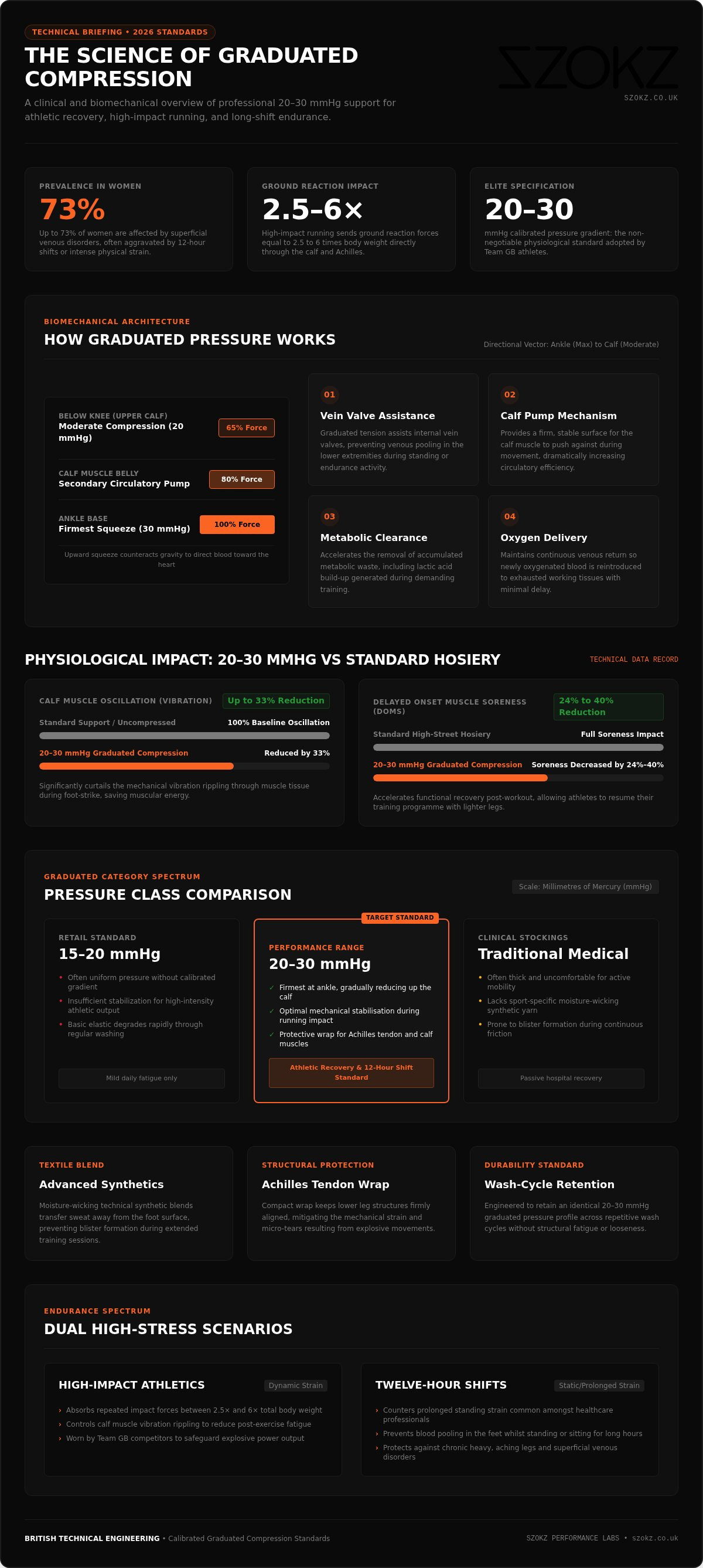
Superficial venous disorders affect up to 73% of women, yet many still rely on standard high-street hosiery to manage daily strain. If you've finished a twelve-hour shift or a high-impact run only to deal with heavy, aching legs, you know that basic elastic isn't enough. Finding the right compression socks for women isn't about aesthetics. It's about technical precision.
You likely already recognise that recovery is just as vital as the performance itself. We promise to show you how professional-grade 20-30 mmHg graduated compression can transform your athletic recovery, daily comfort, and circulatory health. This guide covers the science of muscle oscillation and the benefits of medical-grade support. We'll examine why specific textile blends, like those worn by Team GB, are the essential tool for your 2026 training programme. Expect faster recovery and reduced swelling. No more blisters. Just pure, functional support that works whilst you move.
Key Takeaways
- Understand the mechanics of graduated compression and why pressure must be concentrated at the ankle to effectively facilitate blood flow.
- Learn why 20–30 mmHg is the definitive standard for compression socks for women, providing the stability needed for both high-impact sport and long shifts.
- Identify the critical differences between recovery for endurance athletes and the specific circulatory needs of healthcare professionals.
- Discover how moisture-wicking synthetic blends prevent blister formation whilst maintaining consistent pressure through multiple wash cycles.
- Explore the technical benefits of British-engineered gear used by Team GB athletes to maintain peak physiological performance.
Understanding Compression Socks for Women: More Than Just Tight Hosiery
Compression garments are often misunderstood. Many people still associate them with hospital recovery or elderly care. In reality, modern compression socks for women are high-performance tools engineered to optimise circulatory health. They aren't just tight socks. They're functional equipment designed to facilitate oxygen delivery and metabolic waste removal. By applying specific pressure levels, they support the body's natural mechanics and ensure your legs feel light after intense activity.
Moving beyond medical necessity, these tools now support high-performance lifestyles. Elite athletes use compression to maintain discipline in their recovery routines. The proactive use of these garments ensures that heavy, aching legs don't become a barrier to training or daily productivity. It's a silent partnership between the gear and the wearer's achievements, allowing for consistent performance without the distraction of physical fatigue.
How Graduated Pressure Actually Works
At the heart of this technology is the pressure gradient. In graduated compression stockings, the squeeze is firmest at the ankle and gradually decreases as it moves up the leg. This structure assists the valves in your veins. It creates an upward squeeze that helps blood fight gravity and return to the heart. Your calf muscle acts as a secondary pump. When you move, the compression provides a stable surface for the muscle to push against, increasing circulatory efficiency. This mechanism effectively prevents blood from pooling in the feet whilst you stand for long shifts or sit during travel.
The Difference Between Athletic and Medical Grade
Distinguishing between retail support and technical gear is essential. Standard shop-bought support socks often provide uniform pressure. This lacks the technical precision needed for performance. Technical gear uses the millimetres of mercury (mmHg) scale to define exact support levels. For active individuals, material choice is critical. Clinical stockings are often thick and uncomfortable. In contrast, professional-grade compression socks for women use advanced synthetic blends. These fabrics offer durability and moisture management that clinical versions cannot match. To understand the specific requirements of this standard, you can consult our 20-30 mmHg compression socks UK buying guide. High-performance socks must withstand the rigours of movement whilst maintaining a consistent pressure profile through every wash cycle.
Decoding the Pressure: Why 20-30 mmHg is the Performance Standard
Most high-street options offer 15-20 mmHg. This is insufficient for high-intensity output. Professional-grade compression socks for women focus on the 20-30 mmHg range. This is the physiological "sweet spot" for active recovery. It provides the firm support needed to stabilise muscle tissue during explosive movements. This level of pressure isn't just about comfort. It's about mechanical efficiency.
High-impact running generates ground reaction forces equal to 2.5 to 6 times your body weight. This creates muscle oscillation, which is the vibration that ripples through your calf muscle. Technical research indicates that medical-grade compression reduces this oscillation by up to 33%. Less vibration means your muscles waste less energy. It also significantly reduces delayed onset muscle soreness (DOMS) by 24% to 40%. The result is a faster return to training.
Circulatory Benefits and Oxygen Delivery
Oxygen delivery is the priority for any athlete. Graduated pressure facilitates the rapid removal of metabolic waste. This includes lactic acid that accumulates during heavy sessions. A MedlinePlus guide on compression stockings confirms that this specific pressure prevents blood pooling in the lower extremities. For professional athletic recovery, 20-30 mmHg is the non-negotiable standard. It ensures that fresh, oxygenated blood reaches your working muscles more effectively.
Reducing Fatigue During High-Intensity Training
Explosive movements strain the Achilles tendon and calf muscles. Compression provides a protective wrap that keeps these structures compact. This reduces the mechanical stress on the lower leg and can mitigate the risk of micro-tears. If you're looking for specific gear recommendations, our Best Compression Socks For Sport 2026 British Guide provides a detailed breakdown of the top performers.
Maintaining this 20-30 mmHg profile requires precise textile engineering. SZOKZ uses a technical blend of 65% nylon, 15% polyester, and 20% spandex. This specific composition ensures the pressure doesn't degrade after repeated use. Cheap alternatives often lose their elasticity within weeks. Our compression socks for women are designed to hold their shape and performance standard through dozens of wash cycles. You can view our full range of professional-grade performance gear to find the right fit for your specific discipline.
From Marathons to Long Shifts: Essential Use Cases for Women
Performance compression is not limited to the athletics track. It's a versatile tool for any woman facing prolonged physical strain. Whether you're navigating a marathon or a double shift, the physiological demands on your lower limbs are significant. Modern compression socks for women bridge the gap between elite sport and professional endurance. They provide a consistent baseline of support that adapts to your environment. Technical fabrics now allow for all-day wear without compromising on comfort or breathability.
Daily activity often leads to "heavy leg" syndrome. This sensation is the physical result of fluid accumulation and metabolic fatigue. Proactive compression mitigates this by maintaining active circulation. It ensures that your legs feel as fresh at the end of the day as they did at the start. It's about maintaining a high standard of physical readiness, regardless of your schedule.
Athletic Recovery and Injury Prevention
The "post-workout window" is critical for long-term progress. Wearing compression socks for women for 24 to 48 hours after high-intensity training maximises the benefits of metabolic waste clearance. This practice is particularly effective for managing shin splints and calf strains. By providing external stabilisation, the socks help maintain tissue alignment during the repair phase. There's also a psychological benefit. Feeling physically supported during heavy training blocks reduces perceived effort and builds confidence in your recovery process.
Professional Support: Nurses, Retail, and Hospitality
Healthcare and retail professionals face unique circulatory challenges. Standing for 12 or more hours on hard floors places immense pressure on the vascular system. This often results in painful end-of-day swelling and foot fatigue. Technical compression reduces this fluid build-up by assisting the return of blood to the heart. For those in clinical environments, our Compression Socks for Nurses 2026 UK Buying Guide provides specific frameworks for selecting gear that handles the rigours of a hospital ward.
Travel and Daily Circulation
Long-haul travel presents a different set of risks. Prolonged inactivity whilst flying or on long car journeys slows blood flow. This increases the risk of deep vein thrombosis (DVT). According to Cleveland Clinic's compression therapy recommendations, graduated pressure is a primary tool for mitigating travel-induced circulatory issues. Modern technical fibres ensure temperature regulation and moisture management. You stay comfortable and protected throughout the journey.
Choosing the Right Pair: Material, Fit, and Durability
Selecting compression socks for women requires a technical approach. It's not just about choosing a favourite colour. You must match the garment to your specific physical output. For high-intensity sport, stability and arch support are the priorities. For recovery or long-haul travel, all-day comfort and moisture management take precedence. A professional-grade sock acts as a silent partner to your discipline, providing the tools you need to succeed without distraction.
There is a distinct trade-off between cushioning and compression. Excessive padding often interferes with the graduated pressure profile. Technical designs focus on targeted padding at high-impact zones like the ball and heel. This ensures the 20-30 mmHg pressure remains consistent across the calf whilst protecting against ground reaction forces. High-performance gear prioritises this balance to ensure maximum circulatory efficiency during movement.
Sizing and Measurement for a Perfect Fit
Shoe size is an unreliable metric for compression gear. It doesn't account for the volume of your calf or the narrowness of your ankle. To achieve the correct pressure gradient, you need three specific measurements taken at home. Use a flexible tape measure for the best results:
- Ankle circumference: Measure the narrowest point just above the ankle bone.
- Calf circumference: Measure the widest part of the calf muscle whilst standing.
- Leg length: Measure from the floor to the popliteal fold, which is the crease behind your knee.
Avoid socks that are too long. Fabric that bunches behind the knee can act as a tourniquet. This restricts blood flow and causes discomfort. A precise fit ensures the pressure is highest at the ankle, as intended by the graduated design.
Performance Fabrics vs. Standard Materials
Standard cotton is unsuitable for technical compression socks for women. It absorbs moisture, becomes heavy, and loses its shape. This leads to friction and blisters. Technical synthetic blends, specifically those using high-tensile nylon and spandex, are essential. These materials provide the necessary elasticity whilst allowing the skin to breathe. Breathability is crucial for preventing fungal issues during long periods of wear, such as twelve-hour hospital shifts.
Durability is a hallmark of quality engineering. Look for reinforced heel and toe areas that can withstand repeated mechanical stress. High-grade synthetics maintain their compression levels through dozens of wash cycles. This ensures your investment continues to deliver physiological benefits long after cheaper alternatives have failed. Quality gear doesn't just look modern; it performs consistently.
Elevating Your Performance with SZOKZ Professional Grade Socks
SZOKZ represents the intersection of elite sports science and everyday functional utility. We don't believe professional-grade tools should be restricted to the stadium. Our range of compression socks for women provides physiological advantages to every user. Whether you're a competitive runner or a professional on a long shift, your circulatory needs are identical. We act as your silent partner. Our gear supports your discipline whilst you focus on the objective.
Rooted in British engineering, our design process prioritises technical excellence. We focus on the mechanics of movement. Every stitch serves a purpose. This grounded approach ensures our products deliver tangible results. We value performance over flashiness. Our commitment to quality means you can rely on your equipment in any environment.
Team GB Standards for Every Active Woman
The technology within our socks isn't theoretical. It's proven. SZOKZ gear is worn by Team GB and Olympic athletes who demand high standards. We utilise rigorous testing and feedback loops with elite performers to refine our designs. This ensures our 20-30 mmHg standard is more than a label; it's a performance guarantee. For those looking to improve stability across all training disciplines, The Ultimate Guide to Sports Grip Socks explains how our engineering principles apply to speed and footwork.
The SZOKZ Engineering: Comfort Meets Power
The efficacy of a compression garment depends on its weave. SZOKZ uses a specific technical blend to maintain 20-30 mmHg pressure throughout the day. We've developed a bespoke anatomical fit for our compression socks for women. This isn't a scaled-down men's product. It's a design accounting for female physiological proportions. The result is a secure, powerful fit. No slipping. No bunching. You get consistent support that empowers your movement. Explore the SZOKZ compression range for women to find the right tool for your discipline.
Optimising Your Recovery Standard
Technical recovery is a deliberate choice. You can settle for basic high-street elastic or invest in gear that supports your physiological potential. Professional-grade compression socks for women provide the stability needed to maintain your training discipline. It's about ensuring your legs feel light and ready for the next challenge, whether that's a marathon or a twelve-hour shift. True performance requires gear that doesn't lose its shape after a single wash.
SZOKZ gear is designed for 20-30 mmHg performance. This isn't just marketing. It's the technical standard worn by Team GB athletes to ensure peak circulatory efficiency. We focus on the textile engineering so you can focus on the results. We act as your silent partner, facilitating recovery whilst you pursue your next achievement. With free UK delivery on orders over £30, elite-level support is accessible for every active woman. Don't let fatigue dictate your schedule.
Your achievements are a result of your own hard work. Our tools simply ensure you're in the best position to succeed. Stay disciplined. Keep moving. Let the gear handle the rest.
Frequently Asked Questions
What is the best compression level for women’s sports socks?
The optimal level for performance and recovery is 20-30 mmHg graduated compression. This range provides the firm support required to stabilise muscles and facilitate blood flow during high-intensity activity. Whilst lower levels like 15-20 mmHg offer mild comfort, they often lack the technical pressure needed for significant physiological benefits. Professional athletes, including those in Team GB, rely on this 20-30 mmHg standard to ensure their gear works as hard as they do.
Can I wear compression socks all day whilst at work?
You can certainly wear compression socks for women throughout your entire working day. They are particularly beneficial for professionals in healthcare, retail, or hospitality who spend long hours standing on hard surfaces. The graduated pressure prevents fluid from pooling in your lower limbs, which reduces end-of-shift swelling and foot pain. Ensure you have a professional fit to maintain comfort for 12 or more hours without the fabric bunching behind your knees.
How do I know if my compression socks are too tight?
Your socks should feel like a firm, supportive hug rather than a restrictive tourniquet. Signs that they are too tight include numbness, tingling in your toes, or a noticeable loss of skin colour. If you see deep, painful indentations that persist long after removal, you likely need a larger size. Always measure your ankle and calf circumference rather than relying on shoe size to ensure the pressure gradient remains safe and effective for your circulation.
Do compression socks actually help with muscle recovery after running?
Research confirms that graduated compression significantly aids post-run recovery by reducing delayed onset muscle soreness (DOMS). By facilitating the removal of metabolic waste like lactic acid and reducing muscle oscillation during the run, these socks help your tissues repair faster. Wearing them for 24 to 48 hours after a high-intensity session ensures you can return to training sooner. This is why professional-grade gear is a staple for endurance athletes across the UK.
How often should I replace my performance compression socks?
Most performance compression socks should be replaced every four to six months with regular use. Over time, the technical synthetic fibres like spandex and nylon begin to break down, which leads to a loss of the precise 20-30 mmHg pressure gradient. If you notice the socks are easier to pull on or they no longer feel as supportive around the ankle, it's time for a new pair. High-quality engineering ensures they last longer than standard alternatives.
Are compression socks safe to wear during pregnancy?
Compression socks are generally safe and highly recommended during pregnancy to manage swelling and prevent varicose veins. The expansion in blood volume and hormonal changes can lead to circulatory strain, which graduated pressure effectively mitigates. You should consult your midwife or GP before starting a compression routine, especially if you have existing health conditions. Ensure you choose breathable fabrics to maintain comfort as your body temperature fluctuates during the third trimester.
How should I wash my compression socks to maintain the pressure?
To preserve the elastic integrity of compression socks for women, you should wash them in cool or lukewarm water. Use a gentle detergent and avoid fabric softeners, as these can coat the technical fibres and reduce their effectiveness. Always air dry your socks away from direct heat sources like radiators. Never put them in a tumble dryer, as high heat will destroy the spandex and permanently compromise the graduated pressure profile of the garment.
What is the difference between 15-20 mmHg and 20-30 mmHg?
The primary difference lies in the intensity of the pressure. 15-20 mmHg is a mild level suitable for general wellness, minor swelling, or short-haul travel. In contrast, 20-30 mmHg is a medical-grade firm support level designed for athletic recovery and managing chronic venous insufficiency. For women who find that standard socks don't stop their legs from aching after a long day, the 20-30 mmHg range provides the necessary technical support to produce tangible results.
Comments
No comments yet. Be the first to add one.