


Resting for weeks won't cure shin splints if your calf muscles continue to pull violently against the tibia with every foot strike. If you're battling sharp, debilitating pain along your shinbone, you already know the frustration of derailed training blocks and generic garments that slide down or pinch behind your knees. Finding the right compression socks for shin splints uk runners rely on isn't just about squeezing the calf; it's about targeted mechanical stability. Lasting relief requires dampening muscle oscillation whilst stabilising the lower limb to stop repetitive periosteal strain at the root.
You'll discover how technical sports compression relieves medial tibial stress syndrome, enhances venous return, and flushes metabolic waste to accelerate recovery. We cut through the confusion between medical stockings and athletic wear, providing a practical framework to help you choose the correct size and calibrated 20–30 mmHg pressure profile for your miles ahead.
Key Takeaways
- Understand how repetitive muscle oscillation and foot pronation overload the periosteum, transforming manageable training fatigue into chronic medial tibial stress syndrome.
- Discover why calibrated 20–30 mmHg compression socks for shin splints uk runners rely on provide the clinical gold standard for dampening impact vibrations.
- Identify the critical physiological differences between full-length compression socks and footless calf sleeves, avoiding distal swelling and fluid pooling during long sessions.
- Explore how in-shoe footbed stability works alongside calf compression to neutralise micro-slips that strain the tibialis posterior under load.
- Implement a practical five-step recovery framework with defined wear windows to flush metabolic waste and safely rebuild running volume.
Understanding Shin Splints: Biomechanics, Symptoms, and Causes
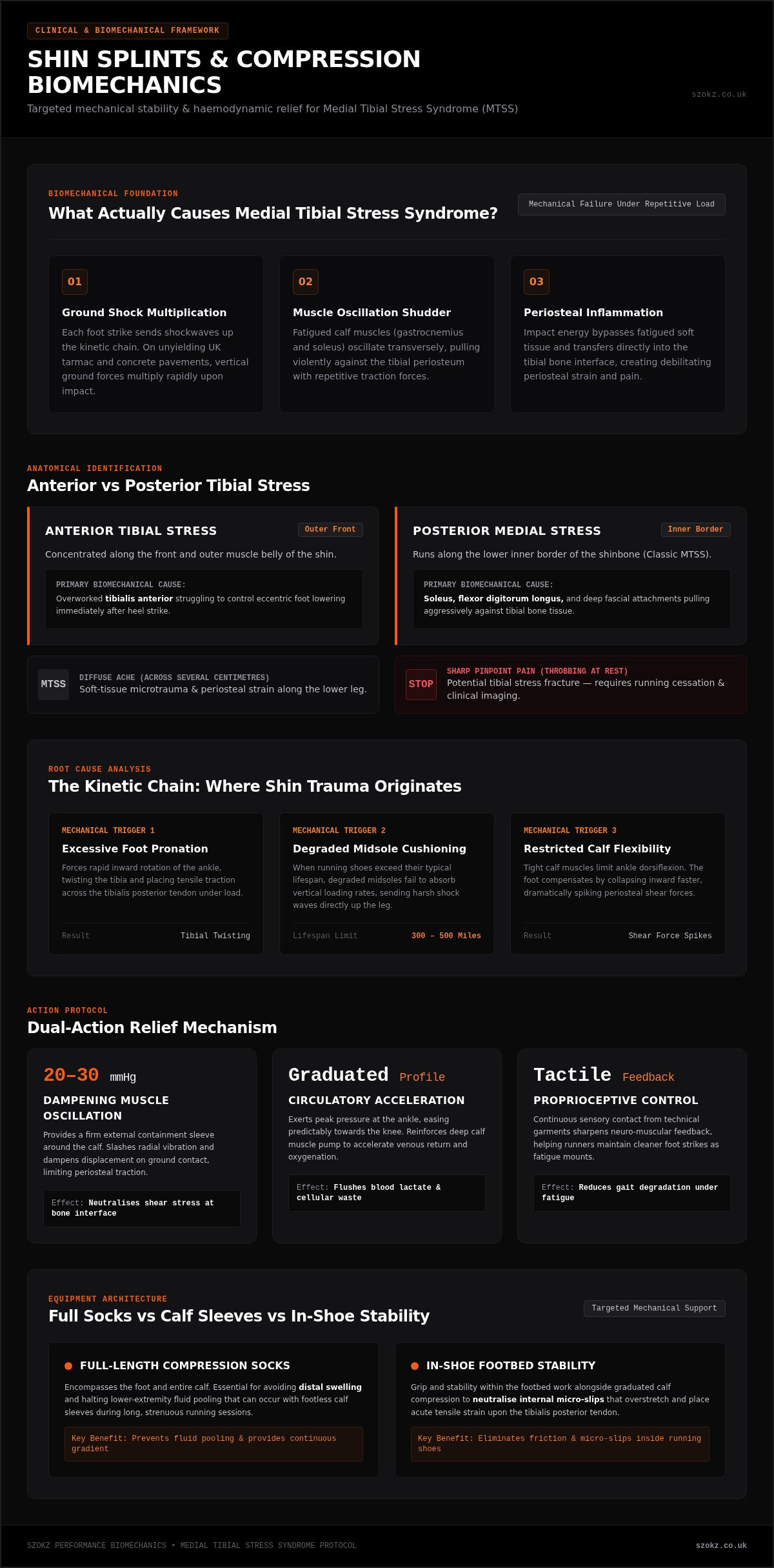
Shin splints are not a singular injury; they represent mechanical failure under repetitive load. Clinically classified as Medial Tibial Stress Syndrome (MTSS), this condition involves ongoing periosteal inflammation along the tibia. Each foot strike sends shockwaves up the kinetic chain. On unyielding UK tarmac and concrete pavements, these ground forces multiply quickly. When surrounding muscle groups fatigue, impact energy transfers directly into the tibial periosteum rather than dissipating through soft tissue. Technical garments like compression socks for shin splints uk athletes select provide external structural support by dampening muscle oscillation, but they operate as mechanical tools rather than standalone cures.
Anterior vs Posterior Tibial Stress: Identifying Your Pain
Pinpointing the exact site of discomfort reveals the specific anatomical tissues under strain:
- Anterior tibial stress: Concentrated along the front and outer muscle belly. It stems from an overworked tibialis anterior struggling to control eccentric foot lowering after initial heel strike.
- Posterior medial stress: Runs along the lower inner border of the shinbone. This classic presentation involves the soleus, flexor digitorum longus, and deep fascial attachments pulling aggressively against bone tissue.
Diffuse ache spread across several centimetres indicates soft-tissue microtrauma and periosteal strain. In contrast, sharp pinpoint pain that aches throbbingly at rest or under gentle thumb pressure signals a potential tibial stress fracture, requiring complete cessation of running and clinical imaging.
The Kinetic Chain: How Foot Mechanics Trigger Shin Trauma
Shin trauma rarely starts at the shin itself. It begins at ground contact. Excessive foot pronation forces rapid inward rotation of the ankle, twisting the tibia and placing tensile traction across the tibialis posterior tendon. When trainers exceed their typical 300 to 500-mile lifespan, degraded midsoles fail to dampen vertical loading rates, transferring harsh shock waves straight up the leg.
Tight calf muscles compound the issue by restricting ankle dorsiflexion. The foot compensates by collapsing inward faster, spiking periosteal shear forces with every stride. Integrating structured gait adjustments alongside compression socks for running recovery reduces lower-leg shudder, protecting vulnerable tissue while you rebuild your training capacity.
How Compression Socks Deliver Measurable Shin Splint Relief
Graduated compression provides dual-action support through mechanical oscillation control and haemodynamic acceleration. Choosing technical compression socks for shin splints uk runners depend on means addressing both muscle fatigue and structural strain simultaneously. By delivering targeted pressure gradients, these garments stabilise fatigued lower-leg musculature and enhance proprioception. Continuous tactile contact sharpens sensory feedback from the calf, helping you maintain cleaner foot strikes as fatigue mounts. For an expanded breakdown of post-session protocols, explore our compression socks for running recovery guide.
Dampening Muscle Oscillation: Limiting Periosteal Traction
Every foot strike creates impact shock waves that send transverse vibrations rippling through the gastrocnemius and soleus. When these muscle bellies oscillate unchecked, they exert violent traction tugs directly against the tibial periosteum. This continuous mechanical shaking inflames connective tissue.
Calibrated 20–30 mmHg compression provides a firm, external containment sleeve around the calf. It dampens muscle displacement on landing, slashing radial vibration and neutralising shear stress at the bone interface. Less muscle movement translates directly to less periosteal irritation.
Circulatory Acceleration: Reducing Secondary Inflammatory Fluid
True graduated compression exerts peak pressure at the ankle, easing off predictably towards the knee. This pressure gradient reinforces the deep calf muscle pump, accelerating venous return back to the heart:
- Metabolic clearance: Speeds the removal of blood lactate and exercise-induced cellular waste from hard-working tissues.
- Edema prevention: Halts lower-extremity fluid pooling immediately following intense running intervals.
- Tissue oxygenation: Enhances arterial inflow, ensuring micro-torn fascial layers receive nutrient-dense blood for faster cellular repair.
This biological mechanism reinforces standard NHS shin splint treatment advice regarding swelling management and controlled rest. Managing fluid build-up early halts inflammatory cycles before they become chronic. If you want to protect your lower limbs against repetitive road pounding, you can explore technical compression wear engineered to British athletic standards.
Selecting the Best Compression Socks for Shin Splints in the UK
Selecting effective compression socks for shin splints uk athletes require means looking past arbitrary shoe sizes. True functional performance depends on calibrated pressure profiles and technical yarn construction. Cotton blends stretch out quickly, retain moisture, and lose their compressive elasticity within miles. High-grade synthetic blends combining polyamide, polyester, and elastane maintain continuous mechanical tension whilst wicking sweat away from the skin. For a wider evaluation of technical fabric construction, review our guide to the best compression socks for sport.
| Pressure Profile | Compression Class | Primary Application | Athletic Benefit |
|---|---|---|---|
| 15–20 mmHg | Class 1 (Light) | Travel, recovery, desk wear | Basic venous support; prevents passive pooling |
| 20–30 mmHg | Class 2 (Firm) | High-impact road and trail running | Gold standard; dampens muscle oscillation and stabilises periosteum |
| 30–40 mmHg | Class 3 (Extra Firm) | Clinical vascular conditions | Medical-only; unsuitable for sport without clinical prescription |
Deconstructing Pressure Ratings: 15–20 mmHg vs 20–30 mmHg
Pressure gradients dictate functional outcomes. A mild 15–20 mmHg rating works well for light travel or post-exercise lounging, but it lacks the structural resistance required to counteract high ground impact forces. Active road runners need 20–30 mmHg graduated pressure. This firmer profile mechanically halts transverse calf shear without restricting joint mobility. Never jump to Class 3 (30–40 mmHg) hosiery for athletic training; excessive compressive tension can compromise arterial blood flow under heavy muscular contraction.
Precision Calf Measurement: Avoiding Fit and Rolling Errors
A compression garment sized only by shoe size will almost certainly fail. Sizing must be dictated by calf girth and lower-leg geometry:
- Morning measurements: Measure the widest point of your calf circumference using a flexible tape measure first thing in the morning, before daily fluid pooling begins.
- Ankle tension: Check the narrowest point directly above your malleolus (ankle bone) to ensure the base pressure matches the stated rating without acting like a tourniquet.
- Cuff placement: Pull the sock smooth so the top band finishes approximately two finger-widths below the tibial tuberosity. Never fold or roll the top cuff down; double-layered fabric doubles local compression and pinches the popliteal nerve.
Socks vs Calf Sleeves vs In-Shoe Grip: Building Complete Stability
Mechanical stability across the lower leg requires more than simple calf constriction. Many athletes assume calf sleeves and full compression socks provide identical benefits, but their physiological impact differs significantly. Calf sleeves terminate right at the ankle, leaving the entire footbed exposed. When searching for compression socks for shin splints uk athletes must recognise that full lower-limb integration often yields better mechanical outcomes than isolated sleeves. For shorter training days or focused lower-joint stability, review our ankle compression socks reference guide.
The Full Sock Advantage: Preventing Distal Fluid Accumulation
Calf sleeves stop right above the malleolus. This creates a distinct pressure boundary where tight elastic meets bare skin. During extended runs, that abrupt cut-off traps blood and interstitial fluids beneath the elastic cuff, causing distal pooling across the dorsum of the foot and ankle joint.
Full-length socks eliminate this restriction by encasing the entire footbed. Compressive force begins under the plantar arch and moves upward without interruption. Enclosed heels also remove the friction point where lower sleeve cuffs rub against the Achilles tendon. While footless sleeves work adequately for multisport transitions like triathlons, high-impact running demands the unbroken lymphatic flow of a full sock.
Footbed Anchoring: Eliminating Unwanted Clawing and Shearing
Most athletes overlook how internal shoe movement destroys lower-leg health. When smooth socks slide across footbeds, the toes clench in a reflex attempt to stabilise the stance phase. This involuntary clawing locks the foot into rigid tension, triggering sustained overactivation across the anterior tibial compartment.
Micro-slippage within the trainer multiplies ground reaction forces. Each tiny slide demands rapid eccentric braking from the tibialis anterior, driving deep muscle fatigue and inflammatory bone stress:
- Plantar traction: Anchoring the footbed stops forward foot slide inside the toe box during hard braking and sharp turns.
- Reduced clawing: Eliminating internal slippage allows the toes to splay naturally, reducing compensatory strain through the deep toe flexors.
- Heel lock: Securing the rearfoot minimises tibial twisting during heel strike, protecting the medial shin border from rotational torque.
Practical Recovery Protocol: Integrating Compression into Your UK Training
Managing medial tibial stress requires a disciplined recovery plan rather than passive rest. Incorporating technical compression socks for shin splints uk runners rely on provides immediate mechanical stability, but your overall loading strategy dictates long-term recovery. Follow this five-step management framework:
- Volume deload: Reduce weekly running mileage by 50% to 70% during the initial two-week acute phase.
- Active containment: Wear graduated garments during all high-impact sessions to minimise periosteal shock.
- Venous flush: Keep compression on post-workout to accelerate cellular waste removal and limit swelling.
- Kinetic strengthening: Target deep lower-leg stabilisers through progressive eccentric loading.
- Structured progression: Follow the 10% rule, never increasing weekly distance by more than 10% once symptoms subside.
Timing Your Compression: Active Workouts vs Post-Exercise Rest
Wear calibrated garments during track repeats, tempo runs, and competitive matches. Active containment halts transverse calf shudder at peak landing velocity. Once your session ends, keep your socks on for two to four hours while sitting or walking to maintain elevated venous velocity. Avoid sleeping in 20–30 mmHg socks. When you lie horizontally, gravity no longer resists blood return, making firm sports compression redundant overnight.
Rehabilitation Synergy: Exercises to Pair with External Support
External containment works best alongside targeted tissue conditioning. Perform daily straight-leg and bent-knee eccentric heel drops off a step to build tensile strength across the gastrocnemius and soleus complexes. Add seated calf raises to isolate and strengthen the deeper soleus muscle. Anchor a heavy resistance band to perform seated dorsiflexion curls, directly reinforcing the tibialis anterior to control foot slap during heel strikes.
Care and Longevity: Preserving Elastane Gradient Strength
Wet British weather tempts many to dry running kit on radiators, but high heat damages elastane cores. Wash technical garments inside out on a gentle cycle below 30°C and dry them naturally on a drying rack. Repeated stretching and friction degrade compressive tension over time; replace performance socks every six months to ensure consistent pressure delivery. Explore precision-engineered options built to Olympic standards in the SZOKZ athletic collection.
Rebuild Your Mileage with Calibrated Mechanical Support
Overcoming medial tibial pain demands a structured strategy, not guesswork. Lasting relief comes from combining disciplined load management with targeted oscillation control. The right compression socks for shin splints uk athletes choose stabilise the deep calf musculature, accelerate post-run recovery, and eliminate harmful in-shoe slippage before it strains the periosteum.
SZOKZ gear delivers the clinical gold standard in athletic containment. Engineered specifically for high-impact sports, road running, and lower-limb recovery, our calibrated 20–30 mmHg pressure profiles are trusted by Team GB and Olympic athletes across the UK. You can also benefit from free UK delivery on qualifying orders over £30.
Equip your training with proven physical support and return to the road with complete confidence.
Frequently Asked Questions
Do compression socks actually cure shin splints or just mask symptoms?
Compression socks don't cure shin splints on their own, but they don't merely mask symptoms either. They provide functional mechanical support by dampening calf muscle oscillation and accelerating venous return. This limits periosteal traction and flushes inflammatory byproducts. Real recovery still requires modifying your training volume, correcting running form, and strengthening lower-limb stabilisers. Technical garments protect vulnerable tissue while underlying structural healing takes place.
What compression level is best for running with shin splints?
A calibrated pressure profile of 20–30 mmHg is the clinical standard for managing active shin splints. Lighter garments rated at 15–20 mmHg work well for travel and passive recovery, but lack the tension needed to halt muscle shear during ground impact. Calibrated 20–30 mmHg compression socks for shin splints uk runners rely on offer the exact external containment required to stabilise the calf and reduce tibial bone stress under repetitive loading.
Can I wear compression socks all day whilst working in the UK?
Wearing sports compression socks throughout a normal working day is completely safe and beneficial if you stand or sit for long hours. Prolonged standing or desk work causes venous blood and lymph fluid to pool in the lower limbs, increasing tissue tension around the tibia. Graduated pressure maintains continuous circulation, limiting swelling and keeping calves fresh. Just ensure the socks fit smoothly without folding or pinching behind your knees.
Is it better to wear compression socks or calf sleeves for shin pain?
Full compression socks are generally better than calf sleeves for running with shin pain. Footless calf sleeves end at the ankle, which can trap fluid and cause swelling across the top of the foot during extended runs. Full socks deliver continuous, uninterrupted pressure from the plantar arch up to the knee. This continuous gradient optimises lymphatic flow, stops ankle pooling, and prevents cuff friction against the Achilles tendon.
How tight should sports compression socks feel around my shins?
Sports compression socks should feel firmly supportive and snug, like a supportive second skin, but never painfully tight. You should notice a clear sensation of physical containment across the calf muscle belly. If you experience numbness, tingling, skin discolouration, or throbbing in your toes, the sock is too tight or incorrectly sized. Compression must feel structured and secure without restricting joint movement or cutting off arterial blood flow.
Should I wear compression socks to bed to recover from shin splints?
You shouldn't wear 20–30 mmHg sports compression socks to bed. When you lie horizontal, gravity no longer forces blood to pool in your lower extremities. Your circulatory system doesn't need to fight gravity to return blood from your calves to your heart. Wearing firm athletic compression overnight is unnecessary and can cause skin irritation or constricted superficial blood flow. Reserve your compression garments for daytime training and post-run recovery.
How quickly can I expect shin splint relief when wearing compression?
You should experience an immediate dampening of muscle vibration during your first run in calibrated socks. The physical containment halts painful calf shaking on impact straight away. Biological tissue repair takes longer. For lasting relief from medial tibial stress syndrome, combine compression socks for shin splints uk athletes choose with a 50% mileage deload and calf strengthening. Most mild to moderate cases resolve within four to eight weeks of disciplined management.
Comments
No comments yet. Be the first to add one.