


The assumption that effective circulatory support demands heavy, knee-high hosiery is fundamentally flawed. For rapid agility work and long shifts on your feet, locking down the entire calf often traps heat without addressing the true source of foot strain. Calibrated ankle socks compression focuses mechanical tension directly across the plantar fascia and subtalar joint, eliminating restrictive bulk whilst delivering stability where your foot absorbs the greatest impact.
If you routinely battle arch fatigue, ankle wobble, or deep heel soreness, you already know how fast tired feet derail your performance. You don't have to tolerate clammy, calf-length socks just to get reliable joint protection. This reference guide demonstrates how targeted low-cut compression reinforces connective tissue, sharpens proprioception, and shields vulnerable strike zones against friction. We will unpack the physiological mechanisms behind targeted arch support, evaluate clinical pressure ratings, and help you choose the ideal pair for sports, demanding shifts, and active recovery.
Key Takeaways
- Understand the biomechanics of ankle socks compression, focusing elastomeric tension on the plantar fascia and subtalar joint rather than trapping heat across the calf.
- Differentiate between 15–20 mmHg profiles for continuous daily activity and calibrated 20–30 mmHg zones for firm joint stability and post-exercise recovery.
- Discover how engineered compressive arch bands lock the foot in place to eliminate micro-shearing, shoe slip, and blister formation.
- Learn why measuring midfoot circumference alongside shoe size guarantees correct structural alignment and prevents localized tourniquet effects.
- Master essential maintenance protocols, avoiding heat and fabric softeners to protect technical elastane fibres across dozens of wash cycles.
What Is Ankle Socks Compression and How Does It Function?
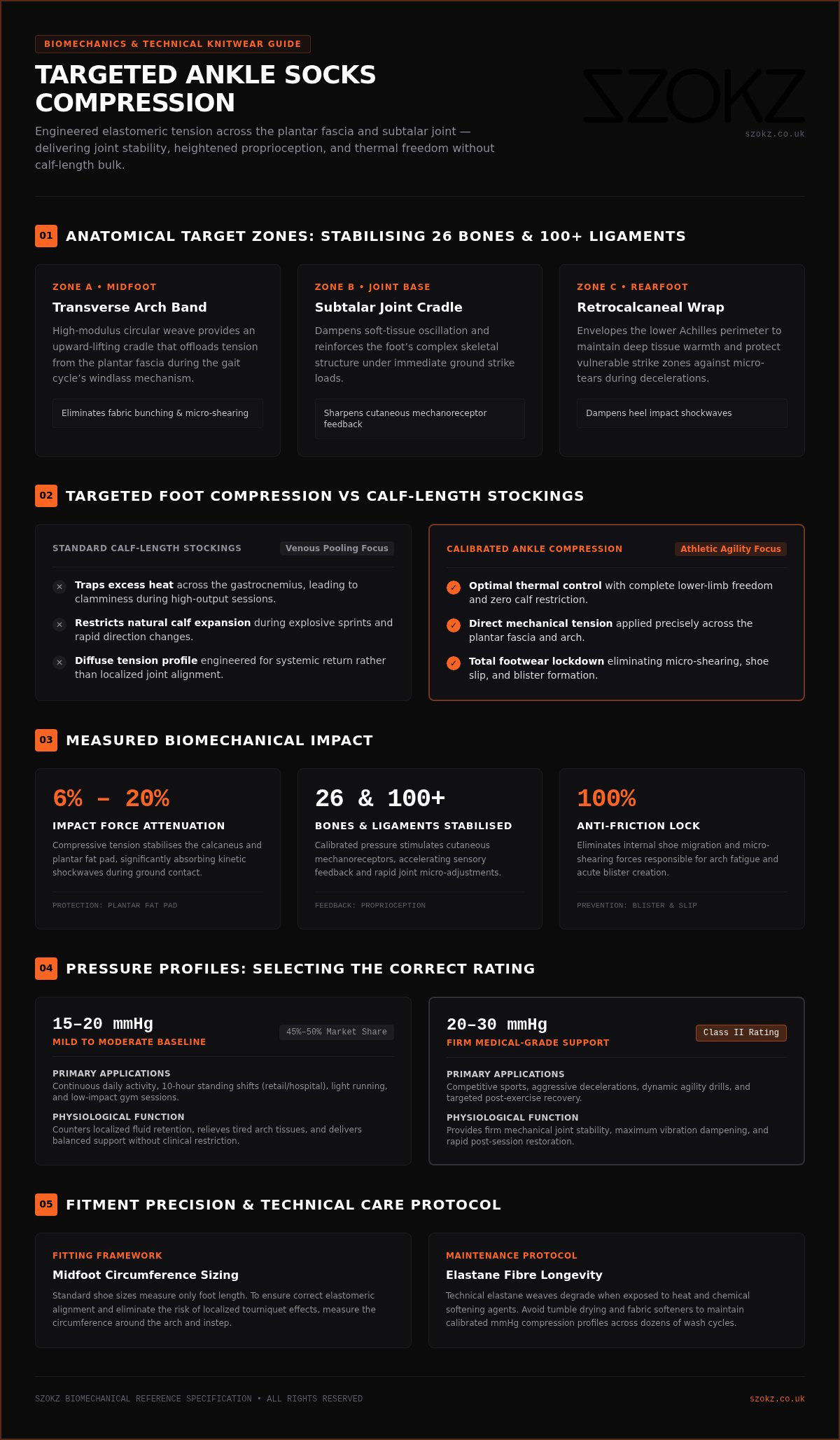
Ankle socks compression delivers focused elastomeric pressure directly to the structural architecture of the human foot. While generic athletic socks rely on passive elastic cuffs simply to stay upright, true compression hosiery applies calibrated mechanical tension across specific anatomical zones. This pressure centres on the midfoot arch, the subtalar joint, and the lower Achilles perimeter. It wraps the foot firmly, dampening soft-tissue oscillation and stabilising the complex network of 26 bones and over 100 ligaments during ground contact.
Targeted Foot Compression Versus Calf-Length Graduated Stockings
Most commercial literature treats compression purely through the lens of venous disease. Full-length medical garments utilise graduated compression mechanics to push deoxygenated blood upward past the calf muscle pump toward the heart, countering systemic venous pooling. Low-profile socks serve an entirely different functional brief. Instead of managing systemic return along the gastrocnemius, low-cut profiles focus on localized joint alignment, arch elevation, and immediate structural feedback.
Full knee-highs quickly become a liability during multidirectional agility sports. They trap heat across the lower leg, restrict natural calf expansion during explosive sprints, and cause discomfort during warm-weather training. Low-cut designs eliminate that calf-length bulk entirely. You retain complete lower-limb mobility and optimal thermal control whilst keeping the foot locked securely in place.
The Biomechanical Role of the Plantar Fascia and Arch Band
The core of any high-performance ankle compression profile is the transverse arch band. By knitting high-modulus elastane into an upward-lifting circular weave, the sock mimics functional sports taping. This elastomeric cradle supports the medial longitudinal arch, actively offloading tension from the plantar fascia during the gait cycle's windlass mechanism.
- Micro-vibration dampening: High-impact footstrikes send kinetic shockwaves through the calcaneus. Compressive tension stabilises the plantar fat pad, attenuating impact forces by 6% to 20% and preserving connective tissues.
- Heightened proprioception: Calibrated pressure stimulates cutaneous mechanoreceptors across the skin. This sensory input improves joint position awareness, allowing your nervous system to execute rapid micro-adjustments on uneven turf or hard courts.
- Achilles base reinforcement: Snug compression wraps the retrocalcaneal zone, keeping deep tissue warm and reducing localized micro-tears during sudden decelerations.
Athletes seeking comprehensive joint discipline across dynamic training sessions often select targeted athletic compression socks over heavy medical sleeves. You secure the exact stability your feet demand without compromising speed, ventilation, or agility.
Compression Levels Explained: Choosing Between 15-20 mmHg and 20-30 mmHg
Textile pressure is measured in millimetres of mercury (mmHg), the universal medical metric for compressive force. In low-cut technical knitwear, this rating indicates the resting mechanical squeeze applied over the midfoot and lower ankle. Selecting the correct rating transforms ankle socks compression from a standard elastic sock into an active functional tool. Matching the pressure profile to your training volume or physical workload ensures measurable biomechanical support without restricting arterial flow.
Mild to Moderate Compression (15-20 mmHg) for Daily Comfort
The 15–20 mmHg range serves as an accessible baseline for all-day wear. It accounts for roughly 45% to 50% of the consumer compression market because it requires no clinical oversight. For professionals enduring ten-hour shifts on hard retail floors or hospital wards, this gentle squeeze counters localized fluid retention and soothes tired arch tissues.
During low-impact gym workouts, light running, or casual walking, 15–20 mmHg delivers balanced mechanical support. It wraps the midfoot firmly enough to prevent fabric bunching without feeling excessively tight inside standard trainers.
Firm Medical-Grade Support (20-30 mmHg) for High Performance
Stepping up to 20–30 mmHg introduces firm, Class II medical-grade support. This tier is engineered for competitive sport, aggressive decelerations, and targeted post-session recovery. High training loads cause microscopic structural trauma to the foot. Calibrated 20–30 mmHg zones stabilize the subtalar complex during lateral plant-and-cut movements, actively limiting ankle inversion risk.
Firm compression accelerates local recovery. Research indicates compression therapy improves localized microvascular blood velocity by 30% to 40%, clearing metabolic waste and blunting post-exercise swelling. Reviewing established clinical guidelines for wearing and caring for compression garments ensures you wear high-pressure textiles safely and maintain their elastic resilience over time.
- 15–20 mmHg: Best for prolonged standing, daily walking, low-impact exercise, and preventing general foot fatigue.
- 20–30 mmHg: Engineered for high-impact sports, sprint deceleration, heavy lifting, and managing acute tendon strain.
Precision sizing is vital at higher pressure brackets. A 20–30 mmHg sock that is too small can create a constriction band around the malleolus. If you need deeper technical specifications on medical-grade ratings, consult our comprehensive 20-30 mmHg compression buying guide. When ready to upgrade your gear, explore our full range of performance-engineered compression socks built for UK athletes.
Key Benefits of Compression Ankle Socks for Sports and Recovery
Active compression stabilises foot architecture during repetitive ground strikes. Instead of relying solely on heavy footwear midsoles for protection, wearing technical low-cut socks reinforces the soft tissues internally. By locking the calcaneus and midfoot into alignment, ankle socks compression minimises energy leakage across rapid transitions and safeguards tired joints under heavy training loads.
Blister Prevention Through Friction Reduction and Secure Fit
Friction blisters stem from microscopic movement between damp skin, sock fabric, and the footwear lining. Standard athletic socks bunch up around the toe box and heel cup as perspiration accumulates. High-modulus elastane yarns eliminate this excess slack. The fabric moulds directly to the contours of the foot, acting like a protective second skin.
Moisture management reinforces this mechanical barrier. Synthetic micro-polyamide and polyester fibres pull sweat away from the epidermis to external evaporation channels. Dry skin retains its structural resilience against repeated shear stress. For a deeper breakdown of yarn density and anti-friction construction, read our anti-blister performance buying guide.
Accelerated Muscle and Tendon Recovery Post-Training
Intense track sessions, court sports, and road runs create micro-trauma across the intrinsic foot musculature. Gravity naturally pools lymphatic fluid and cellular waste in the lowest extremities once dynamic movement ceases. Targeted low-cut compression applies persistent resting pressure across the plantar network, counteracting dependent fluid pooling without confining your calves.
This sustained external squeeze preserves vessel diameter and speeds up waste removal. As highlighted in Cleveland Clinic's guide to compression levels and benefits, therapeutic pressure supports microcirculation, helping deliver nutrient-dense, oxygenated blood directly to repairing fibres. You don't need complicated recovery routines to see practical benefits; follow these straightforward protocols:
- Immediate post-session wear: Slip into fresh compression socks within fifteen minutes of finishing your workout to blunt acute inflammatory swelling.
- Two to three-hour duration: Maintain wear during post-exercise rest periods to assist fluid reabsorption through local capillary beds.
- Post-shift active recovery: Keep a clean pair on hand after standing shifts to alleviate deep arch ache and restore tissue elasticity before your next session.
How to Choose the Best Ankle Compression Socks: A Practical Evaluation Framework
Relying solely on shoe size routinely undermines the performance of compressive knitwear. Generic footwear sizing reflects foot length, not total volume or arch geometry. Finding the right pair of ankle socks compression requires an objective evaluation of dimensional fit, anatomical shaping, and technical yarn performance.
Accurate Sizing and Anatomical Fit Criteria
Precision fit dictates how effectively mechanical pressure transfers to your joints. Follow these three structural checks before buying:
- Step 1: Measure midfoot arch circumference: Take a flexible measuring tape and wrap it around the narrowest point of your instep. Compare this measurement against manufacturer sizing charts. If your arch circumference falls between brackets, size down for firm athletic support or size up for all-day working comfort.
- Step 2: Verify true anatomical knitting: Look for asymmetric left and right foot profiles. Dedicated contours allow the compressive band to track the exact line of your plantar fascia, preventing bunched fabric around the outer pinky toe.
- Step 3: Inspect the toe closure and collar: Hand-linked, seamless toe boxes are non-negotiable. Raised seams press painfully into toenails during sudden forward decelerations. Ensure the collar features a reinforced heel tab that sits just above your shoe counter to protect your Achilles from abrasive rubbing.
Material Composition, Breathability, and Traction Integration
Textile selection dictates how long a compressive garment maintains its calibrated elasticity under sweat and repetitive wash cycles.
- Step 4: Scrutinise synthetic yarn ratios: Prioritise multi-filament nylon or polyamide paired with 15% to 25% elastane. Dense synthetic weaves provide high tensile strength and fast capillary wicking. Pure cotton must be avoided; it absorbs moisture, collapses under weight, and stretches permanently out of shape.
- Step 5: Integrate footbed traction: Compressive knitwear locks the sock to the foot, but agility sports demand that the sock also locks to the footwear insole. Internal foot slip inside boots or running shoes bleeds propulsion power and generates internal friction. Pair targeted arch bands with external grip pads to eliminate insole movement entirely.
Learn how strategic outsole grips interact with compressive knits by exploring the ultimate guide to sports grip socks.
Maximising Longevity and Daily Performance: Wear, Care, and Brand Engineering
High-tensile compression hosiery demands deliberate handling. Yanking a pair on by the top cuff strains the circular knit, weakening the elastane fibres and distorting the targeted pressure zones. Instead, gather the sock body down to the heel pocket, slide your toes firmly into the seamless toe box, and smoothly roll the fabric up over your calcaneus. Calibrated ankle socks compression should sit flat across the instep without twists, ripples, or pulled threads.
Essential Care Protocols to Preserve Calibrated Tension
Polymer creep and micro-fibre fatigue degrade elasticity over time. Standard high-performance elastane maintains calibrated pressure for roughly three to six months, or 30 to 50 active wash-and-wear cycles, before tension naturally drops. Poor laundry habits accelerate that decline. Protecting your gear requires three strict rules:
- Wash at 30°C on a gentle cycle: Invert socks before washing to protect outer textile friction pads and flush accumulated salts from the inner weave. Cold or lukewarm water protects synthetic elasticity.
- Ban fabric softeners and bleach: Softeners leave slick silicone residues on micro-polyamide fibres. These chemical coatings clog moisture-wicking channels and break down synthetic rubber cores, permanently compromising the compression rating.
- Air dry flat: Keep socks away from tumble dryers and direct radiators. High ambient heat snaps thin elastane threads, leading to irreversible sagging and loose arch bands.
Engineered Performance: Why British Athletes Choose SZOKZ
Athletic discipline requires equipment that performs without compromise. At SZOKZ, our engineering focuses on structural stability and uncompromising durability. By integrating calibrated 20–30 mmHg pressure zones directly into dynamic foot architecture, our All Sport Ankle Socks and High Intensity Sport Socks provide the agile athlete with firm joint lockdown without calf-length restriction.
This relentless focus on textile integrity is why our gear is trusted and worn by Team GB and Olympic athletes across high-intensity sports. Whether executing explosive court transitions, navigating long training runs, or accelerating recovery between competitive fixtures, your feet remain secured by proven engineering. For athletes anywhere in the country, we provide free nationwide UK delivery on all qualifying orders over £30, equipping you with professional-grade foot support delivered directly to your door.
Upgrade Your Footwear Foundation for Uncompromising Agility
Effective movement begins at the ground. You don't need heavy, restrictive calf sleeves to protect your feet during demanding physical training. Calibrated ankle socks compression provides direct mechanical support across the plantar fascia, sharpens joint proprioception, and eliminates blister-causing friction inside your footwear.
Whether you require moderate tension for long shifts on your feet or calibrated 20–30 mmHg pressure zones for verified joint and arch stability during explosive drills, targeted support transforms foot mechanics. That exact functional discipline is why Team GB and Olympic competitors trust SZOKZ to anchor their training regimens across the country.
Back your training with proven textile engineering, unlock sharper footwork, and enjoy free UK delivery on all qualifying orders over £30. Your strongest performances always start from the ground up.
Frequently Asked Questions
Do ankle compression socks work as well as knee-high compression socks?
They work exceptionally well, but they serve an entirely different functional purpose. Knee-high stockings target the calf muscle pump to assist systemic venous return throughout the entire lower leg. Ankle socks compression targets localised joint mechanics, plantar fascia tension, and subtalar stability. If your goal is enhanced agility, reduced shoe friction, and targeted arch support without excess thermal bulk, ankle compression is the superior athletic option.
Can I wear ankle compression socks all day whilst working or walking?
Yes, wearing them through long working days is safe and highly beneficial for your feet. Moderate compression levels (15 to 20 mmHg) actively counter dependent fluid pooling, support tired arches, and alleviate structural fatigue from standing on hard surfaces. Just make sure the cuffs sit smoothly without bunching up, and take them off before heading to bed to allow your skin to breathe.
Is 20-30 mmHg compression safe for everyday gym training and running?
Firm 20 to 30 mmHg compression is safe and ideal for healthy athletes tackling rigorous sessions. This pressure bracket provides robust mechanical lockdown during explosive cuts, heavy lifts, and repetitive footstrikes. If you have underlying arterial circulation conditions like peripheral arterial disease, avoid high-compression ratings without clinical guidance. For general athletic training, calibrated 20 to 30 mmHg pressure offers unmatched structural stability.
How do I know if my compression ankle socks are too tight?
Your socks should feel like a firm, reassuring wrap rather than a tourniquet. Warning signs of excessive tightness include numbness, tingling toes, sharp pinching across your instep, or skin discolouration. If removing the sock leaves deep, painful indentations that linger for hours, your pair is too small. Always cross-reference your midfoot circumference against manufacturer sizing charts to ensure an accurate, comfortable fit.
Will compression ankle socks help relieve plantar fasciitis discomfort?
Targeted compression provides significant daily relief by mechanically offloading tension from the plantar aponeurosis. An engineered arch band lifts the midfoot tissues, mimicking functional low-dye taping techniques to limit micro-tearing during weight-bearing steps. While compressive socks don't replace structured physical therapy or strength work, they cushion ground impacts and ease the acute morning ache associated with plantar fascia strain.
Can I sleep in ankle compression socks after a tough workout?
Sleeping in compression socks is generally unnecessary and best avoided. When you lie horizontal, gravity no longer pulls fluid down into your lower extremities, reducing the physiological need for external pressure. Resting without compressive wear also allows your skin to air out naturally overnight. For best results, wear your socks for two to three hours post-training, then remove them before sleep.
How often should I replace my athletic compression ankle socks?
Active athletes should replace compressive footwear every three to six months. Technical elastane yarns undergo continuous polymer stretching through high-impact movement, sweat exposure, and regular washing. After roughly 30 to 50 active wear cycles, the resting tension drops below its calibrated rating. Once the arch band feels noticeably loose or the knit stops snapping back crisply, it is time for a fresh pair.
Comments
No comments yet. Be the first to add one.