


Disposable pharmacy flight socks do little to stop deep cabin fluid retention. Hours of motionless seating force blood into your lower extremities, leaving you landing with rigid calves and shoes that refuse to lace up. Finding the right compression socks for flying isn't about grabbing whatever is hanging on the airport terminal rack; it's about applying calibrated mechanical pressure that actively drives venous return.
You shouldn't have to accept heavy, aching legs as an inevitable toll of travel. Deciphering the difference between mild 15-20 mmHg tension and performance-grade 20-30 mmHg graduated compression can be frustrating, especially when poorly engineered socks bunch behind the knee and pinch your circulation.
You will discover how to select, fit, and wear graduated compression socks to eliminate in-flight leg swelling and fatigue once and for all. We break down the technical differences between pressure ratings, anatomical sizing rules, and cabin habits so you arrive at your destination ready to hit the ground running.
Key Takeaways
- Inactivity and cabin pressure drops deactivate your calf muscle pump, causing fluid to pool in lower extremities during long-haul travel.
- Calibrated 20-30 mmHg graduated compression socks for flying outperform disposable travel pairs by actively driving venous blood upward from the ankle.
- Calf circumference measurements determine true physiological pressure delivery, eliminating the bunching and pinching caused by standard shoe sizing.
- Putting on your socks before departure prevents fluid retention before it begins, keeping legs light and mobile upon touchdown.
- High-grade technical yarns retain structural elasticity and precise pressure profiles through repeated wash cycles where budget socks fail.
Why In-Flight Stagnation Demands Compression Socks for Flying
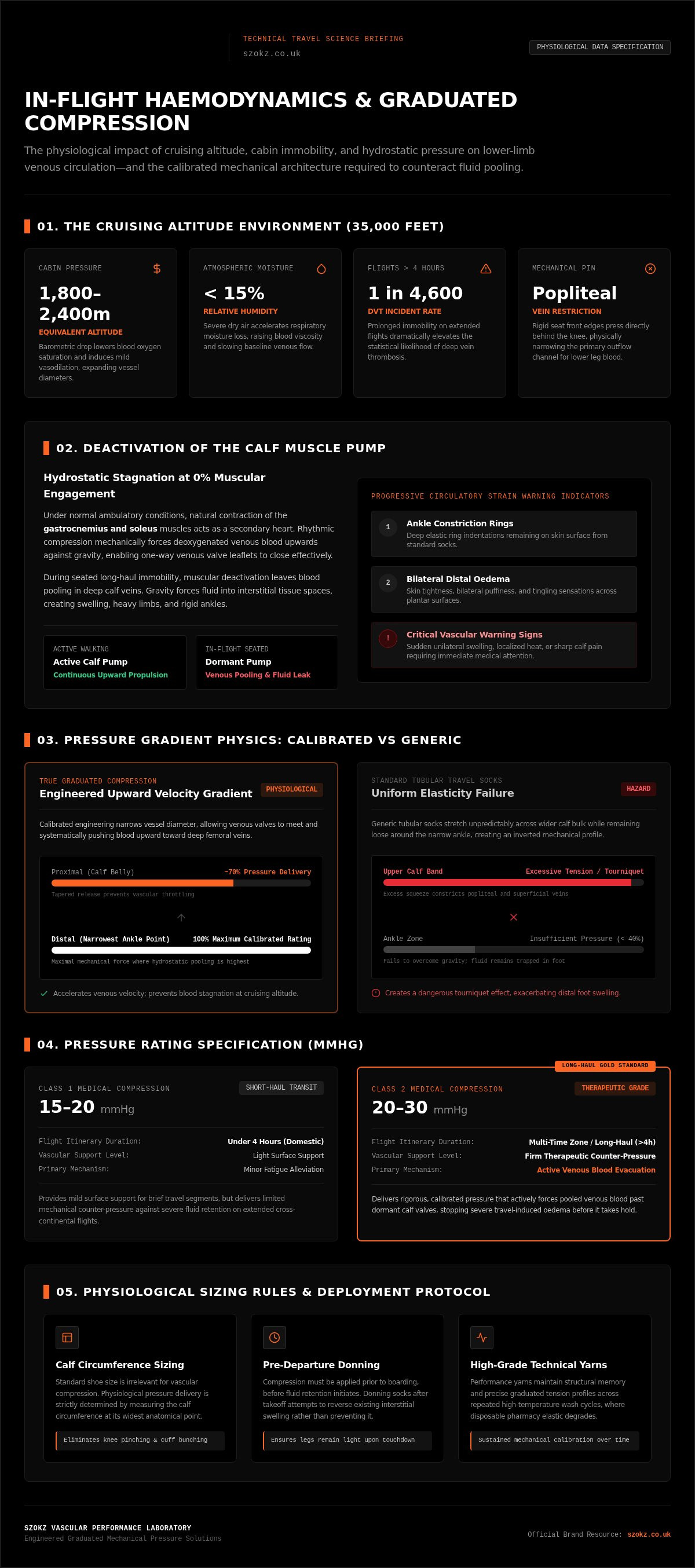
Cruising at 35,000 feet strains the human vascular system. Commercial aircraft cabins are pressurised to an equivalent altitude of 1,800 to 2,400 metres above sea level. This barometric drop lowers blood oxygen saturation and triggers mild vasodilation, while cabin humidity routinely plummets below 15 percent. Simultaneously, prolonged immobility shuts down the calf muscle pump. Walking contracts the gastrocnemius and soleus muscles, pumping deoxygenated blood upward against gravity. When you remain seated, gravity takes over. Blood pools in deep calf veins, increasing hydrostatic pressure and forcing fluid into interstitial tissues. For flights lasting over four hours, the risk of deep vein thrombosis reaches roughly 1 in 4,600 flights. Medical-grade compression stockings deliver the mechanical counter-pressure necessary to maintain venous velocity at cruising altitude.
The Haemodynamics of High-Altitude Cabin Inactivity
Standard cabin seats worsen vascular restriction. The firm edge of a seat base presses directly into the popliteal space behind your knees, pinching the popliteal vein and obstructing upward blood return. Meanwhile, dry cabin air increases respiratory moisture loss, raising blood viscosity. Without calf contraction, sluggish blood pools in your lower limbs. Wearing graduated compression socks for flying creates an external pressure gradient that narrows vein diameter, allowing venous valve leaflets to close properly and drive blood back toward the heart.
Identifying Key Symptoms of Travel-Induced Circulatory Strain
Vascular strain presents in stages during long-haul transit. Early warning signs include deep elastic ring marks around the ankles, skin tightness, and tingling sensations across the soles of your feet. Bilateral puffiness is common, but sudden unilateral swelling, localized heat, or sharp calf pain indicates potential vascular complications requiring prompt medical attention.
Conditioned athletes are not immune. In fact, elite athletes with low resting heart rates and high vascular compliance frequently experience rapid venous pooling when confined to tight rows. Consulting an in-flight swelling checklist and securing calibrated pressure ensures your legs stay light and operational upon arrival.
How Graduated Pressure Levels Prevent In-Flight Swelling
Graduated compression functions on precise hydrodynamics. Compression intensity is measured in millimetres of mercury (mmHg), indicating the mechanical force exerted against vascular walls. Generic travel socks often rely on uniform elasticity, squeezing the limb equally from cuff to foot. This design fails. Without a pressure differential, blood remains trapped in the lower leg. The Centers for Disease Control and Prevention highlights graduated pressure when detailing Preventive measures for DVT during prolonged travel.
Comparing Pressure Ranges: 15-20 mmHg versus 20-30 mmHg
Pressure ratings dictate physiological efficacy during travel:
- 15-20 mmHg (Class 1): Suitable for short domestic journeys under four hours. Provides light surface support and eases minor fatigue, but offers limited counter-pressure against severe fluid retention.
- 20-30 mmHg (Class 2): The gold standard for long-haul itineraries. Delivers firm, therapeutic-grade vascular compression that actively forces pooled venous blood past dormant calf valves.
Choosing proper compression socks for flying depends on your travel schedule. Flights spanning multiple time zones demand the firmer 20-30 mmHg profile to stop oedema before it takes hold. For a thorough breakdown of pressure classifications, explore our 20-30 mmHg compression buying guide.
The Engineering Behind Calibrated Graduated Architecture
Effective vascular propulsion requires strict architectural calibration. True graduated profiles apply 100 percent of their rated pressure at the narrowest point of the ankle, tapering systematically to approximately 70 percent at the calf belly. This upward-decreasing tension gradient directs fluid toward the deep femoral veins.
Cheap tubular socks lack these calibrated zones. They stretch unpredictably over wider muscle bulk, creating a reverse gradient that constricts the calf tighter than the ankle. This creates a dangerous tourniquet effect that traps fluid in the foot. Choosing calibrated engineered athletic compression knitwear guarantees precise millimetre-accurate pressure profiles that keep circulation moving at cruising altitude.
How to Choose the Best Compression Socks for Flying
Selecting flight hosiery based on shoe size alone is a critical error. Foot length shares zero physiological correlation with lower-leg venous volume or calf muscle mass. Matching a sock purely to your UK shoe size guarantees either insufficient pressure or severe venous constriction. Choosing the best compression socks for flying requires biometric fitting and purpose-built textile construction.
Biometric Sizing Protocol: Calf Circumference versus Shoe Size
Precise pressure delivery relies on exact circumference metrics taken before tissue expands. Follow this protocol with a flexible tape measure:
- Ankle Circumference: Measure around the narrowest section of the lower leg, directly above the ankle bone (malleolus). This point anchors the 100 percent pressure level.
- Calf Circumference: Measure around the widest point of the calf muscle belly while standing. This establishes the calibrated 70 percent taper zone.
Never size down to achieve firmer tension. Undersized compression socks for flying overstretch their elastane cores, causing the upper welt to roll down and create a dangerous constriction band below the knee.
Technical Fabric Engineering for Long-Haul Cabin Environments
Cabin air dries your skin whilst sitting generates trapped heat in your footwear. Traditional cotton flight socks absorb moisture, lose structural elasticity within hours, and collapse into rough folds. High-grade synthetic yarns, such as micro-polyamide and technical elastane blends, offer continuous moisture management and rapid evaporation. These engineered fibres maintain calibrated elasticity under tension, retaining consistent compressive force across fourteen hours of travel. Reinforced heel pockets lock the sock to the foot's anatomical pivot point, while seamless toe enclosures stop friction blisters during long terminal walks.
Top-Band Construction and Anti-Roll Elastication
The top band must keep the garment upright without strangling surface circulation. Budget options rely on thin elastic bands that dig into skin tissue behind the knee. High-performance models feature wide, flat-knitted welts that distribute retention forces evenly across the proximal calf. Flatlock stitching prevents abrasion ridges during seated confinement. Review our pressure socks for flying checklist to verify your sizing and textile specs before heading to the departure gate.
Step-by-Step Protocol: When and How to Wear Travel Compression
Timing determines physiological performance. Slipping into tight elastane inside a cramped aircraft lavatory compromises the garment's efficacy. Once interstitial swelling begins, graduated compression works against pooled fluid rather than preventing it. Applying your socks correctly before boarding ensures full circulatory support from takeoff to touchdown.
Pre-Flight Preparation: Correct Donning Technique
Put your socks on early in the morning on travel day, well before fluid accumulates around the ankles. Avoid bunching the fabric like standard socks, which overstretches technical fibres and creates irregular tension bands.
- Turn the sock inside out down to the heel pocket, leaving only the footbed inverted.
- Slide your foot in until your heel sits squarely in the reinforced heel cup.
- Gently unroll the shaft upward over your ankle and calf, smoothing the weave with flat palms.
- Position the top welt exactly two finger-widths below the knee crease to avoid popliteal impingement.
In-Cabin Movement and Hydration Strategy
Graduated compression socks for flying provide steady mechanical pressure, but muscular activation accelerates blood clearance. Use cabin downtime proactively. Every sixty minutes, complete ten seated ankle rotations and twenty seated toe-and-heel raises to manually engage the soleus pump. When the seatbelt sign turns off, take a five-minute walk down the aisle. Pair this movement with consistent hydration; drink 250 millilitres of water every hour and avoid cabin alcohol, which worsens dehydration and reduces venous tone.
Post-Landing Recovery and Safe Removal
Resist the urge to strip your socks off immediately upon landing. Terminal walks, passport control queues, and baggage collection involve stationary standing that triggers sharp spikes in hydrostatic pressure. Keep your compression socks on until you reach your final accommodation.
After removal, inspect your lower legs. Normal compression leaves faint, uniform weave impressions without deep red welts or pinched skin. If your travel itinerary involves immediate training or multiple connecting legs, review proven sports recovery compression practices to keep your legs primed.
Why Elite Athletic Compression Outperforms Standard Flight Socks
Airport pharmacy stands frequently push flimsy, paper-thin travel socks designed for single trips. These disposable nylon tubes rapidly lose elasticity under constant stretch, slumping down the calf within hours of departure. In contrast, elite athletic compression socks for flying apply high-density circular knitting engineered to manage sustained vascular loads. By combining calibrated 20-30 mmHg pressure profiles with heavy-duty durability, athletic-grade garments transform in-cabin circulatory support into an exact science.
Textile Durability and Calibrated Pressure Retention
Cheap flight socks rely on exposed elastic threads that quickly crack under heat, tension, and standard machine cycles. Elite athletic construction utilises multi-filament polyamide and double-wrapped elastane cores. This advanced weaving method preserves precise millimetre-of-mercury tension profiles across hundreds of washes.
Worn by Team GB and British Olympic athletes, these garments meet rigorous specifications that demand consistent mechanical tension. Anatomical left-and-right foot mapping contours cleanly around the metatarsals and toes, eliminating the bunched fabric that causes chafing inside travel shoes.
Versatility from Airport Concourse to Destination Activity
High-performance flight socks also eliminate redundant luggage. Generic travel hosiery provides zero impact protection on hard concourse floors. Athletic compression designs incorporate zoned cushioning along the footbed and Achilles tendon, dampening ground shock as you navigate long airport terminals. After landing, you don't need to pack away your travel gear. You can transition straight into a destination road run or gym session with active vascular support already in place.
For shorter training sessions or warmer local climates once unpacked, explore our ankle socks compression guide for targeted lower-limb stability. Choosing compression socks for flying from the SZOKZ performance collection equips your journey with British-engineered resilience, backed by free UK delivery on orders over £30.
Arrive at Your Destination Ready to Move
Long-haul journeys shouldn't leave you sidelined by painful fluid retention, stiff calves, or sluggish circulation. Choosing the best compression socks for flying comes down to functional mechanics rather than guesswork. Prioritise calibrated 20-30 mmHg graduated profiles that actively assist venous return, fit your gear using precise calf measurements rather than shoe size, and don your pair before fluid begins to pool.
British textile engineering bridges the gap between elite sports recovery and high-altitude cabin comfort. Engineered to the exact specifications trusted by Team GB and British Olympic athletes, resilient technical yarns preserve their structural tension across thousands of miles. High-performance knitwear keeps your vascular system supported, backed by free UK delivery on orders over £30.
Step off the aircraft feeling light, mobile, and ready to tackle your travel itinerary without missing a beat.
Frequently Asked Questions
How many hours should a flight be before you need compression socks?
You should wear compression socks on flights lasting four hours or longer. At this threshold, extended immobility significantly slows lower-limb circulation and increases venous pooling. Flights exceeding four hours elevate the risk of deep vein thrombosis, making mechanical support crucial. For shorter domestic journeys under four hours, compression is optional, though it still reduces post-flight heavy legs and mild ankle swelling if you remain seated throughout.
Is 15-20 mmHg or 20-30 mmHg better for long-haul flying?
Calibrated 20-30 mmHg compression provides far better protection on long-haul routes. While 15-20 mmHg offers mild surface relief for short hops, it lacks sufficient pressure to counteract deep venous pooling over extended journeys. Choosing 20-30 mmHg compression socks for flying delivers therapeutic, athlete-grade venous propulsion. This higher rating actively forces pooled interstitial fluid back toward the heart, eliminating heavy calf fatigue and severe post-flight ankle oedema.
Can wearing compression socks on planes cause blood clots if worn incorrectly?
Incorrectly worn socks won't directly create a clot on their own, but they can restrict venous return and worsen stagnation. If fabric bunches, folds over, or twists around the calf, it creates a narrow tourniquet effect. This localised constriction traps deoxygenated blood in the foot instead of driving it upward. Always smooth the fabric flat against your skin and keep the cuff two finger-widths below the knee crease to maintain proper flow.
Should I put my compression socks on before arriving at the airport?
Yes, put them on at home before leaving for the airport. Applying compression socks for flying works best when lower-limb tissues remain resting and completely unswollen. Once you stand in security queues or walk through long terminal concourses, gravity causes fluid accumulation. Putting them on early prevents fluid from pooling in the first place, ensuring the garment fits cleanly without overstretching the technical elastane fibres.
Can I sleep on a plane whilst wearing compression socks?
Yes, sleeping in compression socks while seated upright in an aircraft cabin is entirely safe and highly recommended. Unlike sleeping flat in bed where gravity doesn't pool blood in your feet, seated in-flight sleep leaves your lower limbs vertical and immobile for hours. Graduated compression compensates for the absence of muscular calf pumps, keeping blood moving steadily while you rest at cruising altitude.
Why do my flight compression socks roll down or bunch behind my knee?
Rolling and bunching typically indicate sizing errors or pulling the fabric too high. Standard flight socks sized by shoe size rather than calf circumference often stretch unevenly over wider muscle bellies. If you pull the top welt into the soft crease behind your knee, leg flexion pushes the fabric downward into a tight band. Always choose socks based on calf circumference and position the welt below the knee.
How do I wash compression socks so they do not lose elasticity?
Wash them on a gentle 30-degree cycle or hand-wash using mild detergent without fabric softeners. Harsh chemicals and fabric conditioners coat synthetic yarns, breaking down technical elastane cores and weakening mechanical tension profiles. Always air-dry them flat away from direct heat radiators. Never tumble dry or iron your compression socks, as extreme heat permanently damages the calibrated graduated knitting structure.
Comments
No comments yet. Be the first to add one.