


At 35,000 feet, prolonged stillness turns gravity into your circulatory system's toughest test. When your calf muscles remain inactive for hours, fluid naturally pools in your lower limbs. Choosing the right pressure socks for flying changes the equation entirely, transforming standard gear into an active circulatory pump that drives venous blood back towards your heart.
You know the frustrating reality of unbuckling your seatbelt after a long flight only to find your shoes tight, your ankles puffy, and your legs heavy with fatigue. Sorting through technical ratings like 15-20 mmHg versus 20-30 mmHg graduated support shouldn't add friction to travel day, nor should silent worries about deep vein thrombosis linger throughout your journey.
Mastering your in-flight circulation and eliminating lower-leg swelling comes down to disciplined, simple preparation. This comprehensive checklist guides you from initial packing to final touchdown, ensuring you step off the aircraft feeling light, energised, and ready to move.
Key Takeaways
- Understand how pressure socks for flying function as active mechanical pumps to counteract cabin immobility and venous pooling.
- Obtain accurate morning calf and ankle measurements to secure a precise fit for true 20-30 mmHg graduated compression.
- Learn the exact pre-boarding timeline for donning your garments to prevent fluid accumulation before takeoff.
- Identify critical in-flight mistakes, including cuff rolling and garment stacking, that compromise venous blood flow.
- Execute a structured post-flight protocol to maintain vascular stability from touchdown until your final arrival.
What Are Pressure Socks for Flying and How Do They Work?
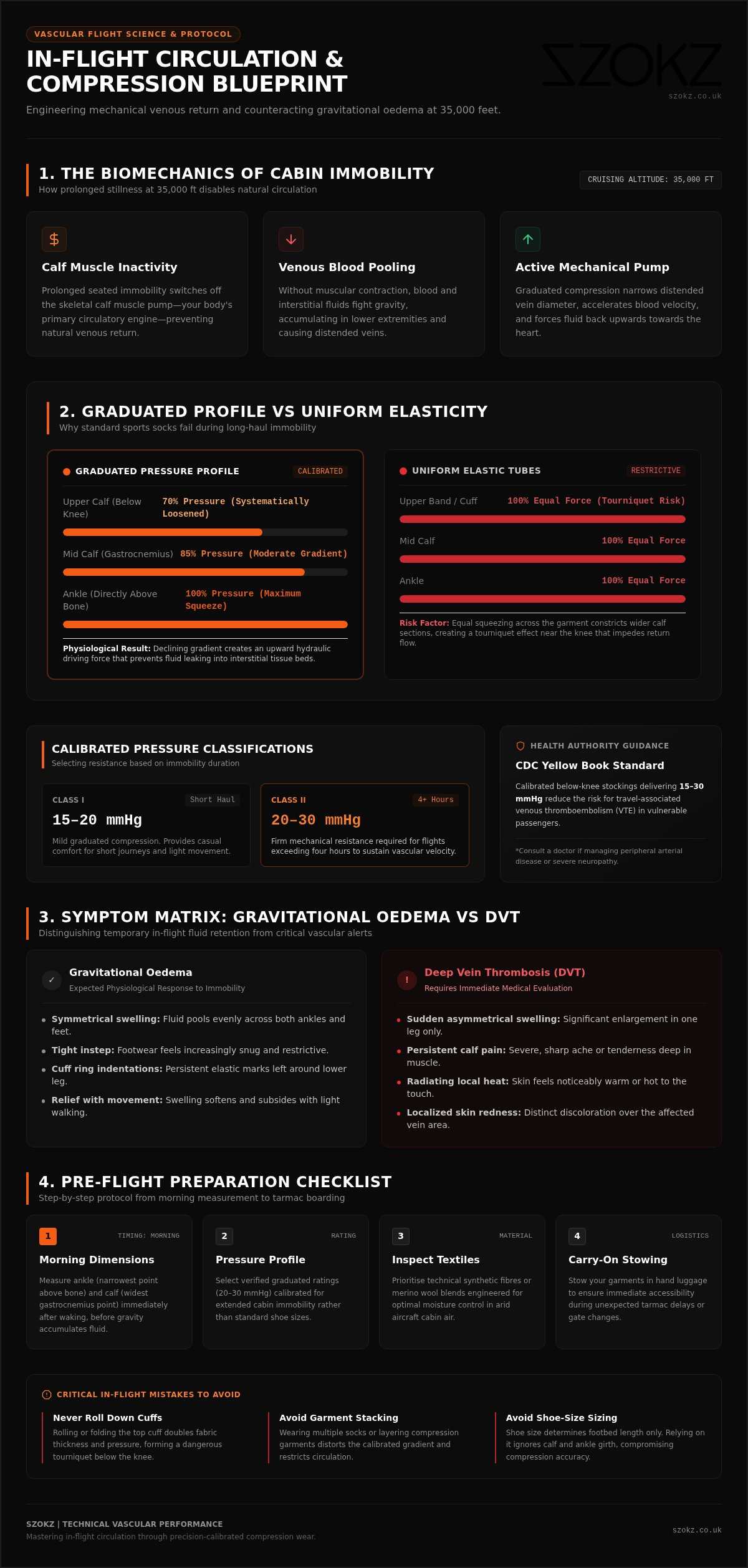
Pressure socks for flying are specialised knit garments engineered to counteract venous pooling during prolonged immobility. Sitting stationary in a pressurised aircraft cabin for hours disables your body's primary circulatory engine: the skeletal calf muscle pump. Without regular leg movement, venous blood and interstitial fluids fight an uphill battle against gravity, accumulating around the ankles. Engineered graduated pressure restores mechanical balance, driving fluid upwards toward the heart.
The Mechanics of Graduated Compression at Cruising Altitude
Graduated compression applies a measured, declining pressure gradient. It fits tightest at the ankle and systematically loosens as it travels up the calf. Medical-grade compression stockings work by narrowing the diameter of distended veins. This narrowing increases venous blood velocity and prevents fluid from leaking into surrounding tissue beds.
Standard sports socks and uniform elastic tubes cannot deliver this result. Uniform elastic squeezes the calf with identical force across the entire garment, often acting as a tourniquet near the knee. Authentic 20-30 mmHg graduated compression provides the exact physiological profile required to maintain vascular flow when you cannot get up to walk.
Recognising the Signs of In-Flight Fluid Retention
Gravitational oedema reveals itself within hours of takeoff. Common warning signs include:
- Footwear feeling tight across the instep.
- Puffy ankles and swollen skin around the ankle bones.
- Persistent indented rings left by standard sock cuffs.
- A dull, heavy ache settling deep in the lower calves.
While mild swelling is common, it's vital to distinguish temporary oedema from deep vein thrombosis (DVT). Symmetrical swelling that softens with light walking is typical fluid retention. Conversely, sudden asymmetrical swelling, persistent calf pain, heat radiating from the limb, or localized skin redness requires urgent medical attention.
Deploying dedicated pressure socks for flying protects your vascular system against long-haul immobility. Elite athletes flying between international fixtures, corporate travellers logging high-mileage schedules, and expectant mothers all rely on calibrated compression to step off the aircraft ready for immediate physical demand.
Pre-Flight Preparation Checklist: Sizing, Ratings, and Packing
Effective circulatory support begins hours before reaching the terminal. Relying on guesswork or standard shoe sizes compromises vascular performance. Use this structured checklist to prepare your gear:
- Step 1: Take morning dimensions. Measure calf and ankle circumferences immediately after waking, before gravity causes fluid to accumulate.
- Step 2: Choose your pressure profile. Select verified graduated ratings calibrated for long periods of immobility.
- Step 3: Inspect the textile blend. Prioritise synthetic technical fibres or merino wool blends engineered for moisture control in arid cabin air.
- Step 4: Stow in hand luggage. Keep your socks in your carry-on bag so they remain accessible during unexpected tarmac delays.
Deciphering Compression Levels: Mild vs 20-30 mmHg
Mild 15-20 mmHg garments offer casual comfort, but flights exceeding four hours demand firmer mechanical resistance. British athletes rely on engineered 20-30 mmHg profiles to maintain vascular velocity between international competitions. For detailed technical distinctions across classes, consult our 20-30 mmHg compression guide.
Official health authorities emphasise this distinction. The CDC Yellow Book notes that calibrated below-knee stockings delivering 15–30 mmHg reduce the risk for travel-associated VTE in vulnerable passengers. If you have active peripheral arterial disease or severe neuropathy, consult your doctor before selecting firm compression wear.
Accurate Calf and Ankle Measurement Protocol
Shoe size determines footbed length, not compression tension. Pressure socks for flying require precise anatomical dimensions to function properly. Pull a flexible tape measure snug against bare skin without pinching:
- Ankle circumference: Measure around the narrowest point of your lower leg, directly above the ankle bone.
- Calf circumference: Stand upright with feet flat, locating the widest point of the gastrocnemius muscle.
Compare these numbers directly against manufacturer size charts. If your calf and shoe measurements diverge, always prioritise calf circumference to prevent fabric overstretching. Travellers seeking reliable vascular support can explore engineered sports compression gear designed to keep circulation sharp across transatlantic distances.
Boarding and In-Flight Checklist: Maximising Circulation Onboard
Timing your garment application dictates performance throughout the flight. Attempting to pull tight elastane over swollen feet whilst wedged in a cramped economy seat leads to bunched fabric and compromised flow. Follow this operational checklist once you arrive at the airport:
- Don before boarding: Put your socks on at the departure gate roughly thirty minutes before boarding, or immediately before taxiing.
- Eliminate fabric wrinkles: Smooth the weave completely flat along the calf so tension distributes evenly.
- Control fluid balance: Drink 250 millilitres of still water for every hour in the air; avoid diuretic spirits and excessive coffee.
- Trigger the calf pump: Execute rhythmic in-seat ankle drills every thirty to sixty minutes.
Step-by-Step Garment Application Protocol
Proper donning aligns the engineered pressure gradient with your lower limb anatomy. Reach inside the sock and pull the leg fabric inside out down to the heel pocket. Slip your toes inside, firmly seat your heel into the reinforced base, and ease the fabric upward over the ankle. Unroll the material gradually up your lower leg using the palms of your hands to smooth out ridges. Never yank from the top cuff. Ensure the upper band rests two finger-widths below the knee crease to avoid constricting the popliteal vein.
In-Seat Ergonomic Exercises and Hydration Discipline
Dedicated pressure socks for flying deliver vital static support, but combining external pressure with active muscle contraction delivers peak blood velocity. The deep calf muscles act as a secondary pump. Activate them every hour using targeted movements:
- Heel-to-toe rockers: Plant your toes and drive your heels up towards the ceiling, holding for two seconds. Reverse the motion by driving your heels into the floor and lifting your toes. Complete thirty repetitions to engage the soleus.
- Ankle circles: Lift your feet slightly off the floor and trace wide circles with your toes, completing fifteen rotations clockwise and fifteen counter-clockwise.
Arid cabin humidity thins mucosal membranes whilst concentrating blood volume. Drink continuous amounts of still water to keep blood viscosity low. Frequent travellers treat cabin immobility with the structured discipline seen when using compression socks for sport, matching technical gear with deliberate movement to land fresh.
Common In-Flight Compression Mistakes to Avoid
Incorrect application compromises vascular hemodynamics. Even the most advanced pressure socks for flying fail if worn improperly. Avoid these critical operational errors:
- Rolling the top band: Folding elastic down creates an acute constriction ring.
- Stacking garments: Layering two pairs creates irregular, uncalibrated tension profiles.
- Tolerating fabric wrinkles: Creased elastane exerts excessive localized pressure.
- Late application: Putting socks on mid-flight traps settled fluid in your feet.
The Tourniquet Hazard: Rolled Cuffs and Fabric Wrinkles
Folding the top cuff down when it feels snug creates a dangerous constriction ring. Doubling the knit hem doubles the localized mechanical force directly beneath the knee. This reversal converts graduated compression into an impromptu tourniquet, choking the popliteal vein and obstructing ascending blood flow. Rather than reducing swelling, rolled bands actively pool blood distally in the calf.
Fabric creases present a similar hazard. Over multi-hour sectors, bunched material bites into skin tissue, cuts off surface capillary flow, and causes painful indentations. Check the alignment of the weave every few hours. Smooth out any horizontal ripples along your shin or Achilles tendon. Never stack two standard socks together to simulate firm support; layered fabrics generate unpredictable pressure spikes that compromise circulation.
Timing Failures: When Putting Socks On Late Backfires
Graduated compression is a preventative countermeasure, not an instant cure for established fluid pooling. Putting on garments mid-flight after your lower legs have swollen severely restricts fluid displacement. The firm knit compresses already-stretched tissue, locking trapped fluid into the footbed and causing throbbing or numbness.
Put your socks on while your legs are rested and fluid levels remain baseline. For female flyers managing demanding travel schedules, our women performance compression guide breaks down specific physiological considerations for maintaining vascular recovery across long sectors.
Post-Flight Recovery Checklist: Garment Removal and Maintenance
Circulatory care doesn't finish when the aircraft wheels touch the tarmac. Standing in immigration queues, waiting at baggage reclaim, and sitting in transit vehicles place renewed static loads on your lower limbs. Keep your pressure socks for flying on until you arrive at your hotel or residence. Follow this post-flight protocol once you reach your room:
- Maintain coverage through transit: Keep socks on through all arrivals corridors and taxi rides.
- Peel rather than yank: Ease the fabric down inside out to protect delicate elastane threads.
- Inspect and hydrate: Check skin contact points and rehydrate tissue dried out by low cabin humidity.
- Restore yarn tension: Wash garments according to technical standards to preserve the graduated profile.
Arrival Routine: Elevation and Active Recovery
Navigating the terminal provides an ideal opportunity to reactivate blood flow. Walk briskly through the concourse to let your natural muscular pump take over from the socks. Once in your room, remove the garments with care. Peel the top band down inside out towards the ankle, gently slipping the heel pocket off before freeing your toes.
Lie flat and elevate your legs against a headboard or pillow stack for fifteen minutes. Elevating your feet above heart level accelerates the drainage of any residual interstitial fluid. After resting, you can switch to low-profile support for casual exploring; consult our ankle compression socks guide to learn how targeted low-cut knit structures support the arch and ankle without full calf coverage.
Caring for Technical Elastic Yarns
Graduated compression wear relies on high-grade synthetic elastane cores. Improper laundering degrades these elastic yarns, causing calibrated millimetres of mercury to decay prematurely. Wash your socks in cool water below 30°C using mild liquid detergent. Never use fabric softeners or bleach. Softeners leave chemical residues that coat individual fibres, destroying their elasticity and blocking moisture-wicking pores.
Always air-dry the fabric flat on a drying rack away from radiators and direct sunlight. Tumble dryer heat breaks internal polymer chains and ruins the graduated compression profile. For frequent long-haul travellers, replace your pressure socks for flying every six months to guarantee active, reliable circulatory support on every journey.
Master Your In-Flight Circulation from Takeoff to Touchdown
Eliminating cabin swelling requires disciplined preparation rather than luck. Accurate morning calf measurements ensure you secure true mechanical support, whilst putting your gear on before boarding protects your veins against early fluid pooling. Combining calibrated external pressure with regular in-seat calf activation keeps blood moving freely throughout the longest flights.
Calibrated 20-30 mmHg graduated compression profiles provide the exact resistance needed to counteract cabin immobility. Trusted and worn by Team GB and Olympic athletes to support recovery between events, high-performance pressure socks for flying protect your lower limbs across long sectors. Enjoy complimentary UK delivery on orders over £30.
Step off the aircraft feeling light, recovered, and ready for your destination.
Frequently Asked Questions
How long before a flight should you put pressure socks on?
Put your socks on roughly thirty to sixty minutes before boarding, ideally before leaving home or at the departure gate. Donning them early ensures the graduated knit supports your vascular walls before hydrostatic pressure causes fluid to pool in the lower limbs. Once fluid settles around the ankles, pulling firm fabric over distended skin becomes difficult and reduces circulatory efficiency.
Can you sleep in pressure socks during an overnight flight?
Yes, you can safely sleep in your garments whilst seated upright on an overnight flight. Sleeping horizontally in bed eliminates gravitational pull on venous blood, but sitting upright in an aircraft cabin leaves your veins vulnerable to pooling even when asleep. Wearing pressure socks for flying keeps the calf muscle pump mechanically supported throughout long rest periods, preventing fluid accumulation.
What compression level is best for flying long haul?
A graduated compression rating of 20-30 mmHg provides the optimal mechanical pressure for long-haul flights over four hours. Mild 15-20 mmHg garments offer light comfort for short trips, but firm 20-30 mmHg profiles deliver true vascular resistance against sustained immobility. Elite British athletes rely on this medical-grade bracket to accelerate venous return and prevent post-flight leg heaviness.
What happens if your flight socks are too tight or roll down?
If flight socks roll down or fit too tightly at the top band, they create an acute tourniquet effect. Rolling the fabric doubles the elastic tension around your upper calf, pinching the popliteal vein and obstructing ascending venous return. This improper wear forces blood to pool in your lower leg, increasing swelling, leaving painful skin indentations, and compromising overall comfort.
Are flight socks necessary on short flights under three hours?
Flight socks aren't strictly required for low-risk individuals on flights under three hours, but they still provide clear physical advantages. Short journeys still involve extended sitting during terminal waits, runway delays, and taxi transfers. Wearing graduated pressure socks for flying minimises micro-swelling and muscle stiffness, ensuring your legs feel light and ready for immediate activity upon touchdown.
Can pressure socks cause blood clots if worn incorrectly?
Pressure socks don't directly generate blood clots, but wearing them incorrectly can impair circulation and increase vascular risk. Bunching the fabric, folding over the cuffs, or wearing socks that are far too small restricts superficial and deep venous blood flow. This localized restriction causes blood to stagnate distally in the foot. Always ensure the fabric lies completely flat without creases.
How do you measure your legs accurately for flight socks?
Measure your legs using a flexible tape measure early in the morning before any natural fluid builds up. First, record the circumference of the narrowest part of your ankle, directly above the ankle bone. Next, measure the widest circumference of your calf muscle whilst standing upright with feet flat. Match these specific anatomical dimensions to manufacturer size charts rather than shoe size alone.
Comments
No comments yet. Be the first to add one.