


Your boots and lifting shoes aren't failing your performance; your socks are. Even the tightest lacing system cannot prevent the internal micro-movements that drain power during sharp cuts, contested scrums, or heavy barbell lifts. That persistent shifting wastes kinetic energy and leaves you nursing raw friction blisters before the final whistle. Choosing technical performance grip socks for football, rugby & gym training solves that mechanical breakdown at the source.
You already know the annoyance of cheap grip pads peeling off after a few washes, whilst brands hide sweat-trapping cotton behind vague claims. In this 2026 guide, you'll discover how engineered silicone traction, published zero-cotton textile formulas, and targeted arch compression lock your foot to the insole, maximise force transfer, and permanently eliminate blister-causing friction. Here is your definitive look at the materials, regulations, and build quality required to secure total stability across every discipline.
Key Takeaways
- Understand how eliminating internal micro-movements locks your foot directly to the footwear insole, preventing energy loss during rapid direction changes.
- Discover why choosing performance grip socks for football, rugby & gym with transparent synthetic blends outperforms sweat-absorbing cotton builds.
- Compare the distinct mechanical stresses across pitch studs, scrum forces, and flat-soled lifting shoes to match your traction requirements.
- Master a practical four-step sizing framework to secure correct grip pad placement and maintain continuous arch support.
- Learn why elite competitors rely on targeted mid-foot compression and high-traction silicone to endure rigorous multi-sport training cycles.
What Are Performance Grip Socks and How Do They Work?
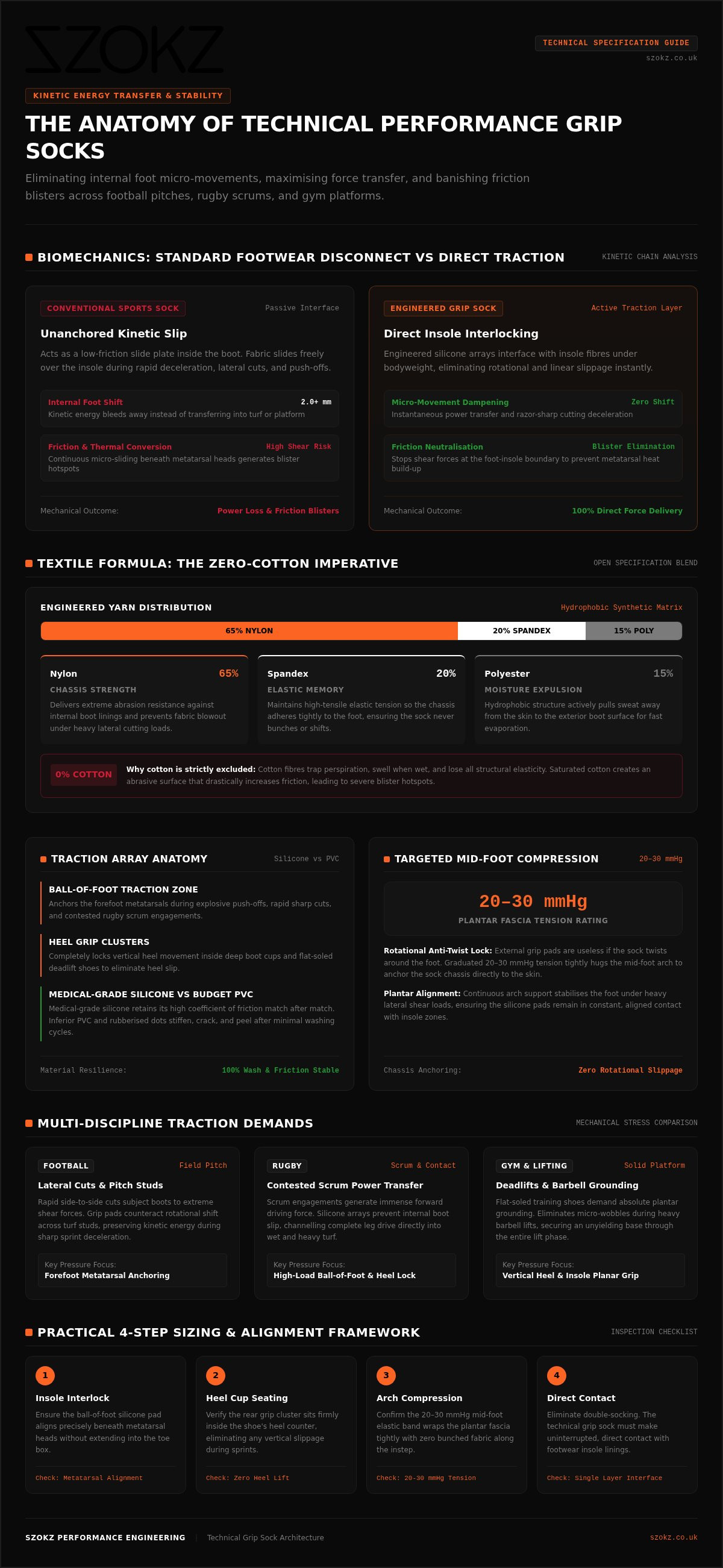
Most athletes view footwear as a simple two-part equation consisting of a shoe and an insole. That overlooks the critical boundary layer: the sock. Traditional sports socks act as a low-friction slide plate inside your boot or trainer. When you plant, your foot moves before your shoe responds. Technical performance grip socks for football, rugby & gym solve this mechanical disconnect. They replace passive fabric with an active, traction-generating interface that anchors the foot firmly in place.
Every dynamic movement relies on force transfer. If your foot shifts even two millimetres inside your footwear, kinetic energy bleeds away instead of pushing into the turf or lifting platform. By eliminating micro-movements, high-traction grip socks deliver instantaneous power transfer and razor-sharp deceleration.
The Biomechanics of Foot Slip Inside Athletic Footwear
Lateral cuts expose footwear to brutal shear forces. Standard synthetic or cotton socks cannot resist these loads; the fabric slides across the factory insole under heavy side-to-side stress. Sprint acceleration suffers immediately as your heel lifts and drives backward. Lateral responsiveness lags. Worse still, that repeated micro-sliding converts mechanical energy directly into thermal energy. This continuous friction and heat build-up beneath the metatarsal heads produces painful hotspots and debilitating blisters during matches.
Anatomy of High-Traction Silicone Grip Arrays
True athletic stability demands an engineered solution on the sole. High-traction silicone grip zones target the primary pressure epicentres: the ball of the foot and the heel.
- Ball-of-Foot Traction: Anchors the forefoot during push-off, explosive cutting, and heavy scrum engagements.
- Heel Grip Clusters: Eliminates vertical heel slip inside deep boot cups and deadlift shoes.
- Direct Insole Interfacing: Silicone grips lock into the fabric texture of modern insoles under bodyweight.
Inferior socks rely on budget PVC or cheap rubberised dots. These low-grade materials stiffen, crack, and peel after minimal washing cycles. In contrast, medical-grade silicone maintains a high coefficient of friction throughout rigorous play. Pairing these grip arrays with structured arch support, as detailed in our guide to the best compression socks for sport 2026 British guide, secures total plantar alignment. Performance grip socks for football, rugby & gym provide the mechanical grip required to push boundaries with absolute confidence.
Key Engineering Features to Compare When Buying Grip Socks
Evaluating sports gear requires objective metrics, not brand slogans. When selecting performance grip socks for football, rugby & gym use, marketing claims frequently mask poor textile construction. True mechanical stability demands precise yarn selection, anatomical grip placement, and graduated arch compression. Examining these features reveals the huge gap between disposable novelty socks and high-performance technical apparel. Understanding the engineering behind sports grip socks ensures your kit performs consistently through high-load sessions.
Why Fabric Composition Matters: The Zero-Cotton Imperative
Cotton has no place in high-output athletic gear. Cotton fibres retain sweat, expand when wet, and lose elasticity rapidly. Saturated fibres become abrasive, spiking skin friction and creating blister hotspots. Elite podiatrist-recommended athletic socks rely on hydrophobic yarns that expel moisture rather than store it.
Demand an open-formula textile specification: 65% nylon, 15% polyester, and 20% spandex. High nylon content guarantees abrasion resistance against boot linings. Polyester pulls sweat to the exterior surface. Spandex delivers high-tensile elastic memory so the chassis never bunches or stretches out of shape.
Targeted Mid-Foot Support: The Role of 20-30 mmHg Compression
A grip sock must lock to the foot before its silicone elements can lock to the insole. If the sock twists around your foot, external traction becomes entirely useless. Targeted 20-30 mmHg mid-foot compression wraps the plantar fascia tightly, preventing rotational slip under lateral loads. This structured tension stabilises your arch, promotes venous return to reduce foot fatigue, and functions just like dedicated compression socks for sport.
Grip Pad Geometry, Coverage, and Durability
Pad density requires fine balance. More grip does not always mean better performance.
- Targeted Pressure Zones: Silicone pads must concentrate at high-load zones (the heel and metatarsal heads) rather than covering the whole footbed.
- Proprioception: Excessively thick rubber blocks isolate sensory feedback, dulling touch and causing uncomfortable shoe constriction.
- Wash Resilience: Premium silicone vulcanises directly into technical yarn. Budget PVC pads melt, stiffen, or peel off after just 10 to 15 wash cycles.
Securing the right pair of performance grip socks for football, rugby & gym work means paying attention to these precise engineering details. If you want to experience the locked-in stability of pure synthetic yarn and medical-grade silicone, explore the range of SZOKZ performance socks built for elite training.
Comparing Demands: Football vs Rugby vs Gym Training
Different sports exert radically different physical stresses on your feet. Pitch turf generates intense rotational and shear forces, whilst gym flooring demands absolute vertical grounding. A single, versatile pair of performance grip socks for football, rugby & gym sessions must handle these contrasting environments without compromising stability or foot comfort.
Football: Explosive Deceleration and Boot Synergy
Sharp 90-degree cuts and abrupt stops generate massive forward momentum inside lightweight football boots. When your foot slides forward, your toes slam against the rigid toe box, resulting in bruised forefeet and damaged toenails. Anchoring the heel eliminates this forward slippage entirely. To maintain this advantage on matchdays, players routinely cut the foot out of their issued team kit, wearing grip socks beneath and joining the two with colour-matched tape. You can learn how to manage boot volume properly in our breakdown of football boot fitting and grip socks.
Rugby: High-Torque Scrums and Muddy Pitch Traction
Rugby forwards transfer brutal driving force through heavy, studded boots on saturated turf. Scrums, rucks, and mauls generate extreme multidirectional torque. If your foot twists over the insole during scrum engagement, power transfer collapses instantly. Furthermore, World Rugby regulations stipulate that clothing cannot exceed 5mm in thickness. Bulky winter socks aren't permitted. Players require thin, high-tensile synthetic fabrics that withstand crushing stud pressure without tearing or gathering under the arch.
Gym Training: Deadlift Grounding and Lateral Plyometrics
Compound barbell lifts require creating a rigid, unyielding tripod through your heel and metatarsal heads. Micro-movements during heavy squats or deadlifts compromise knee tracking and bleed driving force into the insole. Technical performance grip socks for football, rugby & gym training eliminate that movement inside flat-soled lifting shoes.
- Lifting Shoes: Silicone grips lock your foot securely to the insole, preventing lateral rollover under heavy barbell loads.
- Platform Work: For athletes lifting in socks alone, silicone sole clusters deliver direct traction on rubber gym flooring without collecting dust.
- Plyometrics: Secure footing ensures safe, responsive landings during lateral box jumps, skater hops, and weighted sled pushes.
How to Choose Your Ideal Pair: A Practical Buyer’s Checklist
Selecting the wrong size or profile neutralises even the most advanced engineering. If the sock is too loose, your foot slides over the fabric internally. If it is too thick, it chokes foot volume inside narrow boots. Following a structured selection process guarantees you get maximum return from performance grip socks for football, rugby & gym use. For an in-depth comparison of cuts, see our guide on choosing between crew, ankle, and summit styles.
Step 1: Match Sock Cut to Your Sport and Footwear
Match your sock silhouette directly to your footwear collars and kit requirements:
- Crew Length: The standard for football and rugby. Provides adequate calf coverage, locks shin pads firmly in position, and joins cleanly with cut-off team sleeves.
- Ankle Cut: Ideal for gym conditioning, weightlifting, and warm sessions. Keeps your ankles cool whilst preventing collar rub from low-profile cross-trainers.
- Cuff Tension: Look for a ribbed, self-adjusting cuff that anchors without creating a tourniquet effect across the calf muscle.
Step 2: Dial in Sizing for Tight Performance Footwear
Performance grip socks must fit skin-tight. Any slack creates folds, and folds under heavy downward pressure generate blistering friction. If you sit between shoe sizes, always size down. Modern high-tensile elastane expands around wide feet without losing structure. Crucially, sizing down ensures the silicone grip zones sit precisely beneath your calcaneus and metatarsal heads rather than creeping up your heel counter or bunching under your toes.
Step 3: Care and Washing to Preserve Silicone Traction
Technical synthetic blends and silicone grip matrices require simple maintenance to sustain their grip coefficient across dozens of wash cycles:
- Turn Inside Out: Always wash your socks inside-out at 30°C to protect silicone nodes from abrasive contact with machine drums.
- Skip Fabric Conditioners: Softening chemicals deposit a slick, silicone-dulling waxy film across the traction pads. Avoid them entirely.
- Air Dry Only: Never tumble dry or rest socks on direct radiators. Extreme heat weakens spandex memory and loosens silicone bonding.
Investing in technical performance grip socks for football, rugby & gym training only pays off if the gear retains its form and adhesive strength workout after workout.
Why Elite Athletes Choose SZOKZ Performance Grip Socks
Athletic performance depends on uncompromised contact points. SZOKZ engineers technical kit for UK athletes who refuse to let footwear slippage dictate their output. Instead of treating socks as disposable accessories, SZOKZ builds them as functional kinetic hardware. Investing in proven performance grip socks for football, rugby & gym training bridges the physical gap between raw athletic power and the ground.
Elite Validation: From Pitch and Track to the Podium
High-level competition exposes mechanical flaws instantly. SZOKZ is worn by Team GB, Olympic, and Commonwealth competitors across demanding disciplines, including rowing, football, rugby, hockey, and high-intensity gym training. International rowers driving against foot stretchers require unyielding heel security. Footballers and rugby backs rely on instantaneous lateral cuts without in-shoe drift. Powerlifters need immediate force distribution across rubber platforms. When gear satisfies the stringent demands of international podium contenders, it delivers absolute reliability for your weekly training programme.
Engineering Transparency: The Published Formula Advantage
Most commercial brands conceal cheap filler materials behind vague proprietary names. SZOKZ operates with complete textile transparency. Every pair features an open-formula blend: 65% nylon, 15% polyester, and 20% spandex. Zero cotton. No moisture retention. No structural distortion after brutal sweat sessions.
- Targeted Compression: 20-30 mmHg mid-foot compression wraps the arch tightly, preventing in-shoe rotation and supporting the plantar fascia.
- Silicone Contact Zones: High-traction silicone clusters at the ball and heel anchor directly to technical insoles.
- UK-Wide Accessibility: Built for athletes nationwide, free UK delivery applies on orders over £30.
Take control of your stability across the pitch and weight room. You can explore the performance grip socks collection today to secure the verified traction, blister prevention, and mid-foot support your training demands.
Upgrade Your Foundation for Peak Performance
Securing genuine stability inside your footwear isn't complicated when you choose the right materials. Eliminating in-shoe micro-movements protects against debilitating friction blisters whilst converting every ounce of effort into direct propulsion, scrum drive, or lifting power. Technical performance grip socks for football, rugby & gym training establish that vital link between your feet and the ground.
By trusting an open zero-cotton formula of 65% nylon, 15% polyester, and 20% spandex backed by a 20–30 mmHg arch compression wrap, you ensure your gear won't stretch, twist, or slip. It's the precise specification relied upon by Team GB, Olympic, and Commonwealth athletes across the most demanding disciplines.
Step onto the pitch or gym floor knowing your footing is completely locked in. With free UK delivery on orders over £30, building a more resilient, high-output kit bag has never been simpler.
Frequently Asked Questions
How do grip socks prevent blisters during football and rugby matches?
Blisters result from frictional shear stress when standard socks slip against factory insoles. Grip socks immobilise the foot using high-traction silicone nodes positioned at the ball and heel. By eliminating repetitive micro-sliding inside the boot, shear forces drop to near zero. Without persistent friction and heat accumulation against the skin, painful hotspot formation stops entirely during high-intensity play.
Can I wear the same grip socks for both gym training and field sports?
Yes, technical performance grip socks for football, rugby & gym training are engineered for multi-sport versatility. The silicone arrays that prevent in-boot slipping on wet turf provide equal lateral stability during box jumps, sled drives, and heavy barbell lifts. Durable synthetic yarns and targeted arch support ensure the socks easily withstand studded boot pressure and textured gym flooring alike.
Why do professional footballers cut the feet off their official club socks?
Standard club-issued match socks are slippery, thin tubes that offer zero internal traction. Players cut the feet away to wear high-traction grip socks inside their boots for locked-in responsiveness. They pull the severed club sleeve up their calf to display team colours, securing the junction around the ankle with colour-matched tape to comply with strict kit regulations.
Are silicone grip pads uncomfortable or bulky inside tight boots?
No, properly engineered silicone pads sit flush with the sock fabric without creating high-pressure ridges. They disperse impact forces evenly across the metatarsals and heel counter. Unlike cheap PVC dots, thin silicone arrays compress subtly under bodyweight. You get a direct, connected feel through your footwear rather than irritating lumps or unwanted bulk inside snug boots.
Why is cotton considered a poor material for athletic grip socks?
Cotton acts like a sponge, absorbing perspiration and losing its dimensional structure under load. Saturated cotton expands, stretches, and rubs raw against warm skin. It also traps sweat right against the foot, breaking down tissue integrity. Technical performance grip socks for football, rugby & gym use zero-cotton synthetic blends, like nylon and polyester, to expel moisture whilst maintaining elastic recovery.
How long do technical grip socks retain their traction after washing?
High-grade silicone grips easily survive 30 to 50 wash cycles when cared for properly. Cheap PVC pads often peel or crack after 10 to 15 washes. To maximise longevity, wash your socks inside-out at 30°C and skip fabric conditioners, which leave a slick coating over the traction nodes. Air drying protects the elastane core and keeps the silicone pliable.
What compression level is ideal for athletic grip socks?
A targeted rating of 20 to 30 mmHg around the mid-foot arch provides optimal mechanical support. This level of firm compression anchors the sock directly to your plantar fascia, preventing rotational fabric twist under heavy shear forces. It also supports local circulation, reduces foot fatigue during long matches, and speeds up post-session recovery without restricting toe movement.
Do grip socks fit into narrow, modern synthetic football boots?
Yes, provided they feature a zero-cotton, streamlined profile. Modern synthetic boots leave minimal spare volume, meaning bulky socks can pinch the forefoot and cause numbness. Quality grip socks use tightly knitted nylon yarns that fit like a second skin. Sizing down when between shoe sizes ensures a contour fit that slides effortlessly into modern, narrow boots without bunching.
Comments
No comments yet. Be the first to add one.